10. A. Events: Safety and environment: [p.74]
10.1 Water quality p. 74
a) Water quality
- (i) Samples of the water collected from three different locations on the swim course will be separately analysed and the poorest results will determine if the swim can take place. The following values are set as the World Triathlon tolerance limits in the different types of water:
- Sea and transition water:
- PH between 6 and 9;
- Entero-cocci not more than 200 per 100 ml (cfu / 100 ml);
- Escherichia coli E. Coli not more than 500 per 100 ml (cfu / 100 ml);
- Absence of positive visual evidence of Red Tide Algal bloom.
- Inland water:
- PH between 6 and 9;
- Entero-cocci not more than 400 per 100 ml (cfu / 100 ml);
- Escherichia coli E. Coli not more than 1000 per 100 ml (cfu / 100 ml);
- The presence of Blue-Green Algal blooms/scum (cyanobacteria) not more than 100.000 cells/ml. This test is only required in case of positive visual evidence of Blue-Green Algal bloom. Because of the potential for rapid scum formation daily visual inspection is mandatory by the LOC Medical Director in the two weeks before the competition in the area prone to scum formation. Where no scums are visible, but the water shows strong greenish discoloration, turbidity and the transparency is less than 0.5 m the cyanobacteria test must be performed.
- All units have to be cfu/100 ml or nmp/100 ml. (cfu: Colony Forming Units; nmp: Most Probable Number).
10.2 Water quality information and decision-making flow p. 74
a) Water Quality Data
-
(i) According to the World Triathlon rules, the LOC must submit water quality tests taken from three locations of the swim course:
-
2 months before the competition;
-
7 days before the competition;
-
on the first competition day of the event, for statistical purposes only.
-
(ii) However, results delivery may vary from 48 hours to 96 hours depending on the methodology that the laboratory is using. Results received more than seven days after the sample collection will not be accepted;
-
(iii) Therefore, making a decision on competition delay based purely on data that is not reflecting the current conditions 100% is not advisable;
-
(iv) Additionally, for Olympic and Paralympic Games the collection of water samples will be done:
-
One test per day for a period of ten days before the first competition till two days after the last competition, one, two and three years before the Olympic Games and the Paralympic Games;
-
From ten days before the first competition till two days after the last competition twice every day, in the morning and in the evening in the year of the Olympic Games and the Paralympic Games;
-
Results will be delivered within 24 hours from the sample collection.
b) Applicable process
- (i) Use approach in the cases but not limited to, where the event is running under rainy conditions recommended by WHO to guide decision making by combining:
- Visual inspection;
- Water quality analysis;
- Weather forecasts.
c) Visual inspection
-
(i) The World Triathlon TD and/or the assigned World Triathlon MD must check the following entities that are specific water quality indicators:
-
The absence of oils and smell of phenol;
-
The colour of the water does not change in an abnormal way;
-
Visibility of the water of more than one meter (this may only be less when natural circumstances cause this);
-
The absence of garbage;
-
The absence of discharge of cooling water from a factory;
-
The absence of sewage discharge or the occurrence of houses and boats;
-
The absence of bird colonies;
-
The absence of Blue-Green, Algal bloom or Red Tide Algal bloom.
-
d.) Water Quality Information Flow:
-
(i) The Events Water Quality Evaluation Panel is represented by:
-
World Triathlon Medical Committee representative;
-
World Triathlon Medical Delegate (if not applicable, the World Triathlon Technical Delegate);
-
LOC Medical Director (if not applicable the LOC Race Director);
-
e.) In case of discrepancy between the results we must consider that the E.Coli are the best indicator bacteria for inland water, and the Enterococci are the best indicator for sea water;
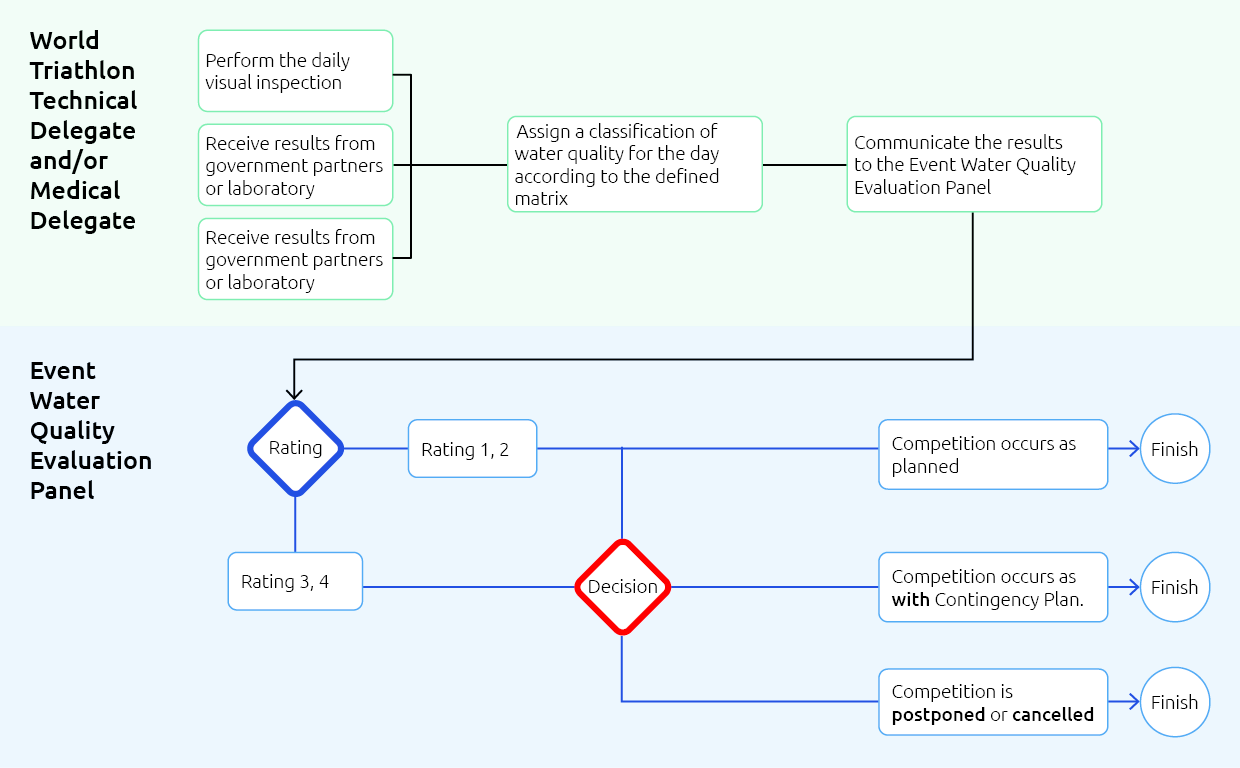
f.) Water Quality Decision Matrix (Sea and Transition water)
| Two past results E.coli < 250* Enterococci < 100* | Last result E.coli: 250 to 500* Enterococci 100 to 200* | Two past results E.coli: 250 to 500* Enterococci 100 to 200* | | Last result E.coli > 500* Enterococci > 200* | ||
|---|---|---|---|---|---|
| Visual Inspection category (susceptibility to faecal influence) | Low | 1 | 2 | 2 | 4 |
| Visual Inspection category (susceptibility to faecal influence) | Moderate | 1 | 2 | 3 | 4 |
| Visual Inspection category (susceptibility to faecal influence) | High | 2 | 3 | 3 | 4 |
Key for Levels:
- 1 = 'Excellent Water Quality': (E. coli < 250 or Enterococci < 100) with no or potential visual pollution during visual check or forecasted heavy rain;
- 2 = 'Good Water Quality': (E. coli < 250 or Enterococci < 100) with poor visual pollution during visual inspection or forecasted heavy rain;
- 2 = 'Good Water Quality': (E. coli: 250 to 500 or Enterococci 100 to 200) but with no or potential visual pollution during visual inspection or forecasted heavy rain;
- 3 = 'Fair Water Quality': (E. coli: 250 to 500 or Enterococci 100 to 200), but with potential or poor visual pollution during visual check and/or potential for forecast of heavy rain;
- 4 = 'Poor Water Quality: (E. coli > 500 or Enterococci > 200), with any visual pollution during visual check and/or potential for forecast of heavy rain.
- g.) Water Quality Decision Matrix (Inland water)
| Two past results E.coli < 500* Enterococci < 200* | Last result E.coli: 500 to 1000* Enterococci 200 to 400* | Two past results E.coli: 500 to 1000* Enterococci 200 to 400* | Last result E.coli > 1000* Enterococci > 400* | ||
|---|---|---|---|---|---|
| Visual category (susceptibility to faecal influence) | Low | 1 | 2 | 2 | 4 |
| Visual category (susceptibility to faecal influence) | Moderate | 1 | 2 | 3 | 4 |
| Visual category (susceptibility to faecal influence) | High | 2 | 3 | 3 | 4 |
Key for Levels:
- 1 = 'Very Good Water Quality': (E.coli < 500 or Enterococci < 200) with no or potential visual pollution during visual check or forecasted heavy rain;
- 2 = 'Good Water Quality': (E.coli < 500 or Enterococci < 200) with poor visual pollution during visual inspection or forecasted heavy rain;
- 2 = 'Good Water Quality': (E.coli: 500 to 1000 or Enterococci 200 to 400) but with no or potential visual pollution during visual inspection or forecasted heavy rain;
- 3 = 'Fair Water Quality: (E.coli: 500 to 1000 or Enterococci 200 to 400), but with potential or poor visual pollution during visual check and/or potential for forecast of heavy rain;
- 4 = 'Poor Water Quality': (E.coli > 1000 or Enterococci > 400), with any visual pollution during visual check and/or potential for forecast of heavy rain.
h.) Decision making
- (i) If the water quality levels show values three (3) or four (4), the swim will proceed, only if the Events' Water Quality Evaluation Panel permits with a simple majority. In this case, the local water quality regulations may be considered.
10.3 Modifications due to heat p. 78
- a.) Medical Delegate or, if absent, Race Medical Director will measure the WBGT index. All the measurements with the WBGT tool should be taken at the finish area every 30 min starting 3 hours before the start of the competition. The device must be placed in direct sunlight 1.5 m above the ground;
- b.) WBGT index values are categorised:
- (i) Assessing on-site environmental heat stress at regular intervals using the Wet-BulbGlobe-Temperature (WBGT) index and providing announcements of its readings. WBGT levels for the modification of exercise or competition for healthy adults are based on recommendation from the American College of Sports Medicine (2007);
- (ii) Any decision made will take into consideration the level of medical assistance, facilities in the medical tent, evolution of the weather conditions and forecast, period of the competitive season, race distance and category, athlete fitness level and the age of the athletes. Event organisers will pay particular attention to unexpected or unseasonably hot weather in mass- participation events, considering that the unacclimatised participants or participants without a sufficient level of training are at higher risk for heat illness;
- (iii) During the races, weather information and the WBGT index will be provided at the Sport Information Centre and the Athlete Lounge. The information will be posted in the Athlete Lounge in time for athlete check in. The WBGT index will be converted to a five-level coloured flag system indicating the heat illness risk of current weather conditions. The information will be delivered in the form of written announcement.
| WBGT Risk Categories | WBGT Risk Categories | WBGT Risk Categories | WBGT Risk Categories | WBGT Risk Categories | WBGT Risk Categories |
|---|---|---|---|---|---|
| Flag Colour | Black | Orange | Blue | Green | |
| WBGT Index (°C) | > 32.2 | 30.1-32.2 | 27.9-30.0 | 25.7-27.8 | < 25.7 |
| Risk | Extreme | Very High | High | Moderate | Low |
- c.) For sprint and standard distance events, in case of very high risk (red flag) the following will be taken into consideration:
- (i) If the LOC and Medical Staff are able to provide medical assistance respecting all the rules of the World Triathlon Event Organiser Manual Medical Services and Exertional Heat Illness Prevention document, particularly in large mass participation events:
- Standard distance events: change to Sprint distance;
- Sprint distance and shorter events and below: stay as originally planned.
- (ii) If the LOC and Medical Staff are unable to provide medical assistance respecting all the rules of the World Triathlon Event Organiser Manual Medical Services and Exertional Heat Illness Prevention document, particularly in large mass participation events, the competition must be rescheduled.
- d.) For standard distance and shorter events in case of an Extreme Risk (WBGT index: >32.2°C, Black Flag) the competition must be re-scheduled or cancelled;
- e.) For middle- and long-distance events, a meeting must take place among the assigned Technical Delegate, the assigned Medical Delegate, the LOC Race Director, the LOC Race Medical Doctor and the Chair of the Event Advisory Group for agreeing the heat countermeasures to be implemented in the cases where the event is expecting to take place in very high risk and extreme high-risk conditions.
10.4 Swim Current p. 79
- a.) The Technical Delegate may modify the distance of the swim segment or even cancel the swim, depending on the speed of the current or any other environmental condition which may create safety concerns;
- b.) The race has to be rescheduled or cancelled in the case where the athletes are swimming with the current equal or more 1.5m/s or more than 1.0 m/s for Elites and 0.5 m/s for AgeGroup and Para triathletes in case of swimming against the current. These values against the current are to be measured close to the bank.
10.5 Thunderstorm and lightning p. 79
- a.) Lightning can be an immediate threat to athletes. If lightning strikes are approaching the venue and are within 3.1 miles / 5 km the race should be stopped, the venue should be evacuated and the athletes should be taken to a safe area. Thirty minutes after the last lightning, activities may resume.
10. B. Events: Technical [p.74]
10.6 Wave starts p. 80
- a.) To ensure the safety of the athletes, there are limits on the quantity of athletes starting at the same time. For categories of events which are not specified below, the quota of athletes is defined in the specific qualification criteria. The Technical Delegate may apply lower limits than the indicated, according to the event conditions:
- b.) Athletes from the same Age-Group can be divided in two or more wave starts provided:
- (i) Both/all waves will have the similar number of athletes assigned;
- (ii) Athletes from the same National Federation will be split in all groups randomly, assigning the similar number to each of the waves;
- (iii) National Federations with only one athlete will be entered to one or the other wave, in order to keep the numbers balanced. The same principle will apply to the excess resulting from National Federations with odd number of athletes;
| WTCS / WTPS | World Triathlon Championship | World Triathlon Cup / WTPC | Other Standard and shorter distances triathlons | a Love-Distance Triathlon - All ev | Cross Triathlon - All events | Duathlon - All events | Mixed Relay | |
|---|---|---|---|---|---|---|---|---|
| Elite | 55 | 65 | 65 | 70 | 100 | 100 | 100 | 30 |
| U23 | n/a | 70 | n/a | 70 | n/a | 100 | 100 | 30 |
| Junior | n/a | 70 | n/a | 70 | n/a | 100 | 100 | 30 |
| Youth | n/a | n/a | n/a | 70 | n/a | n/a | n/a | 30 |
| Semi-final/Final (any category) | 60 | n/a | 90 | 90 | n/a | n/a | n/a | n/a |
| Para triathlon | 80 | 122 | 80 | 52/80 (**) | 80 | 80 | 80 | n/a |
| Age-Group | n/a | 200 | n/a | 200 | 500 | 500 | 500 | 200 |
- (iv) The champion will be the athlete with quickest time, no matter in which wave he/she is starting in;
- (v) The result list of the Age-Groups affected will contain the athletes of both waves sorted by times;
- (vi) The waves containing athletes from the same Age-Group will be scheduled one immediately after the other;
- (vii) These waves will not include athletes from a different Age-Group.
10.7 Transition p. 81
- a.) The Technical Delegate will determine the position of the mount and dismount lines. Both lines will be considered as part of the transition area.
10.8 Bike p. 81
- a.) A 10 % tolerance margin will be accepted for the distance of the bike segment provided that it has been approved by the Technical Delegate. In the middle- and long-distance events, this tolerance is limited to 5%;
- b.) There must be a minimum number of penalty boxes as follows:
- (1) Standard distance or shorter events: one every 10 km;
- (ii) Middle- and long-distance events: one every 30 km.
10.9 Support team p. 81
- a.) National Federations can enter in the races a crew to support the athletes and the National Federation delegation. This crew is composed by the following categories: Coaches, Medical, Bike Mechanic, Ski man and National Federation representatives. World Triathlon may add other categories if needed in a specific event. The people entered in the categories of Coaches and Medical must complete the Anti-Doping Education course;
- b.) National Federation's Quota: Every National Federation has a support team quota according to the charts below. When a National Federation has a quota allocated of 3 or higher, different genders will be represented, otherwise the quota will be reduced by 1.
- (i) Elite events:
| Athletes | 1 to 3 | 4 to 6 | 7 or more |
|---|---|---|---|
| Coaches | 2 | 3 | 4 |
| Medical | 1 | 1 | 1 |
(ii) U23 events (U23 not mixed with other categories):
| Athletes | 1 to 6 | 7 or more |
|---|---|---|
| Coaches | 2 | 3 |
- (iii) Junior events:
- (iv) Youth events:
| Athletes | 1 to 6 | 7 or more |
|---|---|---|
| Coaches | 2 | 3 |
| Athletes | 1 to 6 | 7 or more |
|---|---|---|
| Coaches | 2 | 3 |
(v) Para triathlon Events:
| Athletes | 1 to 3 | 4 to 6 | 7 to 9 | 10 to 12 | 13 to 15 | 16 to 18 |
|---|---|---|---|---|---|---|
| Coaches | 2 | 3 | 4 | 5 | 6 | 7 |
| Medical | 1 | 1 | 1 | 1 | 1 | 1 |
(vi) Mixed Relay events:
| Team | 1 or more |
|---|---|
| Coaches* | 3 |
| Medical* | 1 |
(vii) Delegation support for Age-Group events:
| Total number of athletes across all events | 1 to 50 | 51 to 100 | More than 101 |
|---|---|---|---|
| 2 | 4 | 6 | Coaches |
| 1 | 2 | 2 | Bike mechanic/Ski man |
| 1 | 1 | 1 | Medical |
| NF Representatives * | 2 | 2 | 2 |
c.) Head of Delegation:
- (i) National Federations with athletes in every category of Elite, U23, Junior in both genders, will be provided with an extra accreditation with coach access for all events during the World Triathlon Championship Finals;
- (ii) National Federations with athletes in all four events - Duathlon, Aquathlon, Cross Triathlon and Long-Distance Triathlon - in Elite category in both genders, will be provided an extra accreditation with coach access for all events during the World Triathlon Multisport Championships.
- d.) All the personnel registered as part of the support team will receive an accreditation with access according to their role;
- e.) National Federations are responsible for entering their support personnel in the World Triathlon online entry system. World Triathlon will approve the support personnel according to the quota seven days prior to the event. No additions will be admitted after this deadline.
10.10 Start times p. 83
- a.) The minimum time difference between waves will be:
- b.) The Technical Delegate can decide to reduce the above indicated differences in Continental Cup and Duathlon standard distance events provided that the men and the women will not be on the bike segment simultaneously;
- c.) The Technical Delegate can decide to reduce the above indicated differences in Continental Cups and Duathlon standard distance events to a minimum of five minutes if one of the events has fewer than 10 athletes competing, and enough officials to control any potential drafting between male and female athletes;
| Inter gender start time difference (1) | Elite/Age-Group start time difference (2) | |
|---|---|---|
| Continental Cup Sprint | 45 min | 1h |
| Continental Cup Standard | 1h 30 min | 2h |
| World Cup Sprint | 1h 45 min | 1h 30 min |
| World Cup Standard | 2h 45 min | 2h 30 min |
| WTCS Sprint | 1h 45 min | 1h 45 min |
| WTCS Standard | 2h 45 min | 2h 45 min |
| Duathlon Standard Distance | 1h 30 min | 2h 30 min |
| Triathlon / Duathlon MD-LD | 5 min | 5 min |
| Mixed Relay | 1h 45 min | n/a |
- d.) The Technical Delegate can also require different start times by asking for a specific regulation, as indicated under section 1.6;
- e.) Events not included in the previous chart will need the approval of the Technical Delegate prior to publishing the start times.
10.11 Modified events p. 84
- a.) When a competition cannot be held in the original format due to force majeure, all the points for all the rankings related, including Olympic Qualification List points, will be reduced depending on the final conditions under which the event took place:
- (i) If the event remains as a triathlon or the multisport originally planned, but any of all of the segments are shortened according to the World Triathlon Competition Rules, 100 % of the points will be awarded;
- (ii) If the event becomes another World Triathlon multisport competition according to the World Triathlon Competition Rules in terms of distances and conditions, 100% of the points will be awarded;
- (iii) If a triathlon event becomes a duathlon and the swim is replaced by a running segment with similar duration of the cancelled swim, 100% of the points will be awarded;
- (iv) If the event becomes another World Triathlon multisport competition with deviations from the World Triathlon Competition Rules in terms of distances and conditions, 75% of the points will be awarded.
- b.) In the case of events which have multiple stages (semi-final/final format, eliminator format, supertri E, indoor events or other) and that are modified in one or more stages, the reduction of the points will be applied according to the format of the final stage or phase. If the final stage or phase is not modified there will not be reduction of the points. In case of A and B finals, A final format will determine the points reduction.
10.12 Cut-off time p. 84
- a.) Technical Delegate may determine a cut-off time for the entire competition or any intermediate point;
- b.) If there is a cut-off time, it must be announced at least 30 days before registration closes.