17.1 General p. 106
- a.) Para triathlon, as per the World Triathlon Constitution, is governed by the World Triathlon Competition Rules. This section contains the rules which affect only para triathlon.
17.2 Para triathlon Sport Classes p. 106
- a.) World Triathlon Para triathlon has implemented an evidence-based classification system to group impairments into sport classes according to the extent of activity limitation they cause the athlete when performing in the sport of para triathlon;
- b.) There are nine (9) sport classes, as defined in Appendix G:
- (i) PTWC1: Most impaired wheelchair users. Athletes must use a recumbent handcycle on the bike course and a racing wheelchair on the run segment;
- (ii) PTWC2: Least impaired wheelchair users. Athletes must use a recumbent handcycle on the bike course and a racing wheelchair on the run segment;
- (iii) PTS2: Severe impairments. In both bike and run segments, amputee athletes may use approved prosthesis or other supportive devices;
- (iv) PTS3: Significant impairments. In both bike and run segments, the athlete may use approved prosthesis or other supportive devices;
- (v) PTS4: Moderate impairments. In both bike and run segments, the athlete may use approved prosthesis or other supportive devices;
- (vi) PTS5: Mild Impairments. In both bike and run segments, the athlete may use approved prosthesis or other supportive devices;
- (vii) PTVI1: Includes athletes who are totally blind, from no light perception in either eye, to some light perception. One guide is mandatory throughout the race. Must ride a tandem during the bike segment;
- (vili)PTVI2: Includes athletes who are more severe partially sighted athletes. One guide is mandatory throughout the competition. Must ride a tandem during the bike segment;
- (ix) PTVI3: Includes athletes who are less severe partially sighted athletes. One guide is mandatory throughout the competition. Must ride a tandem during the bike segment.
17.3 Para triathlon Medal Events p. 106
-
a.) There will be six (6) medal events as follows:
-
(i) PTWC: PTWC1 and PTWC2 sport class athletes competing together;
-
(ii) PTS2;
-
(iii) PTS3;
-
(iv) PTS4;
-
(v) PTS5;
-
(vi) PTVI: PTVI1, PTVI2 and PTVI3 sport class athletes competing together.
17.4 Classification p. 107
- a.) Para triathlon Classification Rules can be found in Appendix G;
- b.) All Para triathletes competing at a World Triathlon sanctioned competition must have an international para triathlon classification to ensure they meet the minimal eligibility criteria for competition and are assigned an appropriate sport class. Para triathletes requiring classification will need to:
- (i) be available to attend an International Classification appointment with a World Triathlon designated Classification Panel prior to the competition;
- (i) provide, before the athlete is entered into his/her first ever event wait list and at time of classification, the "World Triathlon Pl Medical Diagnostics Form" or "World Triathlon VI Medical Diagnostics Form" signed by the appropriate medical personnel, a passport sized photo and any other relevant medical documentation.
- c.) Para triathletes competing at a World Triathlon event, where classification is not available, will be informed through their National Federation to submit specific medical documentation to World Triathlon, no later than eight weeks before competition, so that a provisional classification can be assigned to them.
17.5 Eligible Classes and Competition Formats p. 107
- a.) All Para triathletes are allowed to compete in triathlon, duathlon and aquathlon events. Only Para triathletes from sport classes PTS2, PTS3, PTS4 and PTS5 are allowed to compete in winter triathlon, winter duathlon, cross triathlon and cross duathlon events;
- b.) All Para triathletes may start all together or grouped in waves. Athletes from the same sport class and gender must start in the same wave;
- c.) The Para triathlon competitions at the Paralympic Games, the World Triathlon Para Championships, the Continental Triathlon Para Championships, World Triathlon Para Series and the World Triathlon Para Cups are taking place on Sprint distance will have a time limit of 2 hours;
- d.) In a Duathlon event, a para triathlon competition should be organised at least in two wave starts with a difference of at least one (1) minute. PTWC1 and PTWC2 athletes should start in the first wave and the rest of the athletes in the second wave;
- e.) At the discretion of the technical delegate the competition format may be changed;
- f.) Athletes in different classes may compete together by using the staggered start called "Interval Start System":
- (i) In all competitions (mass start or interval start), the relevant compensation time will be added to the real times of the athletes. The compensation times are indicated in the
following chart:
| PTWC1 Men | PTWC2 Men | PTWC1 Women | PTWC2 Women | |
|---|---|---|---|---|
| Sprint triathlon | 0:00 | +3:00 | 0:00 | +3:38 |
| Sprint duathlon | 0:00 | +2:44 | 0:00 | +3:18 |
| Aquathlon 750 m + 5 km | 0:00 | +1:17 | 0:00 | +1:33 |
| Aquathlon 1000 m + 5 km | 0:00 | +1:29 | 0:00 | +1:48 |
| PTVI1 Men | PTVI2/PTV13 Men | PTVI1 Women | PTVI2/PTVI3 Women | |
|---|---|---|---|---|
| Sprint triathlon | 0:00 | +2:51 | 0:00 | +3:21 |
| Sprint duathlon | 0:00 | +2:35 | 0:00 | +3:02 |
| Aquathlon 750 m + 5 km | 0:00 | +2:51 | 0:00 | +3:21 |
| Aquathlon 1000 m + 5 km | 0:00 | +3:14 | 0:00 | +3:48 |
- (ii) In races utilising the Interval Start System', the start list should be prepared according to the example shown in Appendix L;
- (iii) If an athlete is reclassified into a different class following observation, their finishing time will be adjusted according to the designated compensation times;
- (iv) In order to avoid overlapping or issues due to time constraints, the Head Referee may allow a mass start;
- (v) Any protests that are filed regarding the starting order and/or compensation times, shall take place according to the World Triathlon Article. 12., "Protest of Eligibility."
17.6 Para triathletes' Briefing p. 108
-
a.) Rule 2.7 b.) includes provisions regarding the Para triathletes briefing;
-
b.) All guides and personal handlers must be registered at the briefing;
-
c.) All Para triathletes will pick up their own race packet following the briefing. The race packet will include:
-
(i) PTWC athletes: red, yellow or green swim cap, 3 race number stickers for the helmet, 1 race number sticker for the handcycle, 1 race number sticker for the racing wheelchair, 4 sets of body marking, 1 race number sticker for the daily wheelchair, 1 bib number for the athlete and 1 bib number for the personal handler;
-
(ii) PTS2, PTS3, PTS4 and PTS5; red, yellow or green swim cap, 3 race number stickers for the helmet, 1 race number sticker for the bike, 3 race number stickers for the prosthesis/aiding devices, 1 bib number for the athlete or 4 sets of body marking, 4 sets of body marking and 1 bib number for the personal handler if authorised;
-
(iii) PTVI: PTVI1 (1 orange swim cap for the athlete) and PTVI2/3 (1 green swim cap for the athlete). Common items: 1 white swim cap for the guide, 6 race number stickers for the helmets, 1 race number sticker for the bike, 4 sets of body marking for the athlete and 1 bib number for the guide with the word "GUIDE written on it.
17.7 Para triathlon Personal Handlers p. 109
-
a.) Securing qualified personal handlers shall be the responsibility of the para triathlete, and they should all be identified and receive credentials from the World Triathlon Technical Officials at the Para triathlon Briefing;
-
b.) Personal handlers are to be allotted as follows:
-
(i) Up to one (1) personal handler for sport classes PTS2, PTS3, PTS4 and PTS5. The classification process will determine for each athlete the allowance of using one handler in the competitions. The information about athletes with allowed handlers, can be found in the World Triathlon Para triathlon Classification Master List https://triathlon.org/documents/paratriathlon-docs. The approval for already classified athletes will be done by an Approval Panel composed of:
-
World Triathlon Head of Classification;
-
A member of the World Triathlon Para triathlon Committee;
-
A person designated by the Sport Department.
-
(ii) Up to one (1) personal handler for sport class PTWC;
-
(iii) No personal handlers for sport class PTVI1, PTVI2 and PTVI3 (Guides may act as the personal handler for this sport class).
-
c.) Personal handlers are specifically allowed to assist Para triathletes by:
-
(i) Helping with prosthetic devices or other mobility equipment;
-
(ii) Lifting Para triathletes in and out of handcycles and wheelchairs;
-
(ili) Removing wetsuits or clothing;
-
(iv) Repairing bikes and helping Para triathletes with other equipment at the transition area or at the official wheel station. PTVI1, PTVI2 and PTVI3 guides can help to repair the bike along the whole bike course, without receiving external help;
-
(v) Racking the bikes in transition.
-
d.) All personal handlers shall be subject to the World Triathlon Competition Rules in addition to further regulations deemed appropriate or necessary by the Head Referee;
-
e.) Any action taken by a personal handler, which propels the Para triathletes forward may result in a disqualification;
-
f. One personal handler can assist maximum of one athlete;
-
g.) All personal handlers shall be located within two (2) meters of their athletes' transition spot during the competition. Permission from a Technical Official is required in order to move outside that zone.
17.8 Para triathlon Registration p. 110
a) Briefing registration
- (i) Para triathletes have to sign the attendance list in order to enter the briefing room. At this stage, they must communicate to the Registration Officials whether they will have their own personal handler;
- (ii) Para triathletes must attend the briefing with their personal handler;
- (iii) Immediately after the briefing, they will collect their race package and their personal handler will collect the personal handler's t-shirt, as provided by the Local Organising Committee.
- b.) Para triathletes' lounge check in:
- (i) Para triathletes, guides and personal handlers must check in together;
- (ii) Personal handlers need to present themselves with the bib number and the official personal handler's t-shirt;
- (iii) If a Para triathlete is present without his/her personal handler/s, he/she has to wait until the personal handler/s arrive. If the Para triathletes wishes to register on his/her own, then the personal handler/s will not have access to the Field of Play;
- (iv) Once a personal handler has been registered, they can only be replaced in exceptional circumstances and only after approval by the Technical Delegate;
- (v) Two Timing chips will be delivered to all athletes during this process;
- (vi) Equipment (prosthesis, crutches, etc.) for the pre-transition area (must have a race number on it) and will be checked at the Para triathletes' lounge.
17.9 Pre-Transition Area p. 110
-
a.) If a pre-transition area exists, para triathletes in PTWC1, PTWC2, PTS2, PTS3, PTS4 and PTS5 sport classes may remove their wetsuits in this area. Only personal handlers from athletes racing in the PTWC1 and PTWC2 sport class are allowed to assist their assigned Para triathlete in this area, but cannot propel nor push the athlete forward. Personal Handlers must not assist their athlete until they are placed by the swim exit assistants on the daily chair, or assigned chair or space in pre-transition;
-
b.) All PTWC1 and PTWC2 athletes must transfer in a day chair from pre-transition to transition. The wheelchairs provided by the PTWC1 and PTWC2 Para triathletes for this area must have functional brakes;
-
c.) The closest available area to the swim exit area will always be used to line up the PTWC1 and PTWC2 wheelchairs according to their race number;
-
d.) There should be a dedicated space in the pre-transition area with numbered chairs from 1-9+0, to set up and display all prosthetic devices/crutches for Para triathletes from the PTS2, PTS3, PTS4 and PTS5 sport classes (if required). PTS2, PTS3, PTS4 and PTS5 athletes must leave their prosthesis or crutches at the chair with the same number as the last digit of their race number. A minimum of two (2) Technical Officials will coordinate the distribution of these equipment devices to the athletes as they exit the water and receive notification of the race number from the Technical Official situated at the water exit. All of the equipment will be lined up in numerical order;
-
e.) No athletes' equipment can be left in the pre-transition area, once the athlete exits the pretransition area. Handler is allowed to carry the equipment of an athlete;
-
f.) Adapted cleats and bike shoes with non-exposed cleats - that are mounted on prosthetic legs - are allowed in the pre-transition area, provided that the cleats are covered or enclosed by anti-slip material;
-
g.) Athletes approved in classification may leave running shoes in Pre-Transition Area. Athletes are responsible to tag the shoes;
-
h.) Para triathletes in PTS2 to PTS5 with an absent lower limb must use a prosthesis or crutches between Pre-Transition and Transition area 1. Hopping on one leg is not permitted from Pre-Transition to Transition area 1.
17.10 Transition Area p. 111
-
a.) The Local Organising Committee shall provide a minimum of 16 swim exit assistants at the swim exit area, who will be responsible for assisting the Para triathletes from the swim exit to the pre-transition area. The final number of swim exit assistants shall be determined by the World Triathlon Technical Delegate. Only these persons will be allowed to enter this area. Their training should be supervised by the World Triathlon Technical Delegate;
-
b.) During the swim exit, the para triathletes will receive assistance from the swim exit assistants according to their swim cap colours, as follows:
-
(i) Red: Para triathlete needs to be lifted from the swim exit to the wetsuit removal area;
-
(ii) Yellow: Para triathlete needs to be supported to walk/run from the swim exit to the wetsuit removal area;
-
(iii) Green, orange or white: Para triathlete does not need any assistance at the swim exit. White caps will be used for the guides.
-
c.) Swim exit assistants will assist the athletes to the best of their ability, in good faith and considering safety as the main principle;
-
d.) Bicycles, tandems or handcycles are not allowed from the swim exit to the transition area;
-
e.) All mobility equipment shall remain within each Para triathlete's assigned space in the transition zone. All used swim caps, goggles, wetsuits, swim tethers, helmets must be left in the bin;
-
f.) Bike shoes must be left in the athlete assigned space in the transition area, before and after the bike segment;
-
g.) PTVI1, PTVI2 and PTVI3 positions in the transition area must be the closest to the mount line (women and men), followed by the rest of the sport classes PTS5, PTS4, PTS3, PTS2 and PTWC1 and PTWC2. PTWC1 and PTWC2 Para triathletes are allowed to ride the handcycle inside the transition area;
-
h.) Each PTWC1 and PTWC2 para triathlete will have an individual space of 4x2 meters. The athlete, the handlers and all the equipment will be inside this space, while completing transition activities;
-
i.) Mobility equipment areas, one before the mount line and other after the dismount line will be provided to be able to use prosthetic legs in transition. That equipment will be moved from mount to the dismount area by a Technical Official or an authorized person by the TD. Athletes may use this extra leg in T1, T2 or both. Athletes will not be penalized if they do not collect the mobility equipment in the dismount mobility equipment area. That equipment must be clearly identified with the athletes' race number.
17.11 Para triathlon Swimming p. 112
- a.) For safety reasons, categories will be presented during the Para triathletes' presentation at competition start in the following order: PTVI1, PTVI2, PTVI3, PTS5, PTS4, PTS3, PTS2, PTWC1 and PTWC2. For safety reasons, PTWC1 and PTWC2 para triathletes should always enter the water after all other Para triathletes are in place;
- b.) The swim start shall be an "in-water" start;
- c.) If the swim portion consists of multiple laps, Para triathletes will not be required to exit the water between laps;
- d.) Artificial propulsive devices including (but not limited to) fins, paddles, or floating devices of any kind are not allowed. All prosthetic and/or orthoses devices are considered propulsion devices except for the approved knee braces. Use of any such devices will result in disqualification;
- e.) Any sharp objects, screws, prosthetic liners, or prosthetic devices that can be harmful are not allowed during the swim segment;
- f.) Wetsuit use is determined by the chart below:
| Swim length | Wetsuits mandatory below | Maximum stay in water |
|---|---|---|
| 750 m | 18 °C | 45 mins |
| 1500 m | 18 °C | 1h 10 mins |
| 3000 m | 18 °C | 1h 40 mins |
| 4000 m | 18 °C | 2h 15 mins |
- g.) If any para triathlete has not completed the swim course within this time limit and is more than 100 meters short of the finish, they shall be removed immediately from the water;
- h.) Wetsuits will not be permitted when the water temperature is 24.6 °Celsius or above;
- i.) If the water temperature is between 30.1°C and 32.0°C, the maximum stay in water 20 minutes;
- j.) The swim portion may be cancelled, if the official water temperature is higher than 32°C or lower than 15 °C. (Official water temperature is calculated, as indicated in the chart below):
- (i) The temperatures above are not always the water temperature used in the final decision. If the water temperature is lower than 22°C and the air temperature is lower than 15°C, then the adjusted value is to decrease the measured water temperature according to the next chart:
| Air temperature (All values in °C) | Air temperature (All values in °C) | Air temperature (All values in °C) | Air temperature (All values in °C) | Air temperature (All values in °C) | Air temperature (All values in °C) | Air temperature (All values in °C) | Air temperature (All values in °C) | Air temperature (All values in °C) | Air temperature (All values in °C) |
|---|---|---|---|---|---|---|---|---|---|
| 15 | 14 | 13 | 12 | 11 | 10 | 9 | 8 | 7 | |
| 22 | 18.5 | 18.0 | 17.5 | 17.0 | 16.5 | 16.0 | 15.5 | 15.0 | Cancel |
| 21 | 18 | 17.5 | 17.0 | 16.5 | 16.0 | 15.5 | 15.0 | Cancel | Cancel |
| 20 | 17.5 | 17.0 | 16.5 | 16.0 | 15.5 | 15.0 | Cancel | Cancel | Cancel |
| 19 | 17 | 16.5 | 16.0 | 15.5 | 15.0 | Cancel | Cancel | Cancel | Cancel |
| 18 | 16.5 | 16.0 | 15.5 | 15.0 | Cancel | Cancel | Cancel | Cancel | Cancel |
| 17 | 16 | 15.5 | 15.0 | Cancel | Cancel | Cancel | Cancel | Cancel | Cancel |
| 16 | 15.5 | 15.0 | Cancel | Cancel | Cancel | Cancel | Cancel | Cancel | Cancel |
| 15 | 15 | Cancel | Cancel | Cancel | Cancel | Cancel | Cancel | Cancel | Cancel |
17.12 Para triathlon Cycling p. 113
-
a.) Para triathlon competitions are draft-illegal events. Winter Triathlon, Cross Duathlon and Cross Triathlon are draft legal events for Para triathletes;
-
b.) In para triathlon competitions, the term "bike" used herein shall include bicycles, tandems, or handcycles;
-
c.) All bikes shall be propelled by human force. Arms or legs can be used to propel the cycle, but not both. Any violation shall result in disqualification;
-
d.) Bike specifications for para triathlon competitions are outlined in the World Triathlon Competition Rules section 5.2 d);
-
e.) Bicycles, tandems, and handcycles must have two independent braking systems. Bicycles and tandems must have an independent brake on each wheel. Both brakes on the handcycles will act on the front wheel;
-
f.) Disc brakes are allowed;
-
g.) Para triathletes with one upper limb impairment may use a splitter in the braking system and it is not considered as a bike adaptation;
-
h.) Protective shields, fairings or other devices, which have the effect of reducing resistance, are not allowed;
-
i.) Artificial hand grips and prosthetics can be fixed to the bike or to the athlete's body, but not both simultaneously;
-
j.) Except for handcycles (PTWC1 and PTWC2), a rider's position shall be supported solely by the pedals, the saddle and the handlebars;
-
k.) Para triathletes with a lower limb above the knee amputation or limb deficiency not wearing a prosthesis may use a support/socket for the thigh which is not considered an adaptation requiring approval;
-
l.) All requests for impairment adaptations to any bike or handcycle must be submitted by the corresponding National Federation in writing for World Triathlon approval at least one (1) month before the event in which the athlete wishes to compete in, with a clear explanation and a minimum of 5 pictures using the form named "Equipment Adaptation Form" posted under: http://www.triathlon.org/about/downloads category/paratriathlon. The solicitant will be informed by the World Triathlon on the outcome of the request once the panel has reviewed the information. If accepted, the information will be incorporated to the "Approved Para triathlon Impairment Adaptations on Bicycles" file under the same location;
-
m.) The World Triathlon and the World Triathlon Technical Officials shall not be liable for any consequences deriving from the choice of equipment and/or any adaptations used by Para triathlete, nor for any defects it may have, or its non-compliance;
-
n.) No bike course shall have a maximum gradient of over 12% at the steepest section;
-
o.) If the use of the bib number is mandatory, it must be visible from the back.
17.13 Para triathlon PTWC1 and PTWC2 Swimming p. 114
-
a.) Athletes may only use up to 3 bindings made of non-floating material around the legs in any position. The bindings will be 10 cm in width, as a maximum;
-
b.) The use of knee brace is permitted, provided the equipment provides neither flotation nor propulsion. If a wetsuit is worn, the brace shall be fitted to the outside of the wetsuit. The knee brace can cover half of the leg's surface as a maximum. The length cannot surpass the upper half of the thigh or the bottom half of the calf and has to be holding the knee/s area:
-
(i) Knee brace specifications:
-
Material: PVC plastic or carbon-fibre with no floatability or propulsion capacity;
-
It cannot have any space or chamber that traps air or any other kind of gas;
-
The thickness is limited to 5mm as a maximum.
-
c.) The knee braces have to be approved by the the World Triathlon. All requests must be submitted by the corresponding National Federation in writing for World Triathlon approval at least (1) month before the event in which the athlete wishes to compete in, with a clear explanation and a minimum of 5 pictures using the form named "Knee Brace Approval Request Form" posted under the "Documents" section of the World Triathlon website. The National Federation solicitant will be informed by the World Triathlon on the outcome of the request once the panel has reviewed the information. If accepted, the information will be incorporated to the "Approved Knee Braces Catalogue file under the same location;
-
d.) The use of wetsuit bottoms is always permitted. 5 mm +/- 0.3 mm, thickness applies.
17.14 Para triathlon PTWC1 and PTWC2 Cycling p. 115
-
a.) Para triathletes must use an arm powered (AP) handcycle in a recumbent position;
-
b.) Specifications of a recumbent position handcycle are as follows:
-
(i) A handcycle shall be an arm powered, three-wheeled vehicle, which conforms to the general principles of the International Cycling Union's (UCI) construction for bicycles, except that the chassis frame is not required to be straight or tubular. For the seat or backrest construction, the maximum frame tube diameter may exceed the maximum defined by the general principles of UCI;
-
(ii) The single wheel may be of a different diameter to the double wheels. The front wheel shall be steerable and driven through a system comprising handgrips and a chain. The handcycle shall be propelled solely through a chainset and conventional cycle drive train, of crank arms, chainwheels, chain and gears, with hand grips replacing foot pedals. It shall be propelled by the hands, arms and upper body only;
-
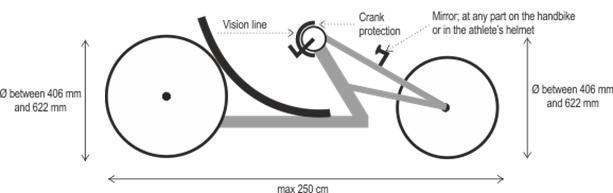
(iii) The Para triathlete must have clear vision. As such, the horizontal of the Para triathlete's eye line must be above the centre of the crank housing/crank set, when he/she is sitting with his/her hands on the handlebars facing forward at full extent, the tip of his/her shoulder blades in contact with the backrest and his/her head in contact with the headrest, when applicable. From this position, conforming measurements are calculated as follows: (#1) The distance from the ground to the centre of the Para triathlete's eyes and (#2) the distance from the ground to the centre of the crank housing (crank set). Measurement (#1) must be equal or greater than measurement (#2);
-
(iv) All handcycles must have a mirror fixed either to the athlete's helmet or at some point on the front of the bike to ensure rear-view vision is possible;
-
(v) The athlete must have the feet positioned in front of the knees during the bike segment;
-
(vi) Adjustments to handcycle may not be made during the competition;
-
(vii) Wheels of the handcycle may vary in diameter between a (ERTRO) 406 mm minimum and a 622 mm maximum, excluding the tyre. Modified hub attachments may be used if necessary. The width of handcycle double wheels may vary between 55 cm minimum and 70 cm maximum, measured at the centre of each tyre where the tyres touch the ground;
-
(viii) Disc wheels are allowed;
-
(ix) Disc brakes are allowed;
-
(x) A handcycle shall not measure more than 250 cm in length or 75 cm in width;
-
(xi) The shifting device can either be within the extremities of the handlebars, or on the side of the Para triathlete's body;
-
(xii) The largest chain ring shall have a guard securely fitted to protect the Para triathlete. This protection shall be made of solid material that is sufficiently robust and covers the chain ring fully over half of its circumference (180°) on the side facing the rider;
-
(xili) Any fillets, or ribs, inserted at joints between tubes, shall be for strengthening purposes only. Non-functional, aerodynamic devices are not permitted for competition;
-
(xiv)A quick release body harness is permitted;
-
(xV) Para triathletes must ensure that their lower limbs have enough support/bracing/foot rest to prevent them from dragging or making contact with the ground during the event;
-
c.) The bib number will be placed at the back of the handcycle and will be visible from the back;
-
d.) The helmet must be fastened before getting onto the handcycle and it must remain fastened till the finish;
-
e.) Athletes must stop completely at the mount line exiting Transition 1 and at the dismount line on entering Transition 2. Once stopped, the Technical Official will say "Go" and the athlete can continue the competition. The wheelchair is considered correctly stopped if the
front wheel stops immediately before the line. If the front wheel stops touching the line or beyond the line, a time penalty will be applied.
17.15 Para triathlon PTWC1 and PTWC2 Running p. 117
-
a.) All para triathletes perform the run portion in a "racing wheelchair";
-
b.) The specifications of a "racing wheelchair" (hereafter referred to as "the chair") are as follows:
-
(i) The chair shall have two large wheels and one small wheel;
-
(ii) There should be a brake at the front wheel;
-
(iii) No part of the body of the chair may extend forwards beyond the hub of the front wheel and be wider than the inside of the hubs of the two rear wheels. The maximum height from the ground of the main body of the chair shall be 50 cm;
-
(iv) The maximum diameter of the large wheel, including the inflated tyre, shall not exceed 70 cm. The maximum diameter of the small wheel, including the inflated tyre, shall not exceed 50 cm;
-
(v) Only one plain, round, hand rim is allowed for each large wheel. No mechanical gears or levers that propel the chair shall be allowed;
-
(vi) Only hand operated, mechanical steering devices will be allowed;
-
(vii) Para triathletes must be able to turn the front wheel manually to the left and right;
-
(vili) No part of the chair may protrude behind the vertical plane of the back edge of the rear tyres;
-
(ix) It will be the Para triathlete's responsibility to ensure the wheelchair conforms to all the above rules and no event shall be delayed while adjustments are made to the chair;
-
(x) Para triathletes must ensure that their lower limbs have enough support/bracing to prevent them from dragging or making contact with the ground during the event;
-
(xi) Para triathletes shall wear the approved bike helmet at all times while seated in the chair.
-
c.) Propulsion by any other method except the Para triathlete pushing on the wheels or pushrims will result in disqualification;
-
d.) It is forbidden to draft off a motorbike or vehicle and blue cards will be used to inform the athletes. Drafting is entering the motorbike or vehicle drafting zone (penalties outlined in 5.6):
-
(i) Motorbike draft zone: the draft zone behind a motorbike will be 20 meters long;
-
(ii) Vehicle draft zone: The draft zone behind a vehicle will be 35 meters long and applies to every vehicle.
-
e.) A Para triathlete attempting to overtake another Para triathlete carries the responsibility of ensuring full clearance of the chair being overtaken before cutting across. The Para triathlete being overtaken has the responsibility not to obstruct or impede the passing Para triathlete once the front wheel(s) of the passing chair is ahead of his/hers;
-
f.) PTWC1 and PTWC2 athletes will be judged as finished, the moment in which the centre of the axle of the leading wheel reaches the vertical plane of the nearer edge of the finish line;
-
g.) The bib number will be placed at the back of the wheelchair and visible from the back;
-
h.) No run course shall have a maximum gradient of over 5% at the steepest section.
17.16 Para triathlon PTS2, PTS3, PTS4 and PTS5 Running p. 118
- a.) Athletes with a lower limb deficiency are permitted to use a prosthesis on that limb only to ensure both legs are balanced and to allow for symmetrical movement during competition. The effective need/use of prostheses, orthoses or other special adaptive equipment must be approved during the classification evaluation and/or evaluated by the Classification Advisory Group;
- b.) The use of running blades is only allowed as long as they are mounted on a prosthesis;
- c.) Athletes will wear a bib number or four sets of body decals, which will be visible from the front.
17.17 Para triathlon PTVI1, PTVI2 and PTVI3 p. 118
The following additional rules apply to all visually impaired (PTVI1, PTVI2 and PTVI3) para triathletes and their guides:
a.) General:
-
(i) No guide dogs will be allowed at any time;
-
(ii) Each athlete must have a guide of the same gender and nationality. Both athlete and guide will hold a licence from the same National Federation;
-
(iii) Each athlete is allowed a maximum of one (1) guide during each competition;
-
(iv) An athlete cannot act as a guide until a period of twelve (12) months has passed since his/her last sprint or standard distance elite triathlon World Triathlon event or any elite triathlon event recognized by World Triathlon on sprint or standard distance;
-
(v) All guides must comply with minimum age requirements as per the World Triathlon Competition Rules Appendix A;
-
(vi) In the event of an injury or illness, and upon presentation of a medical certificate, a guide may be replaced up to 24 hours before the official start of the competition. No changes will be allowed after this deadline;
-
(vii) Guides are not allowed to pull or push the athletes in order to gain unfair advantage;
-
(viii) Athlete and guide shall not be more than 1.5 meters apart during the swim segment and no more than 0.5 meters apart during any other segment of the competition;
-
(ix) Guides may not use paddleboards, kayaks, etc. (on the swim portion) or bicycles, motor bicycles, etc., (on the run portion) or any other mechanical means of transport;
-
(x) All PTVI1 athletes must wear blackout goggles throughout the entire competition. Swim blackout goggles may be removed only once the athlete and guide have reached their bike position in Transition area 1. The bike/run blackout glasses must be used from Transition area 1 until the athlete and guide cross the finish line. Both the blackout goggles and glasses will be checked at registration and the athlete must ensure they do not allow light to enter through the main patched or painted area, nose piece, sides or bottom. Logos are allowed only on the frame;
-
(xi) Athletes and guides are subject to World Triathlon Anti-Doping Rules.
b.) Swimming:
- (i) Each athlete must be tethered to their own guide during the swim;
- (ii) At no time may a guide propel, pull or push the para triathlete with any part of their own body in order to gain an unfair advantage;
- (iii) The guide must swim next to the athlete within a maximum separation distance of 1.5m from the athletes' head to the guide's head. The tether must be elastic rope with bright or reflective colour and up to 80 cm long measured with no tension. It can be fixed at any point of the athletes' body.
c.) Cycling:
- (i) All para triathletes and guides must use a tandem bicycle. The specifications of the tandem bicycle are as follows:
- A tandem is a vehicle for two riders, with two wheels of equal diameter, which conforms to the general principles of UCI construction for bicycles. The front wheel shall be steerable by the front rider, known as the pilot. Both riders shall face forward in the traditional cycling position and the rear wheel shall be driven by both cyclists through a system comprising pedals and chains; the maximum sizes will be 2.70 meters long and 0.5 meters wide;
- The tandem top tube, and any additional strengthening tubes, may slope to suit the morphological sizes of the riders.
d.) Running:
-
(i) Each athlete must be tethered during the run to his/her guide while in motion. The tether shall be made from non-elastic material and not store energy and or offer a performance gain to the athlete;
-
(ii) The athlete may use an elbow lead during the run. The guide-runner is not allowed to push, pull or otherwise propel athletes in order to gain an advantage at any stage during a competition. A guide-runner may assist an athlete who has tripped or fallen to regain his/her footing and/or orientation as long as such assistance does not provide any advantage to the athlete towards his/her running direction;
-
(iii) As the athlete crosses the finish line, the guide must be beside or behind the para triathlete but not further apart than the required 0.5 meters maximum separation distance;
-
(iv) Free Leading zones: for safety reasons, leading is allowed 10 meters before and after an aid station, a sharp turn, penalty box, transition area swim exit, pre-transition area or any other section of the run course determined by the Technical Delegate and indicated at the athlete's briefing.
17.18 Outside assistance p. 120
- a.) Technical Delegates may determine areas or sections of the course where para triathletes may receive assistance, what assistance may be provided and the instructions and conditions applicable;
- b.) Assistance can be provided to a Para triathlete to allow them to get back into their handcycle/racing wheelchair or onto their bike following an incident. In such cases any mechanical repair must be done by the athlete without external assistance. Assistance may only be provided by a Technical Official, Event Personnel, or another athlete in the same race.
17.19 Hygiene p. 120
- a.) It is mandatory for all para triathletes, who use catheters or other urinary diversion devices, to prevent spillage by using a catheter bag at all times. This includes during training, competition and classification.
17.20 Approval panels p. 120
- a.) Decisions on bike adaptations or brace approval will be made by a panel composed of:
- (i) A World Triathlon Technical Committee member;
- (i) A representative of the World Triathlon Sport Department;
- (iii) A member of the World Triathlon Para triathlon Committee;
- b.) The decisions of the Approval Panel can be appealed to the World Triathlon Tribunal. This appeal does not suspend the decision of the Approval Panel, but rather the decision will stay in place during the time the World Triathlon Tribunal takes to make a decision on the appeal.
17.21 Para Triathlon Mixed Relay p. 120
- a.) The distance ranges per leg are: swim 125 m - 150 m; bike 3,5 km - 4 km and run 0,8 km - 1 km;
- b.) The general eligibility rules apply. The minimum age is 15 years old;
c) Team Composition
-
(i) A team is composed of 4 athletes (2 men and 2 women). Each team member will cover a complete triathlon race/distance (draft illegal);
-
(ii) A team can be composed of 3 athletes (at least one of a different gender). Athletes of the same gender cannot cover three segments, so the athlete of the least represented gender must do the 2nd and 4th leg of the relay;
-
(iii) Gender is not a factor in determining the order of the athletes;
-
(iv) Every team must have one and not more PTWC athlete which must only compete in the first leg;
-
(v) In the World Championships, teams will be made of athletes from the same National Federation (NF). In all other events international teams are allowed
-
(vi) An NF can enter more than one team but at least one team must consist of 4 members. At World Championships an NF can only enter 1 team until the maximum quota of 15 teams has been reached. If the start list is not full, a second team may enter ten days before the race, a random draw will be conducted if needed;
-
(vii) Only one PTVI and one PTWC athlete can be part of each team;
-
(viii) Numbers will be assigned according to the last world championships' results, starting at 1. The first team from those NFs absent will receive the next numbers randomly, and the second teams will follow.
-
d.) Combined Sport Classes
-
(i) The Para Mixed Relay Sport Class Points (PMRSCP) table will be used when forming a team. Each sport class is assigned a point value according to the PMRSCP table. Teams shall be composed of athletes from sport classes with a combined point value of a maximum of 20 points. In the case of a 3 members composition, the point value of the athletes' sport class racing twice, will be added twice to the teams' total point value;
-
(i) Para MR Sports Class Points Table:
| CLASS | MEN | WOMEN |
|---|---|---|
| PTVI2-3 | 7 | 6 |
| PTS5k | 6 | 5 |
| PTWC2 | 5 | 4 |
| PTV1 | 5 | 4 |
| PTWC1 | 4 | 3 |
| PTS4 | 4 | 3 |
| PTS3 | 2 | 1 |
| PTS2 | 2 | 1 |
- e.) Personal Handlers. Each team can have one personal handler that can assist only the PTWC and any other athlete who is eligible to receive assistance from the same team;
- f.) Pre-Transition Area. Each team will have its own space in the pre-transition marked with the race number of the team;
- g.) Transition Area. The team members will be grouped together;
h) Relay Exchange
- (i) The relay exchange from one team member to another will be conducted "virtually" at a designated point on the run course near the swim start. The Technical Officials will be responsible to inform the next team member to start the swim leg as soon as the previous team member has crossed the designated line;
- (ii) Each team member will have an in-water start. The athletes shall have their hand on the pontoon or behind the start buoys until signalled to go;
- (iii) Athletes are responsible to be in the start position before the previous team member has completed the leg.
- i.) Finish. Only the athlete covering the last leg is allowed to cross the finish line;
- j.) Number of teams. The maximum number of teams allowed in a specific event will be determined by the TD;
- k.) Two hours before the competition starts, the coach can communicate with the Head Referee a different team composition by:
- (i) Replacing a maximum of one athlete or adding a fourth athlete to the three-member team;
- (ii) Modifying the order of the athlete.