2.1 General Conduct p. 13
- a.) Triathlon and World Triathlon's other related multisports involve many athletes. Competition tactics are part of the interaction between athletes. Athletes will:
- (i) Practice good sportsmanship at all times;
- (ii) Be responsible for their own safety and the safety of others;
- (iii) Know, understand and follow the World Triathlon Competition Rules, available from their National Federations and on www.triathlon.org;
- (iv) Obey local traffic regulations and instructions from race officials;
- (V) Treat other athletes, race officials, volunteers, and spectators with respect and courtesy;
- (vi) Avoid the use of abusive language;
- (vii) Inform a Technical Official after withdrawing from the competition. Failing to do this may result in a suspension;
- (viii) Compete without receiving assistance other than from event personnel and race officials as outlined in 2.2;
- (ix) Avoid using ambush marketing;
- (x) Avoid displaying any kind of demonstration of political, religious or racial propaganda;
On-Course Behavior
-
(xi) Intentionally not dispose of rubbish or equipment around the course except at clearly identified places, such as aid stations, littering areas or rubbish disposal points. All items must be kept with the athlete and returned to their transition spot;
-
(xii) Not attempt to gain an unfair advantage from any external vehicle or object;
-
(xili) Follow the prescribed course; Exceptions will be applied:
-
When it happens because of safety reasons if advantage is not gained;
-
When it happens following the instructions of a Technical Official;
-
When it happens accidentally if advantage is not gained.
-
(xiv) Not use any device that will distract the athlete from paying full attention to their surroundings:
-
Athletes may not use communication devices of any type, including but not limited to cell phones, smart watches, and two-way radios, in any distractive manner during the competition. A "distractive manner" includes but is not limited to making or receiving phone calls, sending or receiving text messages, playing music, using social media, taking photographs or using in a one- or two-way radio communication. Using any communication device in this manner during the competition will result in disqualification;
-
Cameras, phone cameras, and video cameras are prohibited unless permission is given by the World Triathlon or the licence holder of the event. If such permission is given, it is the athlete's responsibility to obtain permission by the Head Referee of such permission prior to the start of the competition. Athletes seen with an unauthorised camera, phone camera, or video camera will be disqualified.
-
(xv) Ensure that the equipment to be used in the race complies with the safety standards and it is in proper condition;
(xvi) Not modify any equipment of the competition set up.
2.2 Outside assistance p. 14
- a.) The assistance provided by event personnel or Technical Officials is allowed but is limited to providing drinks, nutrition, mechanical and medical assistance, upon the approval of the Technical Delegate or Head Referee. The Head Referee may authorise the accredited team support to repair flat tyres or replace wheel(s) if the incident happens before the first athlete arrives at Transition 1. Athletes competing in the same competition may assist each other with incidental items such as, but not restricted to, nutrition and drinks after an aid station, pumps, tubular tyres, inner tubes and puncture repair kits. Exceptions for Para Triathlon events are listed in 17.7 c);
- b.) Athletes may not provide essential race equipment to other athletes in the same competition, while the competition is in progress. Specifically, items that may not be provided to other athletes includes but is not limited to complete bicycles, bicycle frames, wheels and helmets. The penalty for this will be disqualification of both athletes. Athletes may provide to other athletes competing in the same competition other items of equipment provided that the donor is able to continue with their own competition;
- c.) An athlete cannot physically assist the forward progress of another athlete on any part of the course. This will result in the athlete being disqualified. If the athlete receiving this assistance accepts this help (and/or is not actively trying to avoid this assistance) will be disqualified.
2.3 Drug Abuse p. 14
- a.) Athletes and guides will follow the World Triathlon Anti-Doping Rules;
- b.) All athletes and guides are responsible for familiarising themselves with the World Triathlon Anti-Doping Rules including medical and doping control tests, testing obligations, rights, responsibilities and procedures, penalties and appeal processes, and prohibited substances and methods. Athletes, guides and coaches can be entered in an event only after the successful completion of the specific anti-doping education module. This obligation is not applicable to Age-Group athletes;
- c.) World Triathlon has implemented the World Triathlon Anti-Doping Rules and abides by rules set by the World Anti-Doping Agency (WADA) Code.
2.4 Health p. 15
- a.) Triathlons and World Triathlon's other related multisports are strenuous. To be able to compete, athletes should be in excellent physical condition. Their health and welfare is of paramount importance. By starting in a competition, the athletes declare they are in good health and are in appropriate physical condition to complete the competition;
- b.) World Triathlon encourages all the Age-Group athletes and Technical Officials to undergo a periodic health evaluation (PHE) and to undergo a pre-participation evaluation (PPE) prior to engaging in competitive sport. An annual PPE is mandatory for all athletes competing in Youth, Junior, U23, Elite and Para triathlon events, in any World Triathlon event as outlined in Appendix J. More information about PPE can be found in Appendix Q.
2.5 Eligibility p. 15
- a.) All athletes must be in good standing with their National Federations. To ensure this, for World Triathlon and Continental Confederation events, all the entries must be done by the National Federations, not by the athletes themselves;
- b.) Athletes under suspension are not allowed to compete in any World Triathlon event, in any competition sanctioned by World Triathlon members, or in any competition held under the World Triathlon Rules;
- c.) An athlete's age is determined by their age on December 31st in the year of competition;
- d.) Athletes aged 15 to 17 years old are eligible to compete in the Youth category;
- e.) Athletes aged 16 to 19 years old are eligible to compete in the Junior category;
- f.) Athletes aged 18 to 23 years old are eligible to compete in the U23 category;
- g.) The minimum ages to be admitted in the competitions are determined by the distance of the event and by the category of the event as indicated in the chart below:
| Category | Distance | Elite program | u23 program | Junior program | Youth program |
|---|---|---|---|---|---|
| World Triathlon Championship Finals | Standard | 18+ | 18-23 | 16-19 (Sprint)| | n/a |
| World Triathlon Championship Series | Standard | 18+ | n/a | n/a | n/a |
 |
|||||
| World Triathlon Championship Series | Sprint | 18+ | n/a | n/a | n/a |
| --- | --- | --- | --- | --- | --- |
| World Triathlon Championship Series | Sp-sprint | 18+ | n/a | n/a | n/a |
| World Triathlon Championship Series | Eliminator | 18+ | n/a | n/a | n/a |
| World Triathlon Cup | Standard | 18+ | n/a | n/a | n/a |
| World Triathlon Cup | Sprint | 17+ | n/a | n/a | n/a |
| World Triathlon Cup | Sp-sprint | 17+ | n/a | n/a | n/a |
| World Triathlon Cup | Eliminator | 17+ | n/a | n/a | n/a |
| Continental Triathlon Cup | Standard | 18+ | n/a | n/a | n/a |
| Continental Triathlon Cup | Sprint | 16+ | n/a | 16-19 | n/a |
| Continental Triathlon Cup | Sp-sprint | 16+ | n/a | 15-19 | n/a |
| Continental Triathlon Cup | Eliminator | 16+ | n/a | n/a | n/a |
| Development Regional Cup | Sprint | 16+ | n/a | n/a | n/a |
| Supertri E Championships | Sp-sprint | 17+ | n/a | n/a | n/a |
| Continental Triathlon Championships | Standard | 18+ | 18-23 | n/a | n/a |
| Continental Triathlon Championships | Sprint | 18+ | 18-23 | 16-19 | n/a |
| Continental Triathlon Championships | Sp-sprint | 18+ | 18-23 | 16-19 | 15-17 |
| T100 World Tour | Middle | 18+ | n/a | n/a | n/a |
| Mixed Relay World Championships | Sp-sprint | 16+ | 16+ | 16-23 | n/a |
| Mixed Relay Series | Sp-sprint | 16+ | n/a | n/a | n/a |
- h.) An athlete acquires the condition of elite for the same calendar year once is being entered in an elite program of a World Triathlon event of the categories listed below:
- (i) World Championships;
- (il) World Championships Series;
- (iil) World Championships Finals;
- (iv) World Series;
- (v) World Cup
- (vi) T100.
The elite condition is associated to the multisports) of the event the athlete has been entered.
Elite athletes are not allowed be guides and/or to compete in Age-Group events in the same calendar year and in the same Multisport in which they have gained the condition of elite;
-
i.) Athletes will be eligible to compete in the individual Age-Group events in the group in which their age is included. The groups are:
-
(i) 15 to 19 in super sprint distance events (N15)/(F15);
-
(ii) 16 to 19 in sprint distance events (N16)/(F16);
-
(iii) 18 to 19 in standard and longer distance events (N18)/(F18);
-
(iv) 20 to 24 (N20)/(F20);
-
(v) 25 to 29 (N25)/(F25);
-
(vi) 30 to 34 (N30)/(F30);
-
(vii) Etc.
-
j. The different qualification criteria can be found in the World Triathlon Qualification Criteria and published in www.triathlon.org;
-
k.) Specific qualification criteria affecting Major Games and Recognised Games are published in www.triathlon.org;
-
1.) Specific qualification criteria affecting events sanctioned by World Triathlon, but not part of the World Triathlon events structure, are published in the respective website of such events;
-
m.) Athletes may not compete within 24 hours at the same or different World Triathlon event in more than one triathlon or multisport competition (see Appendix I) when one competition is of standard distance or longer. The 24 hours is considered from the start of the race till the start of the other race the following day. Exceptions will be for the mixed relay events at the defined super-sprint distances (see 16.1.a.), PTVI1, PTVI2 and PTVI3 guides and aquathlon;
-
n.) Age limits: Athletes must be a minimum age to compete in any event, as outlined in Appendix A. Continental Confederations may add other age limits for Continental Championships, for youth and younger categories with super-sprint events. The age limits as outlined in Appendix A cannot be modified;
-
o.) An athlete who competes in a category different from his/her age, in a distance in which it is not allowed, or before the 24-hour period, will be disqualified from the events he/she took part in. Any awards, prizes and points will be removed;
-
p.) Eligibility of athletes to the male, female or open races are subject to the criteria determined in the documents:
-
(ii) World Triathlon Eligibility Regulations for Transgender Athletes; and
-
q.) Athletes who are competing under the World Triathlon flag will be entered in the competition by the National Federation the athlete is moving to. They will compete with the same rights as any other athlete in terms of awards, prizes and points.
2.6 Insurance p. 18
- a.) All athletes competing in events must have personal insurance coverage guaranteed by their National Federation. This insurance will cover:
- (i) Any accident occurring on the days and at the location of the competitions, official trainings (listed in the official schedule of the event), official course familiarisations, briefings, opening and closing ceremonies;
- (ii) Liability caused by an athlete during the competition.
- b.) The athlete's National Federation guarantees the existence of the insurance coverage mentioned in this article by entering or confirming an athlete in an event;
- c.) Local Organising Committees or National Federations organising an event cannot force the athletes to pay for an insurance coverage mentioned in this article.
2.7 Registration p. 18
a) Entry
- (i) National Federations will register their athletes for World Triathlon Events following their National Federation qualification system or other World Triathlon approved qualification system;
- (ii) All athletes qualify to any World Triathlon Event as outlined in Appendix J, by the eligibility rules outlined in 2.5 and by the qualification criteria outlined in Appendices E;
- (il) Prior to competing in World Triathlon Championships, World Triathlon Cups, World Triathlon Championship Series events, World Triathlon Para Series, World Triathlon Para Cups and World Triathlon Multisport Championships, Elite, U23, Junior athletes and Para triathletes must sign the World Triathlon Athletes' Agreement, which states that any dispute arising from the World Triathlon Rules that cannot be settled by its
- existing protests and appeals procedure, shall be settled finally by the Court of Arbitration for Sport (CAS) . Once signed, the World Triathlon Athletes' Agreement is valid until the end of the competition year it has been signed in. The Athletes' Agreement is published on www.triathlon.org;
- (iv) National Federations are responsible for entering their athletes, coaches and support team for all World Triathlon Events using the World Triathlon online system on www.triathlon.org. World Triathlon may authorise the use of different entry system provided that National Federations endorse the participation of the athletes entered. Quotas and timelines are indicated in:
- Athletes: The qualification criteria for the specific event;
- Support team: Point 10.9 of these Competition Rules.
b.) Pre-Race Briefings:
-
(i) Coaches' Meeting: If a coaches' meeting is scheduled, it will take place one hour before the Athletes' Briefing. The Technical Delegate will conduct the Coaches' Meeting. The agenda will include the announcement of the Competition Jury and all the technical details of the event as well as specific information for coaches. Coaches' accreditations will be distributed at this meeting, or if the Coaches' Meeting is not scheduled, accreditations will be distributed at the end of the Elite/U23/Junior/Youth Athletes' Briefing;
-
(ii) Age-Group Team Managers' and Coaches' Briefing: At World Championships and at Continental Championships (if applicable), the Technical Delegate will conduct the Age-Group Team Managers' and Coaches' briefing. Only Age-Group Team Managers and Coaches registered on www.triathlon.org are allowed to attend. The agenda of this briefing will include the announcement of the Competition Jury and all the necessary information for the event;
-
(iii) Para triathlon Coaches' Meeting: If a Para triathlon Coaches' Meeting is scheduled, it will take place before the Para triathlon Briefing. The Technical Delegate will conduct it and the agenda will include the announcement of the Competition Jury and all technical details of the event as well as the specific information on para triathlon procedures. Coaches' accreditations will be distributed at this meeting, or if the Team Managers' Meeting is not scheduled, accreditations will be distributed at the end of the Para triathletes' Briefing;
-
(iv) Elite/U23/Junior/Youth/Para triathletes Briefings: At all World Triathlon Events, the Technical Delegate will conduct the Athletes' Briefing. Elite/U23/Junior/Youth athletes and Para triathletes including their Handlers/Guides must be in attendance. Coaches may also attend the briefing. The following penalties apply to athletes who miss the briefing:
-
Athletes / Para triathletes including their Handlers/Guides not attending the briefing, without informing the Technical Delegate about their absence, will be removed from the start list;
-
Athletes / Para triathletes including their Handlers/Guides entering the briefing hall after the briefing has started and athletes not attending the briefing, but who have informed the Technical Delegate about their absence, will receive a time penalty to be served in Transition 1. The time penalty applicable for the specific distance is laid out in section 3.3.e.)(ii);
-
Penalties applied to athletes missing the briefing due to force majeure and informed the Technical Delegate about their absence by the time of the briefing, may be removed if HR and CJ agree on this. If the penalty remains athlete may file a protest against the Head Referee's decision on the time penalty the latest 2 hours before their competition starts;
-
For the World Triathlon Championship Series, World Triathlon Cup events, World Triathlon Para Series or World Triathlon Para Cup events, if an athlete
-
is penalized for missing more than two briefings in a calendar year, they will be removed from the start list for the third missed briefing and each missed briefing thereafter, even if they informed the Technical Delegate in advance.
-
(v) Mixed relay briefing: At all World Triathlon Mixed Relay Events, the Technical Delegate will conduct the Athletes' Briefing. It may be together with the individual event briefing or a separate one. One athlete or a coach or any other accredited member of the delegation support crew for this event from each team must be in attendance. The following penalties apply to teams without representant attending the briefing:
-
Teams not attending the briefing, without informing the Technical Delegate about their absence, will be removed from the start list;
-
Team representatives entering the briefing hall after the briefing has started and team representatives not attending the briefing, but who have informed the Technical Delegate about their absence, will receive a 10 second time penalty to be served in Transition 1 of the first leg.
-
(vi) Athlete/Para triathletes, their Handler, Guides, Coaches and Team Medical must register prior to entering the briefing venue;
-
(vii) For all World Triathlon or Continental Elite events, the briefing will take place at 16.00 one (1) day before the first competition day. In case of 2 briefings the first one start at 16.00 the day before the competition;
-
(vili) For all other World Triathlon or Continental events (U23, Junior, Youth, Para triathlon, Mixed Relay), the briefing will take place one (1) day before the first competition day of the related event and category;
-
(ix) Alteration to any of the times above should be announced on the World Triathlon website 45 days in advance;
-
(x) The pre-race briefings are not open to the media.
c) Packet Pick-Up
- (i) All World Triathlon Events - Age-Group:
- All athletes must provide picture ID at registration/packet pick-up prior to competition. All support team accredited must provide picture ID to receive the accreditation;
- All athletes must pick up their own race packet at the official competition registration area during a designated time. Packet pick-up will be opened on two (2) separate days, starting from 3 days prior to their competition. The hours shall be from 09:00 to 19:00. If a National Federation is unable to make the designated registration time, they must request a different time at least 14 days in advance, in writing to World Triathlon;
- The race packets will contain a minimum of: five (5) official race numbers (one (1) bib number, one (1) bicycle sticker number and three (3) helmet stickers) and four (4) safety pins, numbered swim cap, 4 body tattoo for both
arms and legs or alternative body marking, 1 category body decal for the calf or alternative body marking, timing chip, accreditation pass, tickets for all of the social functions. Local Organising Committee gifts may be distributed at the same time.
- (i) All World Triathlon Events - Elite, U23, Junior, Youth and Para triathlon competitions:
- All athletes and para triathletes must provide picture ID at registration/packet pick-up prior to competition. All support team accredited must provide picture ID to receive the accreditation;
- All athletes will pick up their own race packet at Registration following the Athletes' Briefing;
- The race packet will include: three (3) helmet numbers, one (1) bike number, body decals for both arms and both legs, accreditation pass, athletes' guide, tickets for all of the social functions. Local Organising Committee gifts may be distributed at the same time. When applicable one (1) bib number will also be included in the race packet.
d.) Check-in:
- (i) Age-Group competitions with more than 700 athletes entered will schedule the Checkin the day before the competition. Age-Group events with fewer athletes, and Elite, U23, Junior, Youth and Para triathlon will have the bike check on same day;
- (ii) Technical Officials will conduct the check-in at the athletes' lounge or at the transition area and will include the following:
- Distribution of the swim caps and timing chips (except for the Age-Group events);
- Control of the athletes' uniform, which must comply with the World Triathlon Guidelines Regarding Authorised Identification published on www.triathlon.org. Each uniform should be photographed. If an athlete needs to replace the uniform, this process has to be done again;
- The bike check is regulated under section 5.3;
- Distribution of the race packets to the athletes who missed the briefing.
- (iii) Athletes may be prevented from racing in case not respecting the check-in times.
2.8 Uniform p. 21
-
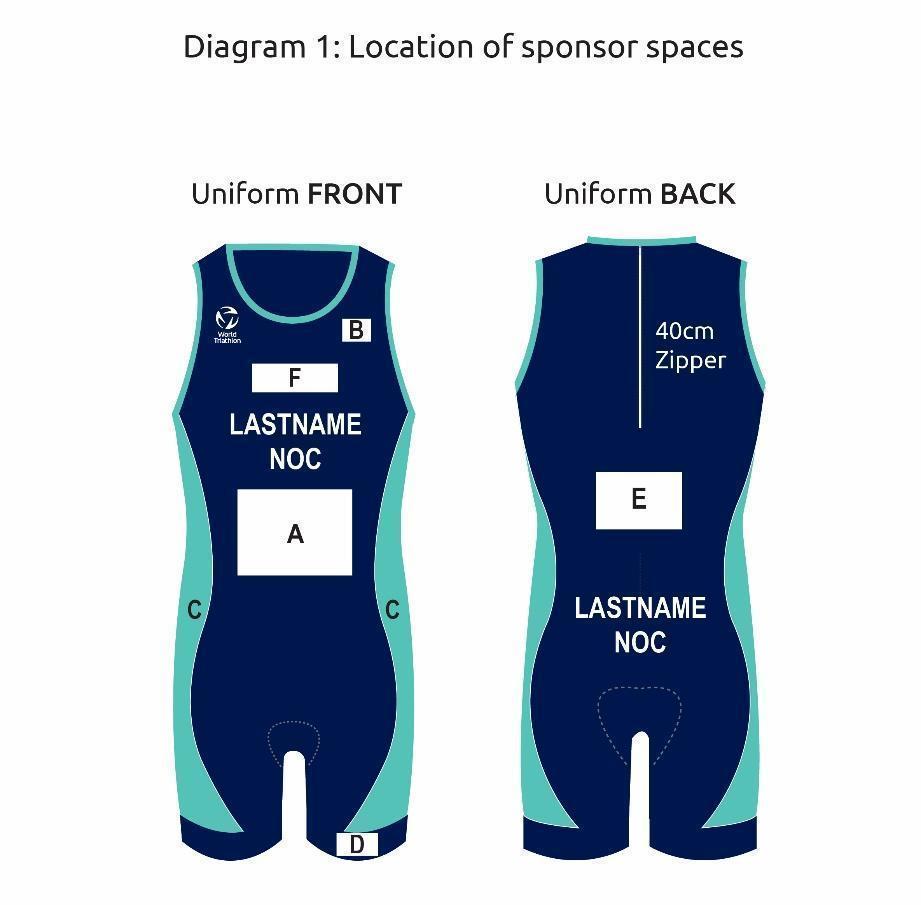
a.) All athletes competing in World Triathlon Events are required to wear their uniform conforming to the World Triathlon Guidelines Regarding Authorised Identification;
-
b.) The World Triathlon Guidelines Regarding Authorised Identification set the space limitation on the athletes' uniforms to include commercial logos;
-
c.) Athletes must follow the following rules with respect to wearing uniforms:
-
(i) Athletes must wear the uniform during the entire competition and award ceremony. Long sleeves and long pants are allowed for the award ceremony;
-
(ii) The uniform must cover the whole torso in the front. The back may be uncovered from the waist up;
-
(ill) Sleeves:
-
All athletes and para triathletes may wear uniforms with sleeves that extend to above the elbow and not covering the elbow in any distance competition.
-
(iv) Arm covers or long sleeves may be used, only if TD approves;
-
(v) Covering the legs below the knees is not allowed in the swim segment when the use of wetsuits is forbidden;
-
(vi) Long sleeves and long pants are allowed in Winter Triathlon events;
-
(vii) A one-piece uniform is preferred. If a two-piece uniform is used, both pieces must overlap and no torso must be visible during the entire competition, except middle- and long-distance events where the midriff is allowed to be exposed;
(vili) Zipper:
- Age-Group athletes and Para athletes may wear uniforms without zipper or with zipper located either at the front or at the back. Front zipper can be undone to any length, provided, that (i) the zipper should be connected at the bottom of the uniform at all times, and (ii) the top of the uniform should cover the shoulders at all times; The uniform should be fully zipped in the last 100 metres before the finish line, when it needs to be zipped up;
- Elite, U23 and Junior athletes may wear uniforms without zipper or with zipper located either at the front or at the back in all middle- and longdistance triathlon events and in all distances of the rest of multisport events. Front zipper can be undone any length, provided, that (i) the zipper should be connected at the bottom of the uniform at all times, and (i) the top of the uniform should cover the shoulders at all times; The uniform should be fully zipped in the last 100 metres before the finish line, when it needs to be zipped up;
- Elite, U23, Junior and Youth athletes may wear uniforms without zipper or with zipper located at the back which will not be longer than 40 cm in standard and shorter distances triathlon events.
| Category | Short and no sleeve | Short and no sleeve |
|---|---|---|
| Category | Back zipper allowed | Front zipper allowed |
| Elite | all events | all other multisport |
| U23 | all events | all other multisport |
| Junior | all events | all other multisport |
| Youth | all events | all other multisport |
| Para | all events | all events |
| Age-Group | all events | all events |
(*) All other multisport: aquabike, aquathlon, cross duathlon, cross triathlon, duathlon, long distance triathlon, long distance duathlon and winter triathlon are included within those as per Appendix I.
- (ix) The uniform must be worn over both shoulders while the athlete is on the Field of Play;
- (x) Elite, U23, Junior, Youth and Para triathlon athletes must wear the same uniform from the start to the finish in standard distance or shorter events;
- (xi) Rain jackets are allowed for middle- and long-distance events or when the Technical Delegate authorises it. Rain jackets must be the same design and colour as the uniform or transparent;
- (xii) Failure to comply with the World Triathlon Competition Rules related to the uniform may result in an athlete having to wear a triathlon suit supplied by World Triathlon. Alternatively, Technical Officials may request the athlete use a permanent marker or other means to eradicate logos on the uniform that do not comply with the Competition Rules. If during the competition or the award ceremony, an athlete wears a uniform with logos that do not comply with the Competition Rules (including the World Triathlon Guidelines Regarding Authorised Identification), he/she will be disqualified.
- d.) For reasons of religion, athletes are allowed to have the body totally covered (except the face) provided that:
- (i) The uniform material is approved by FINA (applicable only for the non-wetsuit swim);
- (ii) The uniform will not interfere with the bicycle mechanisms;
- (iii) Extra identification elements are to be worn over the uniform, following the Technical Delegate's instructions.
- e.) Technical Delegate, after consultation to the Medical Delegate or Events Advisory Group, may authorise individual or exceptional deviations from the rules above for safety or healthy reasons. (i.e. skin cancer), however hands will be uncovered during the swim segment without exception.
2.9 Race numbers p. 23
-
alteration; a.) Any numbering item will be used without alterations unless Head Referee approves the
-
b.) Elite, U23, Junior and Youth athletes will not wear bib numbers, however when, due to the competition schedule they are mixed with Age-Group athletes Technical Delegate can decide on making the use of the bib numbers mandatory for all the athletes;
c) Bib numbers
- (i) Age-Group:
- May be worn for the wetsuit swim segment, but forbidden in a non-wetsuit swim segment;
- Mandatory for the run segment;
- Must be visible on the front during the run segment.
- d.) The use of the bib number in Para triathlon is regulated in section 17;
e) Body marking
-
(i) Elite, U23, Junior, Youth and Para triathlon:
-
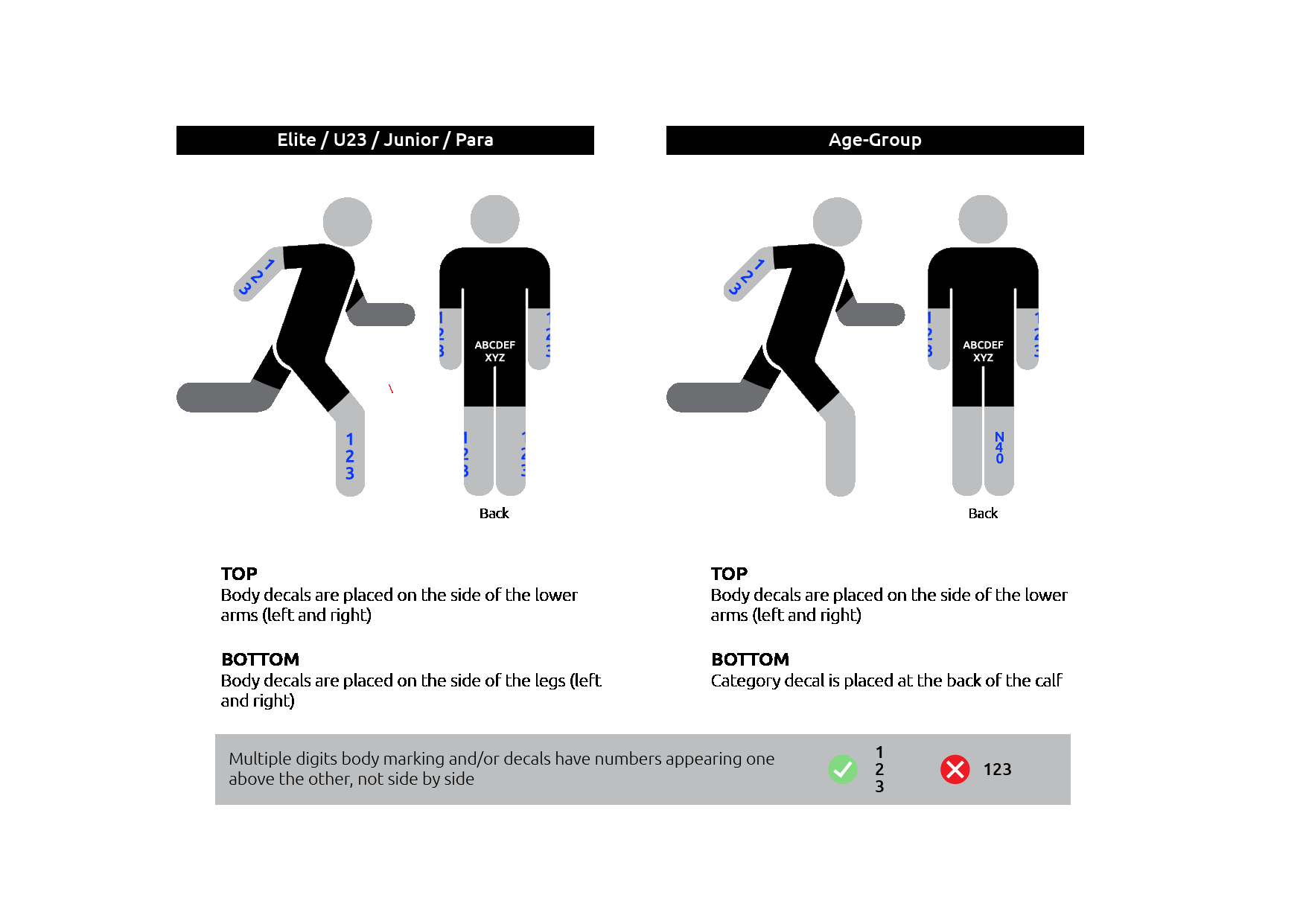
The Local Organising Committee or World Triathlon will provide body marking decals, which the athletes must apply prior to the event;
-
Body markings are to be applied so they are visible on each arm and leg, unless instructed otherwise by the World Triathlon Technical Delegate at the briefing. On the limbs the body marking should be applied at the lower leg and lower arm. Body markings and/or decals using multiple digits will have numbers appearing one above the other, not side by side.
-
(i) Age-Group:
-
The Local Organising Committee will provide body marking or body marking decals, who will apply them prior to the event;
-
Body markings must be applied so they are visible on each arm, as close to the shoulder as possible, unless instructed otherwise by the World Triathlon Technical Delegate at the briefing;
-
Body markings and/or decals using multiple digits will have numbers appearing one above the other, not side by side;
-
One calf of each athlete - if not covered - will be marked with the category and gender of the athletes (For example, the number N25 would appear on a athlete in the 25-29 individual open age category or F25 should appear on a female athlete in the same category or the number X30 would appear on all team members in the 30-39 age category for the Age-Group Mixed Relay)
-
f.) For Winter Triathlon and Winter Duathlon events, points 2.9 a.) to 2.9 e.) do not apply. In these events athletes will be provided with a bib vest which is mandatory to be worn by the athletes during the whole race.
2.10 Assignment of race numbers p. 25
a) General
-
(i) Athletes' race numbers are assigned based on previous results in similar events, by using the most related ranking;
-
(i) The Elite men's and women's events will be numbered starting with number 1, except in middle- and long-distance events;
-
(iii) Number 13 will not be used.
-
b.) Specific events numbering criteria:
-
(i) World Triathlon Championship Series (WTCS) and World Triathlon Championship Finals:
-
First criteria: WTCS Ranking;
-
Second criteria: World Triathlon Ranking;
-
Third criteria: random.
-
(ii) Triathlon U23 World Championships:
-
First criteria: WTCS Ranking;
-
Second criteria: World Triathlon Ranking;
-
Third criteria: random.
-
(iii) Junior - any event:
-
First criteria: World Triathlon Ranking;
-
Second criteria: Applicable Continental Junior Ranking (For example Europe Triathlon, Americas Triathlon, etc.);
-
Third criteria: random.
-
(iv) Triathlon World Cup events:
-
First criteria: World Triathlon Ranking;
-
Second criteria: random.
-
(v) Triathlon Continental Cup events:
-
First criteria: World Triathlon Ranking;
-
Second criteria: random.
-
(vi) Triathlon Elite Continental Championships:
-
First criteria: Top 10 classification of the related Continental Championships in the previous year;
-
Second criteria: World Triathlon Ranking;
-
Third criteria: random.
-
(vii) Triathlon U23 Continental Championships:
-
First criteria: World Triathlon Ranking;
-
Second criteria: random.
(vili) World Triathlon Long Distance Duathlon Championship:
-
First criteria: Top 10 classification of the related World Championships in the previous year;
-
Second criteria: World Triathlon Long Distance Duathlon Ranking;
-
Third criteria: random.
-
(ix) Any other Multisport - any Elite event:
-
First criteria: World Triathlon related ranking;
-
Second criteria: random.
-
(x) Age-Group - any event (including Mixed Relay):
-
First criteria: Age-Group by Age-Group;
-
Second criteria: Grouped by nations (according to the IOC codes of the country) in alphabetical order starting by the host nation.
-
(xi) Para triathlon - any event:
-
First criteria: Athlete Medal Event order including first number as follows: PTWC Women 101, PTWC Men 121, PTS2 Women 202, PTS2 Men 222, PTS3 Women 303 , PTS3 Men 323, PTS4 Women 404, PTS4 Men 424 , PTS5 Women 505, PTS5 Men 525, PTVI Women 606, PTVI Men 626;
-
Second criteria: Para triathlon Ranking;
-
Third criteria: random.
-
(xii) Mixed Relay - any event:
-
First criteria: One team per nation;
-
Second criteria: World Triathlon Mixed Relay World Ranking;
-
Third criteria: random.
-
c.) Numbering of the final of events with a qualifying round format is regulated in sections 20.5 and 21.4.
2.11 Timing and Results p. 27
-
a.) A competition will be won by the athlete who has the shortest time from the start signal to the moment when the athlete finishes the competition as defined in 6.2. a.), 17.15. f.), 18.10 and 22.3, except if the event is conducted under the "rolling start system" as defined in 4.9;
-
b.) The official results will list the athletes according to their finish time and in accordance with the Olympic Results and Information Service (ORIS) standards, a sample of the results format is included in Appendix L;
-
c.) In the event that two athletes tie for a place, and their performances cannot be separated, they will be awarded the same rank, sorted by race number, and the next athlete to finish behind them will occupy the same rank plus two places, with the subsequent athletes ranked in order of finishing;
-
d.) Time splits to be included are:
-
(i) Swim or first segment;
-
(ii) Transition 1;
-
(iii) Bike or second segment;
-
(iv) Transition 2;
-
(V) Run or third segment.
-
e.) Results will include the following Invalid Results Markers (IRM) and listed in this order:
-
(i) athletes who do not finish the competition (DNF);
-
(ii) any lapped athletes or athletes stopped by the last biker - first runner scenario (LAP);
-
(iii) not classified participants for not making the cut-off time in any segment or second, third, fourth, etc teams finishing the race from same NF (NC);
-
(iv) Non-eligible Para triathletes (NE);
-
(v) those who are disqualified (DSQ);
-
(vi) and athletes or teams showing up at pre-race briefing (2.7 b.)) and not starting the race (DNS);
-
(vii) If more than one athlete is marked DNF or LAP, those who completed the most laps should be listed first; if several athletes are marked DNF or LAP on the same lap, athletes should be listed according to their times at the previous timing point with the fastest first, or by ascending start number if no times were recorded up to the point at which they retired;
-
(vili) If more than one participant is included in the same IRM group (different than DNF or LAP), they should be listed within the same group according to ascending start number;
-
(ix) For DSQ athletes, the final time should not be displayed.
-
f.) Additional information will be displayed either at the header or the footer of the results:
-
(i) Swim distance and number of laps;
-
(ii) Bike distance and number of laps;
-
(iii) Run distance and number of laps;
-
(iv) Air temperature;
-
(v) Water temperature;
-
(vi) Wetsuit swim/No wetsuit swim;
-
(vii) Name and country of the Technical Delegate;
-
(vili) Name and country of the Head Referee;
-
(ix) Name and country of the members of the Competition Jury.
-
g.) For mixed relay events, the rules above are applicable and the total time per athlete will be shown;
-
h.) Results will be official once the Head Referee signs them. Incomplete results can be declared official at any time:
-
(i) The Head Referee will use all the resources available to decide the final position of every athlete. The information from technology will be used to assist in the decisionmaking process. The Head Referee may decide, based on the available evidence,
that a competition is tied if there is no way of defining which athlete crossed the line first;
-
(ii) Athletes who deliberately try to finish in a contrived tie situation, where no effort to separate their finish times has been made, will be DSQ.
-
i.) When the race time is taken electronically by a chip timing system:
-
(i) Each athlete will be provided with one (1) or more timing chips. The quantity and use of the timing chips has to be approved by TD;
-
(ii) Athletes has to start the race with the chip placed on the body as indicated in the prerace information;
-
(iii) Technical Officials will check in the pre start area if the chip is properly placed and may request the athlete to modify the position or to place a new chip if the athlete is not wearing it. This may result in a delay of the involved athlete moving to the select the start position;
-
(iv) If it is detected that the athlete lost the timing chip during the race, Technical Officials may offer a replacement chip either in T1 or T2. It is the athlete decision to take the replacement chip or not. If the athlete If does not take it, their splits may not be registered and published in the results. Specifically, for Age-Group races this lost chip circumstance may lead to a disqualification if it is impossible to determine the athlete completed the whole race.
-
j.) Para triathletes changing sport class after classification assessment before the event will be moved to the new sport class. Non-eligible Para triathletes will be removed from the start list;
-
k.) Para triathletes changing sport class after observation during competition will be moved to a new sport class. Non-eligible Para triathletes will be displayed as NE;
-
I.) Results may be modified by the following bodies, without removing the time of a served penalty:
-
(i) Head Referee;
-
(ii) Competition Jury;
-
(iii) World Triathlon Technical Committee as the outcome of a results revision process as outlined in 12.10;
-
(iv) World Triathlon Technical Committee as the result of a change of a para triathlon sport class process;
-
(v) Anti-Doping Hearing Panel.
-
m.) Results may be modified by the following bodies without removing the time of a served penalty other than where the penalty results from a decision made in bad faith, arbitrarily, or in application of the wrong rule:
-
(i) World Triathlon Tribunal excluding the field of play decisions, as the outcome of a level 2 appeal;
-
(il) CAS as result of a level 3 appeal.
-
n.) If results are modified, all affected parties must be notified.
2.12 Exceptional conditions p. 30
-
a.) The following list highlights some of the exceptional situations that may happen. Different scenarios from those indicated may arise, which need to be solved by the Technical Delegate following the same principles. The Technical Delegate may take other decisions if the options below are not possible to implement. Prize money and points will be distributed according to the final result of the race:
-
(i) Before the competition:
-
A triathlon may be modified to a duathlon, aquathlon, or even in a 2 segments competition: swim-run, bike-run or run-bike, by the equivalent distance. Time trial starts are allowed. The preferred option will be a duathlon with the shorter run first;
-
A duathlon may be modified to two segments: bike-run or run-bike. Time trial starts are allowed;
-
The events to be postponed to hold as a minimum two segments. If not possible, the event will be cancelled as no multisport can be run as a single segment event;
-
Mixed Relay events may be modified on the same basis than those indicated in the previous two bullets.
-
(ii) Modification of the competition once started:
-
Any segment, but only one, may be shortened during the competition. The Technical Delegate and Technical Officials will take all reasonable actions to ensure the fairness of the event and the safety of the athletes. Otherwise, the competition will be stopped;
-
For the mixed relay events, once one segment is modified, the modifications will remain for the rest of the legs.
-
(ii) Unplanned interruption of individual standard distance or shorter competition after it has started:
-
If the lead athlete has completed more than 50% of the last segment all athletes will be ranked according to the position at the last available recorded data;
-
In the case that all the athletes are stopped before 50% of the last segment the competition will be restarted, if possible, otherwise no results will be produced;
-
The new start will happen, at least, 45 minutes after the interruption. DSQ athletes will not be able to restart, DNF, DNS and LAP will be able to restart. Time penalties will be removed. If necessary, Competition Jury will meet before the restart to decide on protests filed by DSQ athletes.
-
(iv) Unplanned interruption of individual middle distance or longer competition after it has started:
-
Athletes who completed at least two segments will be ranked according to their position at the last available recorded data;
-
Any athlete who does not complete at least two segments will be included in the results as NC;
-
In the case that all the athletes are stopped before the end of the second segment the competition will be restarted, if possible, otherwise no results will be produced;
-
The new start will happen, at least, 45 minutes after the interruption. DSQ athletes will not be able to restart, DNF, DNS and LAP will be able to restart. Time penalties will be removed. If necessary, Competition Jury will meet before the restart to decide on protests filed by DSQ athletes.
-
(v) Modification of mixed relay competition by shortening it:
-
The race will be considered valid for those teams which completed at least two legs;
-
There are two possible scenarios:
- If all of the teams are able to reach the point of cancellation (i.e. broken pontoon, with no possibility to get in the water). The results of the race will be according to the position and times of the teams at the point the race is stopped;
- If the race has to stop no matter where the teams are (i.e. weather alert) The results of the race will be according to:
- The latest timing split per team;
- The order of the teams to that point.
- (vi) Modification of qualifying round format events:
- In case not all the round of competition (qualifier or final) can be performed, the results of the last complete round performed will be considered as final results by ranking the athletes according to the times on that round;
- If the first round of competition is not completed, the competition will be restarted for all the athletes if possible, otherwise no results will be produced;
- A triathlon may be modified to a duathlon, aquathlon, or even in a twosegment competition: swim-run, bike-run or run-bike, by the equivalent distance. Time trial starts are allowed. The preferred option will be a duathlon with the shorter run first;
- A duathlon may be modified to two segments: bike-run or run-bike. Time trial starts are allowed.
2.13 World Triathlon Events Advisory Group p. 32
- a.) This body will be available to provide support and guidance to the Technical Delegates of all events in the World Triathlon and Continental Confederations calendar;
- b.) The composition of the group will be:
- (i) A representative of the World Triathlon Sport Department (chair);
- (ii) A representative of the World Triathlon Medical Committee;
- (iii) A representative of the World Triathlon Technical Committee.
- c.) The Chair of the group may involve any other elected members or staff of World Triathlon or the respective Continental Confederations;
- d.) The members will be available from Thursday to Sunday on each weekend with an event;
- e.) The Technical Delegates will be able to contact the chair of the advisory group and at his/her discretion a meeting of the group will be called;
- f.) This group will provide support and guidance, but the final decision on any matter will be made on site by the World Triathlon Technical Delegate (except Water Quality matters as outlined in section 10.2).