5.1 General Rules p. 50
- a.) Athletes must obey the specific traffic regulations for the event, unless a Technical Official advises otherwise;
- b.) Athletes are not permitted to make forward progress without being in possession of the bike;
- c.) Athletes have to compete with the bike checked in;
- d.) Athletes leaving the field of play for safety reasons have to return to it without gaining any advantage. If an advantage is gained due to this action, the athlete will receive a time penalty to be served in the transition area for Age-Groupers and at the run penalty box for everyone else. Exceptional scenarios are listed in 2.1 a) (xiii);
- e.) Dangerous riding may result in a penalty. This includes but is not limited to passing another athlete on the wrong side;
- f.) Where an athlete cuts across or makes accidental contact with another athlete during the bike, then immediately moves away and does not cause a crash the athlete will not incur a penalty;
- g.) Where an athlete cuts across another athlete in a dangerous manner or makes contact with another athlete during the bike, does not move away and continues to impede the progress of the other athlete, the athlete will incur a time penalty;
- h.) Where an athlete deliberately targets another athlete during the bike and impedes their progress, gains an unfair advantage, potentially causes harm or a crash the athlete will be disqualified and may be reported to the World Triathlon Tribunal for potential suspension or expulsion;
- i.) Additionally, for the World Triathlon Championship Series, World Triathlon Cups, World Triathlon Para Series or World Triathlon Para Cups, if an athlete is penalised for infringing this rule twice in a calendar year, he or she will not be admitted in the next event from those mentioned above. This sanction is also applicable to the third, fourth or following infringement.
5.2 Equipment p. 50
-
a.) In general, UCI rules, as of January 1st of the current year, will apply during competition and also during familiarisation sessions and official training:
-
(i) UCI road race rules for draft-legal triathlon and duathlon competitions;
-
(ii) UCl time trial rules for draft-illegal triathlon and duathlon competitions;
-
(iii) UCI Mountain Bike (MTB) rules for winter triathlon, cross triathlon and cross duathlon competitions.
-
b.) The bicycle is a human powered vehicle with two wheels of equal diameter. The front wheel shall be steerable; the rear wheel shall be driven through a system consisting of
-
pedals and a chain. Bicycles are referred to as bikes and will have the following characteristics in the following sections;
-
c.) For draft-legal competitions. Elite, U23, Junior and Youth:
-
(i) Frames:
-
The frame of the bike shall be of a traditional pattern, i.e., built around a main triangle of three straight or tapered tubular elements, (which may be round, oval, flattened, teardrop shaped or otherwise in cross-section) such that the form of each element encloses a straight line. The elements of the frame shall be laid out such that the joining points shall follow the following pattern: the top tube connects the top of the head tube to the top of the seat tube; the seat tube (from which the seat post shall extend) shall connect to the bottom bracket shell; the down tube shall connect the bottom bracket shell to the bottom of the head tube. The rear triangles shall be formed by the chain stays, the seat stays and the seat tube with the seat stays anchored to the seat tube at points falling within the limits laid down for the slope of the top tube. The maximum height of the elements shall be 8 cm and the minimum thickness 2.5 cm. The minimum thickness shall be reduced to 1 cm for the chain stays and the seat stays. The minimum thickness of the elements of the front fork shall be 1 cm; these may be straight or curved. The maximum ratio of any two dimensions in a cross section of any tube is 1:3;
-
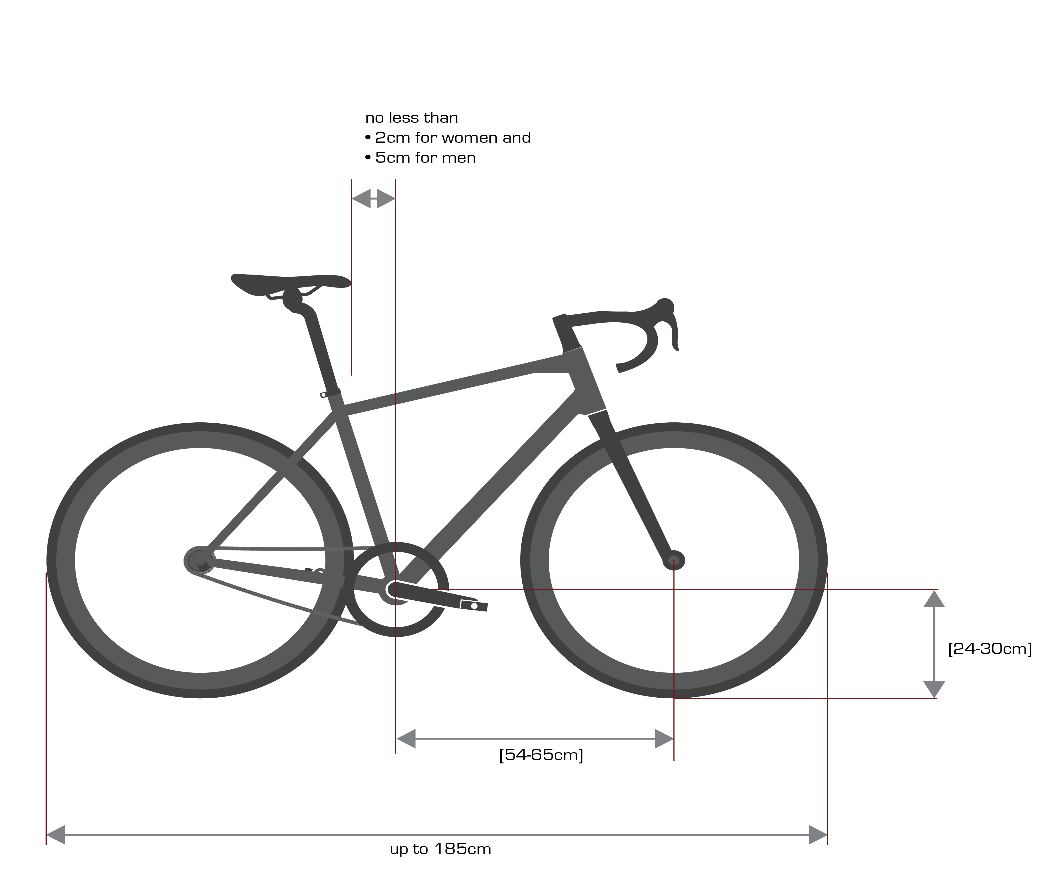
The bike will be no more than 185 cm long, and 50 cm wide;
-
The bike will measure between 24 cm and 30 cm from the ground to the centre of the chain wheel axle;
-
There will be no less than 54 cm and no more than 70 cm between a vertical line passing through the centre of the chain wheel axle and a vertical line through the centre of the front wheel axle;
-
Fairings are prohibited. Any device, added or blended into the structure, that is destined to decrease, or which has the effect of decreasing, resistance to air penetration or artificially to accelerate propulsion, such as a protective screen, fuselage form fairing or the like, shall be prohibited;
-
Bikes provided with the UCI Road Race homologation label (Code RD) are always allowed in World Triathlon draft legal events, even if they contravene any of the previous bullets in this 5.2 c) (i) insert;
-
Bikes provided with the UCl Time Trial homologation label (Code TT) are forbidden unless they comply with the condition listed above.
-
(ii) Saddle position for U23 and Elite events:
-
There will be a vertical line touching the front-most point of the saddle which will be no less than 5 cm for the men, and 2 cm for the women, behind a vertical line passing through the centre of the chain wheel axle, and an athlete must not have the capability of adjusting the saddle beyond these lines during competition;
-
The expected ratios between E (Femur) and E+F (Femur+Tibia) and between F (Tibia) and E+F (Femur+Tibia) is around 56% to 44%. Where the athlete's ratio is nearer to 50/50 an exception will be considered;
-
Exceptions to this rule may be requested 30 days prior to the competition by the National Federation of the athlete to a panel composed of:
-
One person designated by World Triathlon Technical Committee;
-
One person designated by World Triathlon Coaches Committee;
-
One person designated by the World Triathlon Medical and Anti-Doping Committee.
-
Exceptions are valid for four years from the calendar year the request has been made. Following that date, the athlete/National Federation must resubmit the request along with all the supporting documents.
(ill) Non-traditional or unusual bikes:
-
Non-traditional or unusual bikes or equipment shall be illegal unless details have been submitted to the World Triathlon Technical Committee for approval at least 30 days before the Event;
-
Provided all other criteria of the World Triathlon rules are met then full details of the equipment including images must be supplied to the World Triathlon Technical Committee. The procedure is outlined in Appendix P;
-
A catalogue of all previously submitted equipment will be available on the website with confirmation as to whether it has been accepted or rejected. A form is available on the World Triathlon website for athletes wishing to submit equipment for approval.
-
(iv) Logos and race number stickers:
-
Only logos of bicycle related products may appear on the athlete's bicycle;
-
Logos may not interfere with, or hinder the placement of, the bicycle race number on the bicycle frame;
-
The athlete's full name(s) or family name(s) or initial of the first name and family name(s), may appear once on the bike, either on the horizontal bar of the bike or on the shaft of the seat, with a maximum size of 10 cm?;
-
Bike race number stickers, provided by World Triathlon or the Local Organising Committee, must be placed on the bike as instructed, without any alteration.
-
d.) For draft-illegal events, Para Triathlon and Age-Group and draft-legal events:
-
(i) Frames:
-
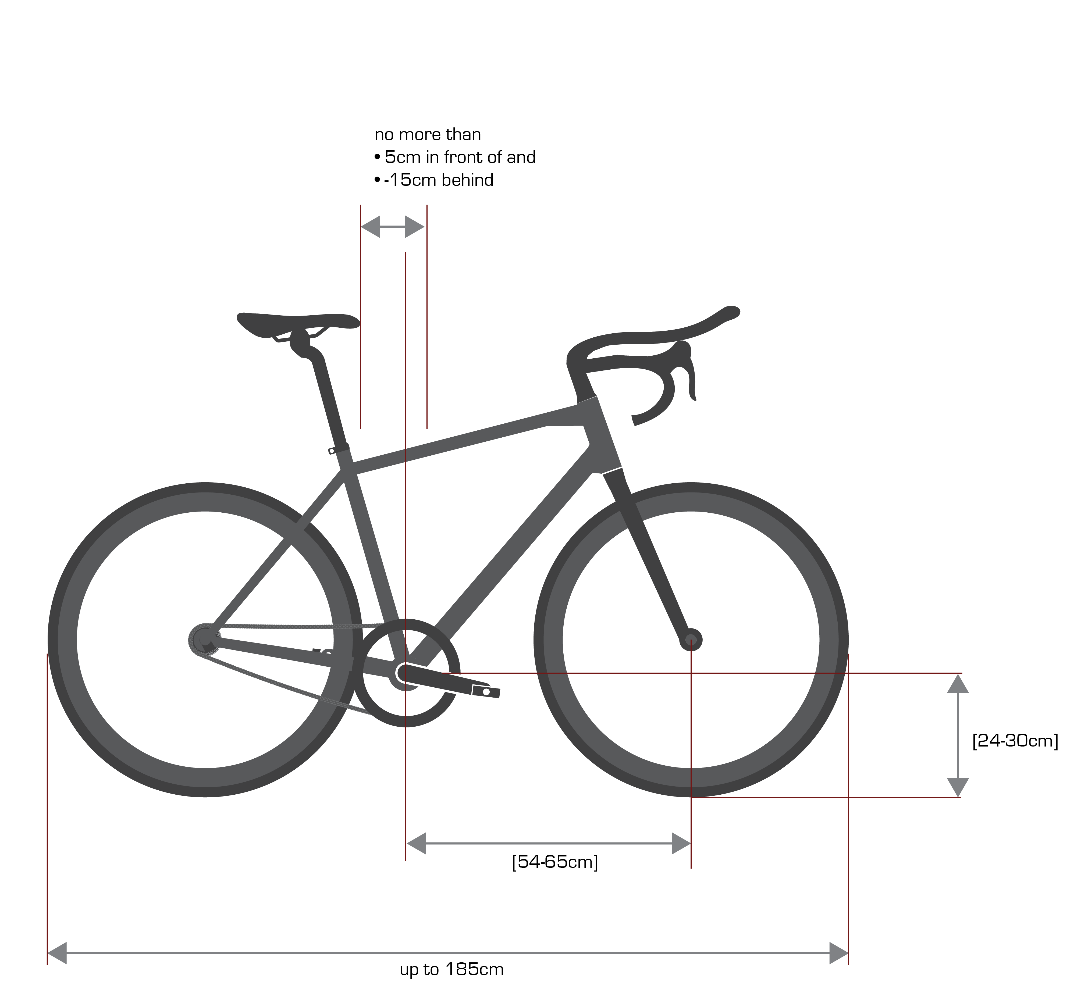
The bike will be no more than 185 cm long, and 50 cm wide;
-
The bike will measure between 24 cm and 30 cm from the ground to the centre of the chain wheel axle;
-
There will be no less than 54 cm and no more than 65 cm between a vertical line passing through the centre of the chain wheel axle and a vertical line through the centre of the front wheel axle;
-
The frame of the bike shall be of a traditional pattern, i.e., built around a closed frame of straight or tapered tubular elements (which may be round, oval, flattened, teardrop shaped or otherwise in cross-section). Bikes built around a diamond shape (no saddle down tube) or with a rear triangle which does not connect at the top of the down tube/top tube section are considered acceptable;
-
Bikes provided with the UCI Time Trial homologation label (Code TT) are always allowed in World Triathlon draft-illegal events, even if they contravene any of the previous bullets in this 5.2 d.) (i) insert.
-
(ii) Saddle-position:
-
There will be a vertical line touching the front-most point of the saddle which will be no more than 5 cm in front of, and no more than 15 cm behind, a vertical line passing through the centre of the chain wheel axle, and an athlete must not have the capability of adjusting the saddle beyond these lines during competition;
-
Non-traditional or unusual bikes:
-
Non-traditional or unusual bikes or equipment shall be illegal unless details have been submitted to the World Triathlon Technical Committee for approval at least 30 days before the Event. Provided all other criteria of the World Triathlon rules are met then full details of the equipment including images
up to 185cm must be supplied to the World Triathlon Technical Committee. The procedure is outlined in Appendix P. A catalogue of all previously submitted equipment will be available on the website with confirmation as to whether it has been accepted or rejected. A form is available on the World Triathlon website for athletes wishing to submit equipment for approval.
(iii) Logos and race number stickers:
- Only logos of bicycle related products may appear on the athlete's bicycle;
- Logos may not interfere with, or hinder the placement of, the bicycle race number on the bicycle frame;
- The athlete's full name(s) or family name(s) or initial of the first name and family name(s), may appear once on the bike, either on the horizontal bar of the bike or on the shaft of the seat, with a maximum size of 10 cm?;
- Bike race number stickers, provided by World Triathlon or the Local Organising Committee, must be placed on the bike as instructed, without any alteration.
e.) Wheels:
-
(i) No wheel may contain any mechanisms, which are capable of accelerating it;
-
(ii) Tubular tyres must be well glued, the levers of the quick releases must be closed tightly onto the hubs and wheels must be fixed properly onto the frame;
-
(iii) There must be a brake on each wheel;
-
(iv) Wheels can be replaced only at official wheel stations, where provided;
-
(v) Technical Officials at the wheel station will give the proper wheel to the athlete. The athlete is responsible for replacing the wheel in the forks. Wheels designated specifically for other athletes or teams cannot be used;
-
(vi) For Elite, U23, Junior and Youth draft-legal competitions, wheels are allowed to be used if they are included in the current UCI approved non-standard wheels lists. (Both list applicable, the one contains wheels approved prior 1st January 2016 and the other after this date.) Wheels not on this list must comply to the following criteria:
-
A diameter between 70 cm maximum and 55 cm minimum, including the tyre;
-
Both wheels must be of equal diameter;
-
Wheels shall have at least 20 metal spokes;
-
The maximum rim dimension (depth) will be 65 mm on each side;
-
The rim must be alloy;
-
All components must be identifiable and commercially available.
-
(vil) For Age-Group draft-legal competitions, wheels must have the following characteristics:
-
Wheels shall have at least 12 spokes;
-
Disc wheels are not allowed.
(vili) For draft-illegal competitions, covers are allowed on the rear wheel. However, this provision may be changed by the Technical Delegate in the interest of safety, i.e. high winds.
f) Handlebars
-
(i) For Elite, U23, Junior and Youth draft-legal competitions, the following handlebar rules will apply:
-
plugged; · Only traditional drop handlebars are permitted. The handlebars must be
-
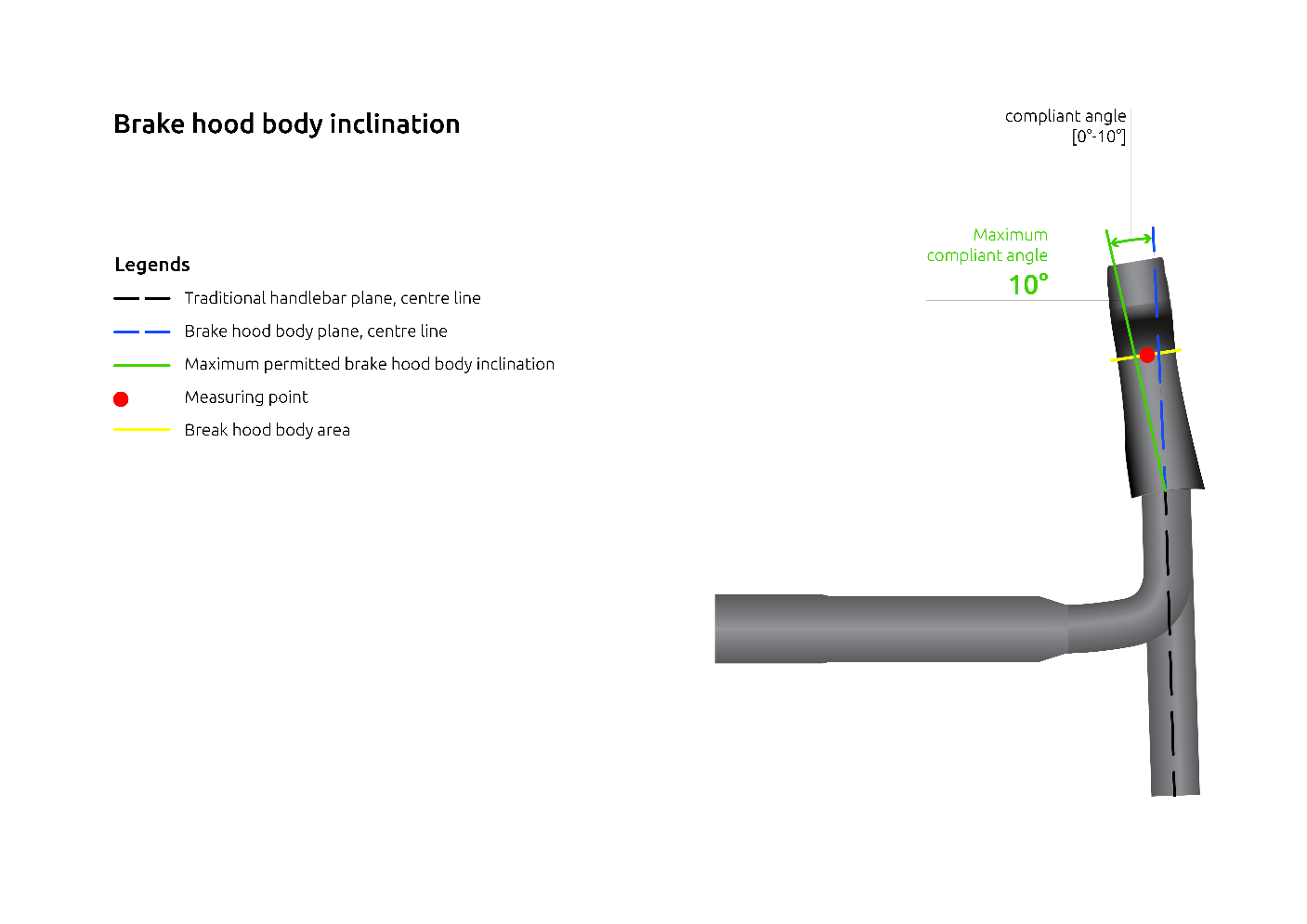
The brake controls attached to the traditional drop handlebars shall consist of two supports with levers. It must be possible to operate the brakes by pulling on the levers with the hands on the lever supports in a safe manner, in accordance with the maximum inclination of 10° of the brake levers as described in the Clarification Guide of the UCI Technical Regulations. Any extension to or reconfiguration of the supports to enable an alternative use is prohibited. A combined system of brake and gear controls is authorised;
-
Water bottles and water bottle holders may not be mounted onto the handlebars;
-
Clip-ons are not allowed.
-
(ii) For Age-Group draft-legal competitions, the following handlebar rules will apply:
-
Only traditional drop handlebars are permitted. The handlebars must be plugged;
-
Clip-ons are not allowed.
-
(iii) For draft-illegal competitions, the following rules on handlebars apply:
-
Only handlebars and clip-on bars not extending beyond the leading edge of the front wheel will be permitted. Clip-on bars in two pieces do not need to be bridged. All tube ends have to be plugged;
-
Water bottles and water bottle holders may be mounted onto the handlebars or clip-on.
-
(iv) There is no limit in the handlebar width.
g.) Helmets:
-
(i) Helmets must be approved by a national accredited testing authority recognised by a National Federation affiliated with World Triathlon;
-
(ii) Helmet must be used in all official activities when the athlete rides the bike: competition, familiarisation and training sessions;
-
(iii) An alteration to any part of the helmet, including the chin strap, or the omission of any part of the helmet, including an outer cloth cover, is prohibited;
-
(iv) The helmet must be securely fastened and fit properly at all times and any garment worn underneath must not affect the fit when the athlete is in possession of the bike. If an athlete moves the bike off the course for any reason, the athlete may not unfasten or remove the helmet until after he/she has moved outside the boundary of the bike course route and has dismounted the bike; and he/she must fasten the helmet securely on the head before returning onto the bike course or before remounting the bike;
-
(v) Helmet race number stickers, provided by World Triathlon or the Local Organising Committee, must be placed on the front and both sides of the helmet, without any alteration. No other stickers are allowed;
-
(vi) There must be a clearance around the official helmet number sticker of 1.5 cm to ensure the number is clearly visible;
-
(Vil) The helmet can be any colour or design;
-
(viii) The helmet shell and any accessories must not extend to cover, obstruct or enclose the athlete's ears. (Looking from the lateral view. Applicable for draft legal races only;
-
(ix) Integrated or detachable visors are not permitted. Helmets must be used without any visor attachments or shield-like accessories. Applicable for draft legal races only.
h) Platform Pedals
- (i) Platform pedals are allowed, provided a quick-release mechanism is fitted to ensure the release of the feet in case of a fall.
i) Disc brakes
- (i) Disc brakes are allowed.
j) Illegal Equipment
-
(i) Illegal equipment includes, but is not limited to:
-
Headphone(s), headsets), technical earplug(s) or smart helmets which are inserted or covering the ears;
-
Glass containers;
-
Mirrors;
-
Bike or parts of the bike not complying with these rules;
-
Uniform not complying with the applicable Guidelines Regarding Authorised Identifications;
-
Water bottles if placed behind the saddle for draft-legal competitions.
-
k.) Any equipment or devices carried during the bike segment or added to the bike are subject to approval by the Head Referee before the competition, must be securely mounted, not endanger any athlete or give unfair advantage;
-
I.) Fairings are prohibited. Fairings are defined as any devices or materials (including duct tape) added, attached, or blended into the structure of the bicycle which have the effect of reducing the resistance to air penetration. Devices or materials (including duct tape) added, attached, or blended into the structure of the bicycle that does not fundamentally alter or enlarge the general shape of the structure, (e.g., to cover valve cut out of the rear disc wheel, to cover bolts access, etc.) are not affected by this rule;
-
m.) Hydration Volume Limitation: Hydration volume (e.g. bottles or hydration systems) mounted to components that rotate around the steering axis (e.g. cockpit extensions, base bar) must have a combined maximum capacity of 2 litres;
-
n.) Rear Mounted hydration systems, (excluding those mounted to the inside the frame triangle bike are limited in size, capacity, dimension and location as set forth below:
-
(i) cannot contain more than two water bottles;
-
(ii) must not exceed 1L capacity per bottle.
-
o.) Specifically, the following items are not allowed:
-
(i) Bottles/hydration or any other objects (excluding nutrition) attached to or inserted in an athlete's race suit;
-
(ii) Any inserts in an athlete's calf sleeves and arm sleeves.
5.3 Bike Check p. 59
- a.) A bike check may include all items listed in 5.2;
- b.) A visual bike check will take place before the athletes access the transition area prior the competition. Technical Officials will check that bikes comply with the World Triathlon Competition Rules;
- c.) Athletes may request approval from the Head Referee after the Athletes' Briefing if their bike is legal;
- d.) Each registered athlete may only check one bike into their transition;
- e.) All athletes must rack their bike before the Transition Area closes. Any athlete unable to do this must inform the Head Referee.
5.4 Overlapping p. 59
- a.) In the draft legal races for Elite, U23, Junior, Youth and Mixed Relay, athletes who have been lapped during the bike segment will be withdrawn from the competition by the Technical Officials. Technical Officials may anticipate this decision, for safety reasons, if the athlete is closer than 100 meters ahead from the leader and the Technical Official is totally sure that the overlapping will happen. This provision can be modified by the Technical Delegate, following the procedure outlined in 1.5.
5.5 Drafting p. 59
a.) General Guidelines:
- (i) There are two kinds of competitions, depending on the allowance of drafting:
- Draft-legal competitions;
- Draft-illegal competitions.
- (ii) The competitions will be draft-legal or illegal according to this table:
| Junior and Youth | U23 | Elite | Age-Group | Para triathlon | |
|---|---|---|---|---|---|
| TRIATHLON | |||||
| Mixed Relay | Legal | Legal | Legal | Legal | Illegal |
| Super Sprint Distance | Legal | Legal | Legal | Illegal | |
| Sprint Distance | Legal | Legal | Legal | Both options | Illegal |
| Standard Distance | Legal | Legal | Illegal | Illegal | |
| Middle and Long Distance | Illegal | Illegal | Illegal |
| DUATHLON | DUATHLON | DUATHLON | DUATHLON | DUATHLON | DUATHLON |
|---|---|---|---|---|---|
| Mixed Relay | Legal | Legal | Legal | Legal | |
| Super Sprint | Legal | Legal | Legal | Illegal | |
| Sprint Distance | Legal | Legal | Legal | Both options | lllegal |
| Standard Distance | Legal | Legal | Illegal | Illegal | |
| Middle and Long Distance | Illegal | Illegal | Illegal | ||
| AQUATHLON | |||||
| WINTER TRIATHLON (all distances) | Legal | Legal | Legal | Legal | Legal |
| CROSS TRIATHLON AND DUATHLON (all distances) | Legal | Legal | Legal | Legal | Legal |
| AQUABIKE | Illegal |
b.) Draft legal events:
- It is forbidden to draft off a different gender athlete;
- (ii) It is forbidden to draft off an athlete being in a different lap;
- (iii) It is forbidden to draft off a motorbike or vehicle.
c.) Draft-Illegal events:
- (i) It is forbidden to draft off another athlete or motor vehicle. Athletes must reject attempts by others to draft;
- (ii) An athlete is entitled to any position on the course, provided they get to that position first and without contacting others. When taking a position, an athlete must allow reasonable space for others to make normal movements without making contact. Adequate space must be available before passing;
- (iii) An athlete who approaches from any position to take advantage of the draft, bears responsibility for avoiding the draft;
- (iv) To draft is to enter the bicycle or vehicle drafting zone:
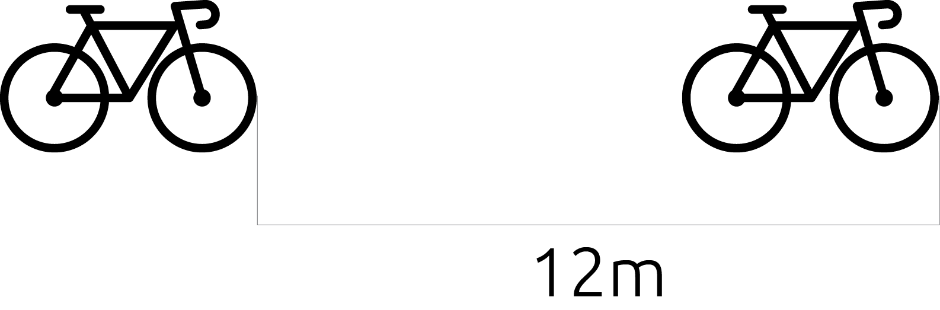
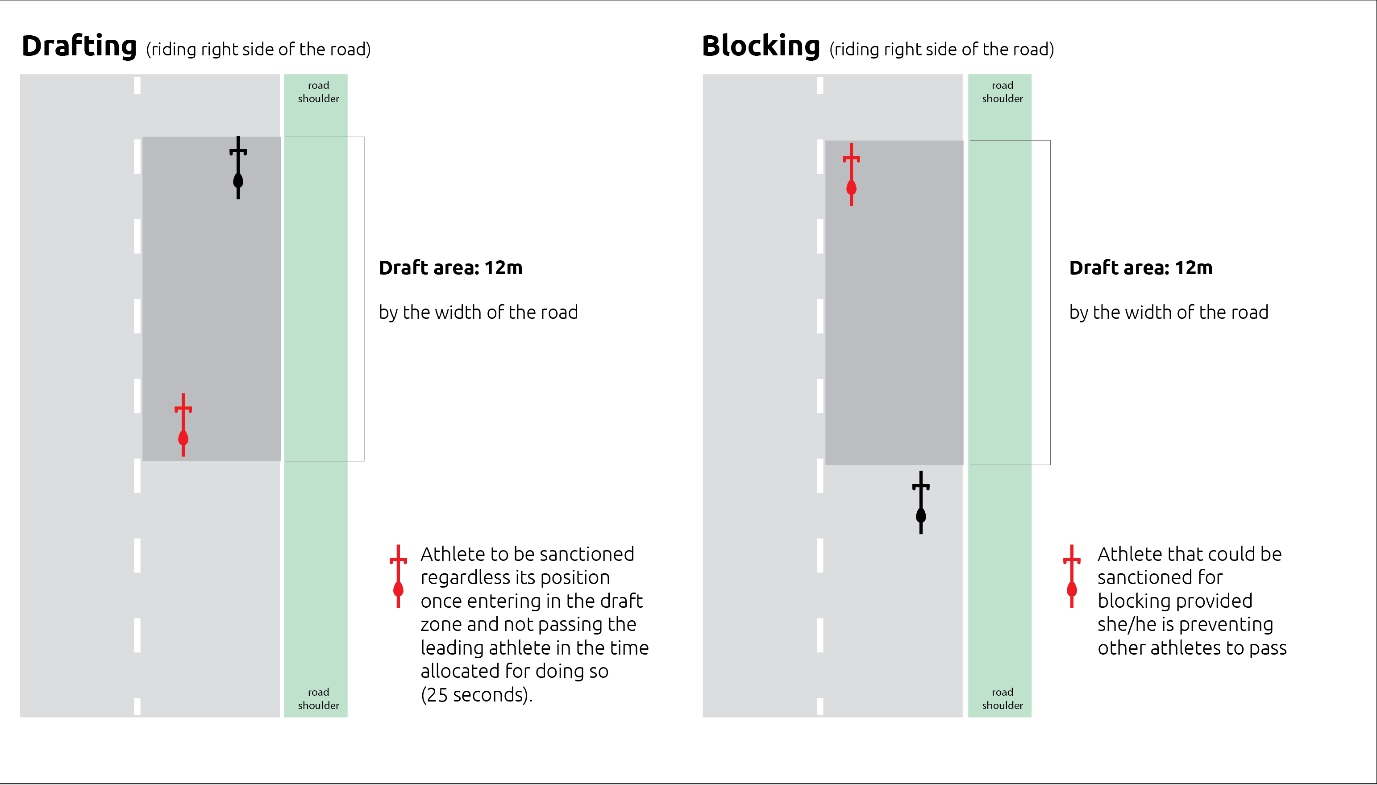
- The bicycle draft zone will be 12 meters long measured from the leading edge of the front wheel. An athlete may enter the draft zone of another athlete but must be seen to be progressing through that zone. A maximum of 25 seconds will be allowed to pass through the zone of another athlete. Several consecutive attempts to overtake with no success may lead to a drafting infringement;
- Motorbike draft zone: the draft zone behind a motorbike will be 20 meters long. This applies also for draft legal events;
- Vehicle draft zone: The draft zone behind a vehicle will be 35 meters long and applies to every vehicle on the bike segment. This applies also for draft legal events.
- (v) Entry into the bicycle drafting zone: An athlete may enter a bike draft zone in the following circumstances:
- For safety reasons;
- If the athlete enters the draft zone, and progresses through it within the allotted time in the overtaking manoeuvre;
- 100 meters before and after an aid station or transition area;
- At an acute turn;
- If the Technical Delegate excludes a section of the course because of narrow lanes, construction, detours, or for other safety reasons.
(vi) Overtaking:
- An athlete is passed when another athlete's front wheel is ahead of theirs;
- An overtaken athlete must drop out of the draft zone of the passing athlete by continuously making rearward progress out of the draft zone of the passing athlete. Re-passing by an overtaken athlete prior to dropping out of the draft zone will result in a drafting violation;
- Overtaken athletes who remain within the draft zone of the passing athlete for more than the allotted time will be given a drafting violation;
- Athletes must keep to the side of the course and not create a blocking incident. Blocking is where an athlete who is behind cannot pass due to the leading athlete being poorly placed on the course;
- The Technical Delegate will instruct the athletes during the briefing on which side they must pass another athlete when mounted on their bicycle.
- (vii) See the diagrams below for events where the right-hand side road rules apply.
5.6 Penalties for drafting p. 62
- a.) It is forbidden to draft in a competition declared as draft-illegal;
- b.) Technical Officials will notify the athletes who draft they are subject to a time penalty. This notification must be clear and unambiguous;
- c.) The athlete sanctioned has to stop in the next penalty box and must stay there for a specific time depending on the competition distance. Drafting time penalties are outlined at 3.3 e.);
- d.) It is the athlete's responsibility to stop in the next penalty box. Failing to stop will result in a disqualification;
- e.) A second drafting offence will lead to a disqualification in standard distance events or shorter;
- f.) The third drafting offence will lead to disqualification for middle- and long-distance events;
- g.) Drafting violations cannot be protested.
5.7 Blocking p. 62
- a.) Athletes must keep to the side of the course and not create a hazard by blocking other athletes on the course. Blocking is where an athlete who is behind an athlete cannot pass due to the leading athlete being poorly placed on the course. Athletes blocking will receive a yellow card to be served at the next bike penalty box.
Illustration for riding on the right side of the road
5.8 Riding positions p. 62
-
a.) The riding position requires that the only points of support are the following: the feet on the pedals, the hands on the handlebars and the seat on the saddle;
-
b.) Additionally, during the draft-illegal races, forearms can be used as a point of support on the handlebar. While arms or elbows are in contact with the handlebar or armrest, hands will grip the clip on;
-
c.) This article does not apply in Cross and Winter races.
Image 1:
Allowed positions in all races:
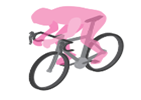
Image 3:
Forbidden positions in all races:

5.9 Wheel Stations p. 63
- a.) Wheel stations are designated locations within the competition course where athletes can replace wheels;
- b.) Three types of wheel stations are available in competitions:
- (i) Neutral Wheel Station: Wheels are provided by the Local Organising Committee (LOC) and are available to all athletes;
- (ii) Team Wheel Station: Wheels are supplied by athletes or their teams and are available only to the designated teams or athletes;
- (iii) Mobile Wheel Station: Wheels are provided by the Local Organising Committee (LOC) and are available to all athletes.
- c.) The following types of wheel stations will be available:
- (i) At Elite, U23, Youth events on Standard and shorter distances on the bike course: at least 1 Neutral Wheel Station and 1 Team Wheel Station;
- (ii) At Para events on the bike course: at least 1 Neutral Wheel Station and 1 Team Wheel Station;
- (iii) At Para events on the run course: at least 1 Team Wheel Station;
Image 2:
Forbidden position in all races (handlebar without clip-on):

- (iv) The Technical Delegate may approve additional wheel stations if required.
- d.) Technical Officials and/or LOC personnel at the wheel stations will distribute wheels to athletes as needed. It is the athlete's responsibility to correctly install the replacement wheel;
- e.) At Para events personal handlers are allowed to assist their athletes with bike repairs, including wheel replacements, but only within the designated wheel station. The Technical Delegate may approve other accredited team staff to assist their athletes with wheel replacements or bike repair at the specific wheel station;
f) Neutral Wheel Station
- (i) The inventory of wheels provided at Neutral Wheel Station are to be approved by the Technical Delegate. The list of provided wheels is to be published at the Athletes' Briefing;
- (ii) The location of the Neutral Wheel Station will be approved by the Technical Delegate and published at the Athletes' Briefing;
- (iii) The Neutral Wheel Station will be marked with a "Wheel Station" sign on the racecourse;
- (iv) There will be a "Wheel Station 200 meters" sign on the racecourse, 200 m before the specific wheel station;
- (v) The servicing follows the "first come first served" principle.
g) Team Wheel Station
-
(i) Teams may supply wheels in advance, ensuring they meet competition standards;
-
(i) The collection of wheels will happen according to the instructions provided at the Athletes' Briefing;
-
(iii) The location of the Team Wheel Station will be approved by the Technical Delegate and published at the Athletes' Briefing;
-
(iv) The Team Wheel Station will be marked with a "Wheel Station" sign on the racecourse;
-
(v) There will be a "Team Wheel Station 200 meters" sign on the racecourse, 200 m before the specific wheel station;
-
(vi) Only dedicated teams or athletes can use the provided wheels;
-
(vii) Teams or athletes must ensure that their wheels are clearly marked with identifiers as specified in the Athletes' Briefing;
-
(vili) The team or athletes is responsible for the readiness and condition of the wheels.
-
h. Mobile Wheel Station:
- (i) The inventory of wheels provided at Neutral Wheel Station are to be approved by the Technical Delegate. The list of provided wheels is to be published at the Athletes' Briefing;
- (ii) The way of operation the Mobile Wheel Station are to be approved by the Technical Delegate. Information regarding its operation is to be published at the Athletes' Briefing;
- (iii) The servicing follows the "first come first served" principle.
- i.) In case of a wheel replacement the original (replaced) wheel must be left at the wheel station. Not adhering this rule may lead to disqualification.