Chapter 1: Introduction
1.1Purposep. 10
- a.) World Triathlon is the sole governing body, responsible for the Competition Rules for Triathlon, Duathlon and its other related multisports. The complete list of sports under the jurisdiction of World Triathlon is included as Appendix I;
- b.) The World Triathlon Technical Committee (World Triathlon TC) will ensure technical aspects of World Triathlon competitions are of the highest quality;
- c.) The World Triathlon Competition Rules specify the conduct and behaviour of athletes during World Triathlon competitions. Where the World Triathlon Competition Rules do not specify, the rules of International Swimming Federation (FINA), International Cycling Union (UCI), World Athletics (WA), International Ski and Snowboard Federation (FIS), IPC Para Swimming, IPC Para Athletics and IPC Para Nordic Skiing will apply in their specific segments, unless World Triathlon Technical Committee decides otherwise;
- d.) The World Triathlon Event Organisers' Manual (EOM) and its related documents set safety and logistical standards for host National Federations (NFs) and for the Local Organising Committees (LOCS);
- e.) The World Triathlon Technical Officials' Certification Programme sets the standards for certifying World Triathlon Technical Officials;
- f.) It will be clearly indicated when a rule applies to a specific competition.
1.2Intentionp. 10
- a.) The World Triathlon Competition Rules are intended to:
- (i) Create an atmosphere of sportsmanship, equality, and fair play;
- (ii) Provide safety and protection;
- (iii) Emphasise ingenuity and skill without unduly limiting the athlete's freedom of action;
- (iv) Penalise athletes who gain an unfair advantage.
- b.) Definitions of all terms used in the World Triathlon Competition Rules are provided in Appendix D. Any difficulty in the interpretation or application of the World Triathlon Competition Rules should be referred to the World Triathlon Technical Committee.
1.3Language and Communicationp. 10
- a.) The official language of World Triathlon Events is English:
- (i) National Federations are responsible for providing translation services from/to English for their own athletes;
- (ii) Local Organising Committees will communicate at least in English, even if another language is used in parallel.
1.4Modificationsp. 11
- a.) The World Triathlon Competition Rules will be adapted for other modern multisport competitions, which fall within World Triathlon's jurisdiction;
- b.) An athlete must not be permitted an advantage not intended by a rule, or to conduct him/herself in a dangerous way. To implement this, every infringement related in the World Triathlon Competition Rules has a sanction attached. Technical Officials base their judgments on whether an advantage, not intended by the Rules, has been gained;
- c.) World Triathlon Competition Rules will be applicable to international competitions hosted by National Federations affiliated with World Triathlon.
1.5Exceptionsp. 11
- a.) The World Triathlon Competition Rules will be applicable to all events sanctioned by World Triathlon and are to be implemented by the appointed Technical Delegate as appropriate. Where the World Triathlon Competition Rules conflict with the laws of the jurisdiction in which the event is to be held, the World Triathlon Competition Rules will override the laws of the jurisdiction to the extent of the inconsistency. Athletes must be notified of the implications of these laws as early as possible and not later than prior to the start of the event;
- b.) Exceptions for special circumstances in a particular event may only be gained from World Triathlon with prior approval. A request for an exception to the World Triathlon Competition Rules must be made in writing 30 days prior to the event to the World Triathlon Technical Committee through by assigned Technical Delegate;
- c.) Exceptions for special circumstances in a particular athlete may only be gained from World Triathlon with prior approval. A request for an exception to the World Triathlon Competition Rules must be made in writing 30 days prior to the event to the World Triathlon Technical Committee by the assigned Technical Delegate from the National Federation to whom the application has been submitted or is being submitted;
- d.) The World Triathlon Technical Committee may consult with other World Triathlon committees, commissions or appropriate parties;
- e.) For any rule exceptions related to events sanctioned by World Triathlon, but not run within the competition system of World Triathlon or any of the Continental Confederations, a permanent panel will be created with one representative from each of the three parties: World Triathlon Technical Committee, World Triathlon Staff, Event Rights Holder. The final proposal from the panel will go to the World Triathlon Technical Committee for endorsement.
1.6Specific Regulationsp. 11
-
a.) A Technical Delegate may approve the addition of specific regulations for a particular competition, provided that:
-
(i) Each additional specific regulation does not conflict with another World Triathlon Competition Rules;
-
(ii) Each additional specific regulation is made available in written form and is announced at the athletes' briefing; and
-
(iii) Each additional specific regulation and the reasons for its inclusion are advised to the World Triathlon Technical Committee one week before the day on which the event is to be conducted. The World Triathlon Technical Committee may invalidate the incorporation of an additional specific regulation only on the authority of the World Triathlon Executive Board.
1.7Intellectual Propertyp. 12
- a.) World Triathlon Events are the exclusive property of World Triathlon, which owns all rights associated including, without limitation, the rights to organise, exploit, broadcast and reproduce World Triathlon Events. These rights include any type of digital media, whether that be photographic or video in nature, captured from within the boundaries of the field of play, regardless of ownership of the capturing device. All the personal data from the athlete entered into any World Triathlon event and the data produced from the event, including the results are exclusive property of World Triathlon.
1.8Unauthorised Exceptions or Additionsp. 12
- a.) The unauthorised exception to, or addition of, a competition rule will prevent an event from being sanctioned and will invalidate a sanction, which has already been granted to an event. This could result in legal complications, particularly in the case of accidents during the event and in subsequent requests for approval from National Federations and/or municipal authorities to use roads and waterways. Insurance authorities have also warned that claims made under such circumstances may be considered invalid.
1.9Rule Updatesp. 12
- a.) The World Triathlon Competition Rules may be changed from time to time by the World Triathlon Technical Committee at its discretion, with the approval of the World Triathlon Executive Board. Any rule change(s) shall be advised in writing to affiliated National Federations at least 30 days before it/they is/are to take effect unless the World Triathlon Executive Board decides otherwise. Updated World Triathlon Competition Rules will be posted on the World Triathlon website (www.triathlon.org).
Chapter 2: Conduct Of Athletes
2.1General Conductp. 13
- a.) Triathlon and World Triathlon's other related multisports involve many athletes. Competition tactics are part of the interaction between athletes. Athletes will:
- (i) Practice good sportsmanship at all times;
- (ii) Be responsible for their own safety and the safety of others;
- (iii) Know, understand and follow the World Triathlon Competition Rules, available from their National Federations and on www.triathlon.org;
- (iv) Obey local traffic regulations and instructions from race officials;
- (V) Treat other athletes, race officials, volunteers, and spectators with respect and courtesy;
- (vi) Avoid the use of abusive language;
- (vii) Inform a Technical Official after withdrawing from the competition. Failing to do this may result in a suspension;
- (viii) Compete without receiving assistance other than from event personnel and race officials as outlined in 2.2;
- (ix) Avoid using ambush marketing;
- (x) Avoid displaying any kind of demonstration of political, religious or racial propaganda;
On-Course Behavior
-
(xi) Intentionally not dispose of rubbish or equipment around the course except at clearly identified places, such as aid stations, littering areas or rubbish disposal points. All items must be kept with the athlete and returned to their transition spot;
-
(xii) Not attempt to gain an unfair advantage from any external vehicle or object;
-
(xili) Follow the prescribed course; Exceptions will be applied:
-
When it happens because of safety reasons if advantage is not gained;
-
When it happens following the instructions of a Technical Official;
-
When it happens accidentally if advantage is not gained.
-
(xiv) Not use any device that will distract the athlete from paying full attention to their surroundings:
-
Athletes may not use communication devices of any type, including but not limited to cell phones, smart watches, and two-way radios, in any distractive manner during the competition. A "distractive manner" includes but is not limited to making or receiving phone calls, sending or receiving text messages, playing music, using social media, taking photographs or using in a one- or two-way radio communication. Using any communication device in this manner during the competition will result in disqualification;
-
Cameras, phone cameras, and video cameras are prohibited unless permission is given by the World Triathlon or the licence holder of the event. If such permission is given, it is the athlete's responsibility to obtain permission by the Head Referee of such permission prior to the start of the competition. Athletes seen with an unauthorised camera, phone camera, or video camera will be disqualified.
-
(xv) Ensure that the equipment to be used in the race complies with the safety standards and it is in proper condition;
(xvi) Not modify any equipment of the competition set up.
2.2Outside assistancep. 14
- a.) The assistance provided by event personnel or Technical Officials is allowed but is limited to providing drinks, nutrition, mechanical and medical assistance, upon the approval of the Technical Delegate or Head Referee. The Head Referee may authorise the accredited team support to repair flat tyres or replace wheel(s) if the incident happens before the first athlete arrives at Transition 1. Athletes competing in the same competition may assist each other with incidental items such as, but not restricted to, nutrition and drinks after an aid station, pumps, tubular tyres, inner tubes and puncture repair kits. Exceptions for Para Triathlon events are listed in 17.7 c);
- b.) Athletes may not provide essential race equipment to other athletes in the same competition, while the competition is in progress. Specifically, items that may not be provided to other athletes includes but is not limited to complete bicycles, bicycle frames, wheels and helmets. The penalty for this will be disqualification of both athletes. Athletes may provide to other athletes competing in the same competition other items of equipment provided that the donor is able to continue with their own competition;
- c.) An athlete cannot physically assist the forward progress of another athlete on any part of the course. This will result in the athlete being disqualified. If the athlete receiving this assistance accepts this help (and/or is not actively trying to avoid this assistance) will be disqualified.
2.3Drug Abusep. 14
- a.) Athletes and guides will follow the World Triathlon Anti-Doping Rules;
- b.) All athletes and guides are responsible for familiarising themselves with the World Triathlon Anti-Doping Rules including medical and doping control tests, testing obligations, rights, responsibilities and procedures, penalties and appeal processes, and prohibited substances and methods. Athletes, guides and coaches can be entered in an event only after the successful completion of the specific anti-doping education module. This obligation is not applicable to Age-Group athletes;
- c.) World Triathlon has implemented the World Triathlon Anti-Doping Rules and abides by rules set by the World Anti-Doping Agency (WADA) Code.
2.4Healthp. 15
- a.) Triathlons and World Triathlon's other related multisports are strenuous. To be able to compete, athletes should be in excellent physical condition. Their health and welfare is of paramount importance. By starting in a competition, the athletes declare they are in good health and are in appropriate physical condition to complete the competition;
- b.) World Triathlon encourages all the Age-Group athletes and Technical Officials to undergo a periodic health evaluation (PHE) and to undergo a pre-participation evaluation (PPE) prior to engaging in competitive sport. An annual PPE is mandatory for all athletes competing in Youth, Junior, U23, Elite and Para triathlon events, in any World Triathlon event as outlined in Appendix J. More information about PPE can be found in Appendix Q.
2.5Eligibilityp. 15
- a.) All athletes must be in good standing with their National Federations. To ensure this, for World Triathlon and Continental Confederation events, all the entries must be done by the National Federations, not by the athletes themselves;
- b.) Athletes under suspension are not allowed to compete in any World Triathlon event, in any competition sanctioned by World Triathlon members, or in any competition held under the World Triathlon Rules;
- c.) An athlete's age is determined by their age on December 31st in the year of competition;
- d.) Athletes aged 15 to 17 years old are eligible to compete in the Youth category;
- e.) Athletes aged 16 to 19 years old are eligible to compete in the Junior category;
- f.) Athletes aged 18 to 23 years old are eligible to compete in the U23 category;
- g.) The minimum ages to be admitted in the competitions are determined by the distance of the event and by the category of the event as indicated in the chart below:
| Category | Distance | Elite program | u23 program | Junior program | Youth program |
|---|---|---|---|---|---|
| World Triathlon Championship Finals | Standard | 18+ | 18-23 | 16-19 (Sprint)| | n/a |
| World Triathlon Championship Series | Standard | 18+ | n/a | n/a | n/a |
 |
|||||
| World Triathlon Championship Series | Sprint | 18+ | n/a | n/a | n/a |
| --- | --- | --- | --- | --- | --- |
| World Triathlon Championship Series | Sp-sprint | 18+ | n/a | n/a | n/a |
| World Triathlon Championship Series | Eliminator | 18+ | n/a | n/a | n/a |
| World Triathlon Cup | Standard | 18+ | n/a | n/a | n/a |
| World Triathlon Cup | Sprint | 17+ | n/a | n/a | n/a |
| World Triathlon Cup | Sp-sprint | 17+ | n/a | n/a | n/a |
| World Triathlon Cup | Eliminator | 17+ | n/a | n/a | n/a |
| Continental Triathlon Cup | Standard | 18+ | n/a | n/a | n/a |
| Continental Triathlon Cup | Sprint | 16+ | n/a | 16-19 | n/a |
| Continental Triathlon Cup | Sp-sprint | 16+ | n/a | 15-19 | n/a |
| Continental Triathlon Cup | Eliminator | 16+ | n/a | n/a | n/a |
| Development Regional Cup | Sprint | 16+ | n/a | n/a | n/a |
| Supertri E Championships | Sp-sprint | 17+ | n/a | n/a | n/a |
| Continental Triathlon Championships | Standard | 18+ | 18-23 | n/a | n/a |
| Continental Triathlon Championships | Sprint | 18+ | 18-23 | 16-19 | n/a |
| Continental Triathlon Championships | Sp-sprint | 18+ | 18-23 | 16-19 | 15-17 |
| T100 World Tour | Middle | 18+ | n/a | n/a | n/a |
| Mixed Relay World Championships | Sp-sprint | 16+ | 16+ | 16-23 | n/a |
| Mixed Relay Series | Sp-sprint | 16+ | n/a | n/a | n/a |
- h.) An athlete acquires the condition of elite for the same calendar year once is being entered in an elite program of a World Triathlon event of the categories listed below:
- (i) World Championships;
- (il) World Championships Series;
- (iil) World Championships Finals;
- (iv) World Series;
- (v) World Cup
- (vi) T100.
The elite condition is associated to the multisports) of the event the athlete has been entered.
Elite athletes are not allowed be guides and/or to compete in Age-Group events in the same calendar year and in the same Multisport in which they have gained the condition of elite;
-
i.) Athletes will be eligible to compete in the individual Age-Group events in the group in which their age is included. The groups are:
-
(i) 15 to 19 in super sprint distance events (N15)/(F15);
-
(ii) 16 to 19 in sprint distance events (N16)/(F16);
-
(iii) 18 to 19 in standard and longer distance events (N18)/(F18);
-
(iv) 20 to 24 (N20)/(F20);
-
(v) 25 to 29 (N25)/(F25);
-
(vi) 30 to 34 (N30)/(F30);
-
(vii) Etc.
-
j. The different qualification criteria can be found in the World Triathlon Qualification Criteria and published in www.triathlon.org;
-
k.) Specific qualification criteria affecting Major Games and Recognised Games are published in www.triathlon.org;
-
1.) Specific qualification criteria affecting events sanctioned by World Triathlon, but not part of the World Triathlon events structure, are published in the respective website of such events;
-
m.) Athletes may not compete within 24 hours at the same or different World Triathlon event in more than one triathlon or multisport competition (see Appendix I) when one competition is of standard distance or longer. The 24 hours is considered from the start of the race till the start of the other race the following day. Exceptions will be for the mixed relay events at the defined super-sprint distances (see 16.1.a.), PTVI1, PTVI2 and PTVI3 guides and aquathlon;
-
n.) Age limits: Athletes must be a minimum age to compete in any event, as outlined in Appendix A. Continental Confederations may add other age limits for Continental Championships, for youth and younger categories with super-sprint events. The age limits as outlined in Appendix A cannot be modified;
-
o.) An athlete who competes in a category different from his/her age, in a distance in which it is not allowed, or before the 24-hour period, will be disqualified from the events he/she took part in. Any awards, prizes and points will be removed;
-
p.) Eligibility of athletes to the male, female or open races are subject to the criteria determined in the documents:
-
(ii) World Triathlon Eligibility Regulations for Transgender Athletes; and
-
q.) Athletes who are competing under the World Triathlon flag will be entered in the competition by the National Federation the athlete is moving to. They will compete with the same rights as any other athlete in terms of awards, prizes and points.
2.6Insurancep. 18
- a.) All athletes competing in events must have personal insurance coverage guaranteed by their National Federation. This insurance will cover:
- (i) Any accident occurring on the days and at the location of the competitions, official trainings (listed in the official schedule of the event), official course familiarisations, briefings, opening and closing ceremonies;
- (ii) Liability caused by an athlete during the competition.
- b.) The athlete's National Federation guarantees the existence of the insurance coverage mentioned in this article by entering or confirming an athlete in an event;
- c.) Local Organising Committees or National Federations organising an event cannot force the athletes to pay for an insurance coverage mentioned in this article.
2.7Registrationp. 18
a) Entry
- (i) National Federations will register their athletes for World Triathlon Events following their National Federation qualification system or other World Triathlon approved qualification system;
- (ii) All athletes qualify to any World Triathlon Event as outlined in Appendix J, by the eligibility rules outlined in 2.5 and by the qualification criteria outlined in Appendices E;
- (il) Prior to competing in World Triathlon Championships, World Triathlon Cups, World Triathlon Championship Series events, World Triathlon Para Series, World Triathlon Para Cups and World Triathlon Multisport Championships, Elite, U23, Junior athletes and Para triathletes must sign the World Triathlon Athletes' Agreement, which states that any dispute arising from the World Triathlon Rules that cannot be settled by its
- existing protests and appeals procedure, shall be settled finally by the Court of Arbitration for Sport (CAS) . Once signed, the World Triathlon Athletes' Agreement is valid until the end of the competition year it has been signed in. The Athletes' Agreement is published on www.triathlon.org;
- (iv) National Federations are responsible for entering their athletes, coaches and support team for all World Triathlon Events using the World Triathlon online system on www.triathlon.org. World Triathlon may authorise the use of different entry system provided that National Federations endorse the participation of the athletes entered. Quotas and timelines are indicated in:
- Athletes: The qualification criteria for the specific event;
- Support team: Point 10.9 of these Competition Rules.
b.) Pre-Race Briefings:
-
(i) Coaches' Meeting: If a coaches' meeting is scheduled, it will take place one hour before the Athletes' Briefing. The Technical Delegate will conduct the Coaches' Meeting. The agenda will include the announcement of the Competition Jury and all the technical details of the event as well as specific information for coaches. Coaches' accreditations will be distributed at this meeting, or if the Coaches' Meeting is not scheduled, accreditations will be distributed at the end of the Elite/U23/Junior/Youth Athletes' Briefing;
-
(ii) Age-Group Team Managers' and Coaches' Briefing: At World Championships and at Continental Championships (if applicable), the Technical Delegate will conduct the Age-Group Team Managers' and Coaches' briefing. Only Age-Group Team Managers and Coaches registered on www.triathlon.org are allowed to attend. The agenda of this briefing will include the announcement of the Competition Jury and all the necessary information for the event;
-
(iii) Para triathlon Coaches' Meeting: If a Para triathlon Coaches' Meeting is scheduled, it will take place before the Para triathlon Briefing. The Technical Delegate will conduct it and the agenda will include the announcement of the Competition Jury and all technical details of the event as well as the specific information on para triathlon procedures. Coaches' accreditations will be distributed at this meeting, or if the Team Managers' Meeting is not scheduled, accreditations will be distributed at the end of the Para triathletes' Briefing;
-
(iv) Elite/U23/Junior/Youth/Para triathletes Briefings: At all World Triathlon Events, the Technical Delegate will conduct the Athletes' Briefing. Elite/U23/Junior/Youth athletes and Para triathletes including their Handlers/Guides must be in attendance. Coaches may also attend the briefing. The following penalties apply to athletes who miss the briefing:
-
Athletes / Para triathletes including their Handlers/Guides not attending the briefing, without informing the Technical Delegate about their absence, will be removed from the start list;
-
Athletes / Para triathletes including their Handlers/Guides entering the briefing hall after the briefing has started and athletes not attending the briefing, but who have informed the Technical Delegate about their absence, will receive a time penalty to be served in Transition 1. The time penalty applicable for the specific distance is laid out in section 3.3.e.)(ii);
-
Penalties applied to athletes missing the briefing due to force majeure and informed the Technical Delegate about their absence by the time of the briefing, may be removed if HR and CJ agree on this. If the penalty remains athlete may file a protest against the Head Referee's decision on the time penalty the latest 2 hours before their competition starts;
-
For the World Triathlon Championship Series, World Triathlon Cup events, World Triathlon Para Series or World Triathlon Para Cup events, if an athlete
-
is penalized for missing more than two briefings in a calendar year, they will be removed from the start list for the third missed briefing and each missed briefing thereafter, even if they informed the Technical Delegate in advance.
-
(v) Mixed relay briefing: At all World Triathlon Mixed Relay Events, the Technical Delegate will conduct the Athletes' Briefing. It may be together with the individual event briefing or a separate one. One athlete or a coach or any other accredited member of the delegation support crew for this event from each team must be in attendance. The following penalties apply to teams without representant attending the briefing:
-
Teams not attending the briefing, without informing the Technical Delegate about their absence, will be removed from the start list;
-
Team representatives entering the briefing hall after the briefing has started and team representatives not attending the briefing, but who have informed the Technical Delegate about their absence, will receive a 10 second time penalty to be served in Transition 1 of the first leg.
-
(vi) Athlete/Para triathletes, their Handler, Guides, Coaches and Team Medical must register prior to entering the briefing venue;
-
(vii) For all World Triathlon or Continental Elite events, the briefing will take place at 16.00 one (1) day before the first competition day. In case of 2 briefings the first one start at 16.00 the day before the competition;
-
(vili) For all other World Triathlon or Continental events (U23, Junior, Youth, Para triathlon, Mixed Relay), the briefing will take place one (1) day before the first competition day of the related event and category;
-
(ix) Alteration to any of the times above should be announced on the World Triathlon website 45 days in advance;
-
(x) The pre-race briefings are not open to the media.
c) Packet Pick-Up
- (i) All World Triathlon Events - Age-Group:
- All athletes must provide picture ID at registration/packet pick-up prior to competition. All support team accredited must provide picture ID to receive the accreditation;
- All athletes must pick up their own race packet at the official competition registration area during a designated time. Packet pick-up will be opened on two (2) separate days, starting from 3 days prior to their competition. The hours shall be from 09:00 to 19:00. If a National Federation is unable to make the designated registration time, they must request a different time at least 14 days in advance, in writing to World Triathlon;
- The race packets will contain a minimum of: five (5) official race numbers (one (1) bib number, one (1) bicycle sticker number and three (3) helmet stickers) and four (4) safety pins, numbered swim cap, 4 body tattoo for both
arms and legs or alternative body marking, 1 category body decal for the calf or alternative body marking, timing chip, accreditation pass, tickets for all of the social functions. Local Organising Committee gifts may be distributed at the same time.
- (i) All World Triathlon Events - Elite, U23, Junior, Youth and Para triathlon competitions:
- All athletes and para triathletes must provide picture ID at registration/packet pick-up prior to competition. All support team accredited must provide picture ID to receive the accreditation;
- All athletes will pick up their own race packet at Registration following the Athletes' Briefing;
- The race packet will include: three (3) helmet numbers, one (1) bike number, body decals for both arms and both legs, accreditation pass, athletes' guide, tickets for all of the social functions. Local Organising Committee gifts may be distributed at the same time. When applicable one (1) bib number will also be included in the race packet.
d.) Check-in:
- (i) Age-Group competitions with more than 700 athletes entered will schedule the Checkin the day before the competition. Age-Group events with fewer athletes, and Elite, U23, Junior, Youth and Para triathlon will have the bike check on same day;
- (ii) Technical Officials will conduct the check-in at the athletes' lounge or at the transition area and will include the following:
- Distribution of the swim caps and timing chips (except for the Age-Group events);
- Control of the athletes' uniform, which must comply with the World Triathlon Guidelines Regarding Authorised Identification published on www.triathlon.org. Each uniform should be photographed. If an athlete needs to replace the uniform, this process has to be done again;
- The bike check is regulated under section 5.3;
- Distribution of the race packets to the athletes who missed the briefing.
- (iii) Athletes may be prevented from racing in case not respecting the check-in times.
2.8Uniformp. 21
-
a.) All athletes competing in World Triathlon Events are required to wear their uniform conforming to the World Triathlon Guidelines Regarding Authorised Identification;
-
b.) The World Triathlon Guidelines Regarding Authorised Identification set the space limitation on the athletes' uniforms to include commercial logos;
-
c.) Athletes must follow the following rules with respect to wearing uniforms:
-
(i) Athletes must wear the uniform during the entire competition and award ceremony. Long sleeves and long pants are allowed for the award ceremony;
-
(ii) The uniform must cover the whole torso in the front. The back may be uncovered from the waist up;
-
(ill) Sleeves:
-
All athletes and para triathletes may wear uniforms with sleeves that extend to above the elbow and not covering the elbow in any distance competition.
-
(iv) Arm covers or long sleeves may be used, only if TD approves;
-
(v) Covering the legs below the knees is not allowed in the swim segment when the use of wetsuits is forbidden;
-
(vi) Long sleeves and long pants are allowed in Winter Triathlon events;
-
(vii) A one-piece uniform is preferred. If a two-piece uniform is used, both pieces must overlap and no torso must be visible during the entire competition, except middle- and long-distance events where the midriff is allowed to be exposed;
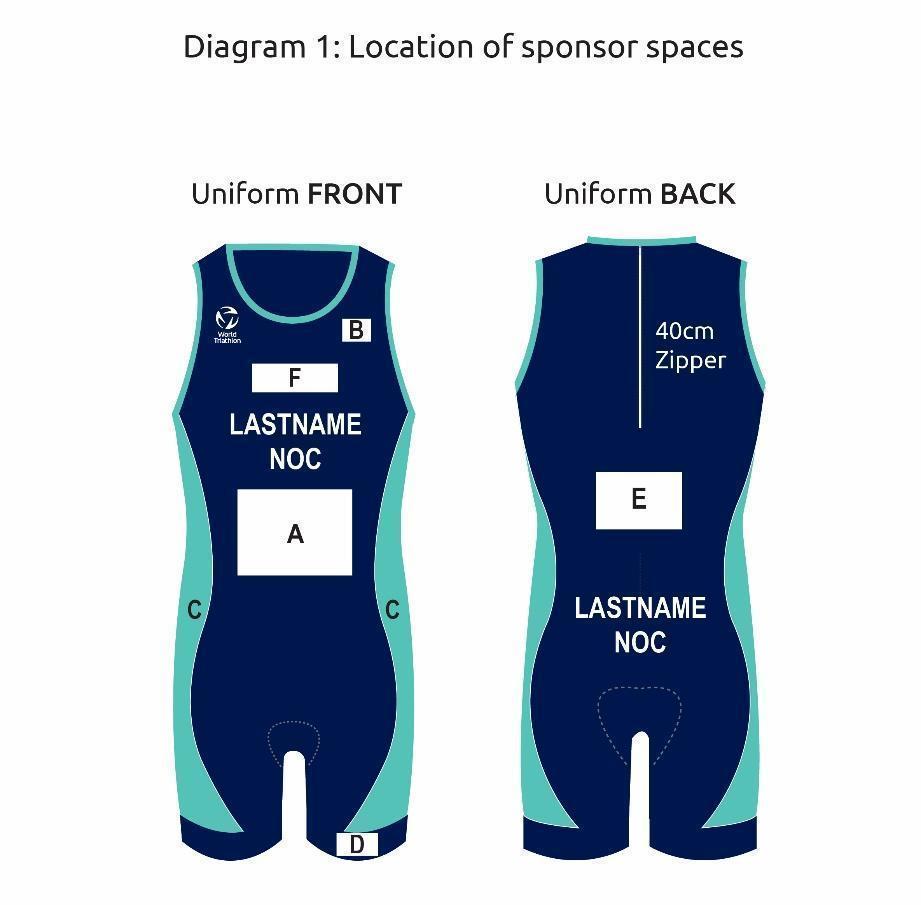
(vili) Zipper:
- Age-Group athletes and Para athletes may wear uniforms without zipper or with zipper located either at the front or at the back. Front zipper can be undone to any length, provided, that (i) the zipper should be connected at the bottom of the uniform at all times, and (ii) the top of the uniform should cover the shoulders at all times; The uniform should be fully zipped in the last 100 metres before the finish line, when it needs to be zipped up;
- Elite, U23 and Junior athletes may wear uniforms without zipper or with zipper located either at the front or at the back in all middle- and longdistance triathlon events and in all distances of the rest of multisport events. Front zipper can be undone any length, provided, that (i) the zipper should be connected at the bottom of the uniform at all times, and (i) the top of the uniform should cover the shoulders at all times; The uniform should be fully zipped in the last 100 metres before the finish line, when it needs to be zipped up;
- Elite, U23, Junior and Youth athletes may wear uniforms without zipper or with zipper located at the back which will not be longer than 40 cm in standard and shorter distances triathlon events.
| Category | Short and no sleeve | Short and no sleeve |
|---|---|---|
| Category | Back zipper allowed | Front zipper allowed |
| Elite | all events | all other multisport |
| U23 | all events | all other multisport |
| Junior | all events | all other multisport |
| Youth | all events | all other multisport |
| Para | all events | all events |
| Age-Group | all events | all events |
(*) All other multisport: aquabike, aquathlon, cross duathlon, cross triathlon, duathlon, long distance triathlon, long distance duathlon and winter triathlon are included within those as per Appendix I.
- (ix) The uniform must be worn over both shoulders while the athlete is on the Field of Play;
- (x) Elite, U23, Junior, Youth and Para triathlon athletes must wear the same uniform from the start to the finish in standard distance or shorter events;
- (xi) Rain jackets are allowed for middle- and long-distance events or when the Technical Delegate authorises it. Rain jackets must be the same design and colour as the uniform or transparent;
- (xii) Failure to comply with the World Triathlon Competition Rules related to the uniform may result in an athlete having to wear a triathlon suit supplied by World Triathlon. Alternatively, Technical Officials may request the athlete use a permanent marker or other means to eradicate logos on the uniform that do not comply with the Competition Rules. If during the competition or the award ceremony, an athlete wears a uniform with logos that do not comply with the Competition Rules (including the World Triathlon Guidelines Regarding Authorised Identification), he/she will be disqualified.
- d.) For reasons of religion, athletes are allowed to have the body totally covered (except the face) provided that:
- (i) The uniform material is approved by FINA (applicable only for the non-wetsuit swim);
- (ii) The uniform will not interfere with the bicycle mechanisms;
- (iii) Extra identification elements are to be worn over the uniform, following the Technical Delegate's instructions.
- e.) Technical Delegate, after consultation to the Medical Delegate or Events Advisory Group, may authorise individual or exceptional deviations from the rules above for safety or healthy reasons. (i.e. skin cancer), however hands will be uncovered during the swim segment without exception.
2.9Race numbersp. 23
-
alteration; a.) Any numbering item will be used without alterations unless Head Referee approves the
-
b.) Elite, U23, Junior and Youth athletes will not wear bib numbers, however when, due to the competition schedule they are mixed with Age-Group athletes Technical Delegate can decide on making the use of the bib numbers mandatory for all the athletes;
c) Bib numbers
- (i) Age-Group:
- May be worn for the wetsuit swim segment, but forbidden in a non-wetsuit swim segment;
- Mandatory for the run segment;
- Must be visible on the front during the run segment.
- d.) The use of the bib number in Para triathlon is regulated in section 17;
e) Body marking
-
(i) Elite, U23, Junior, Youth and Para triathlon:
-
The Local Organising Committee or World Triathlon will provide body marking decals, which the athletes must apply prior to the event;
-
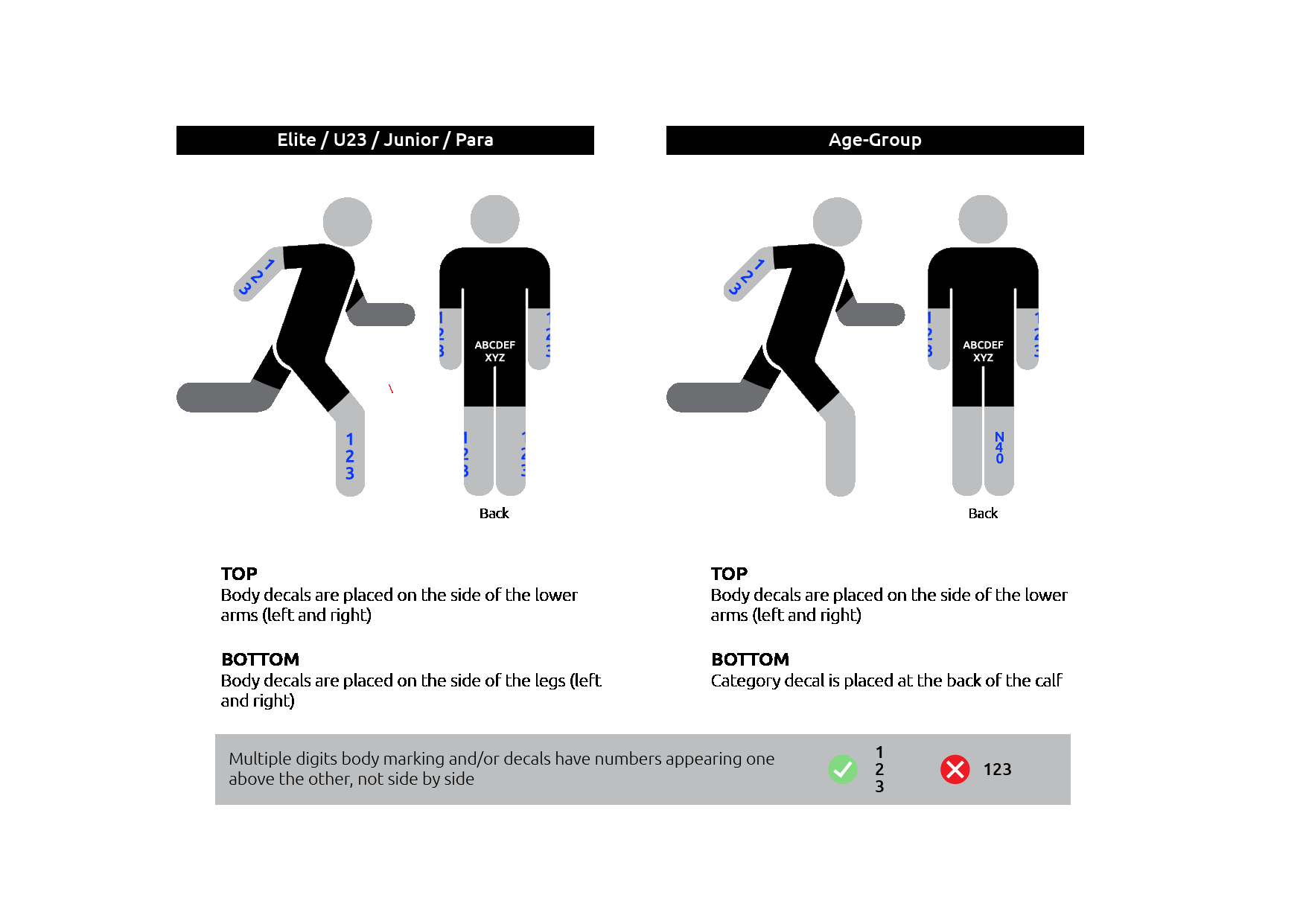
Body markings are to be applied so they are visible on each arm and leg, unless instructed otherwise by the World Triathlon Technical Delegate at the briefing. On the limbs the body marking should be applied at the lower leg and lower arm. Body markings and/or decals using multiple digits will have numbers appearing one above the other, not side by side.
-
(i) Age-Group:
-
The Local Organising Committee will provide body marking or body marking decals, who will apply them prior to the event;
-
Body markings must be applied so they are visible on each arm, as close to the shoulder as possible, unless instructed otherwise by the World Triathlon Technical Delegate at the briefing;
-
Body markings and/or decals using multiple digits will have numbers appearing one above the other, not side by side;
-
One calf of each athlete - if not covered - will be marked with the category and gender of the athletes (For example, the number N25 would appear on a athlete in the 25-29 individual open age category or F25 should appear on a female athlete in the same category or the number X30 would appear on all team members in the 30-39 age category for the Age-Group Mixed Relay)
-
f.) For Winter Triathlon and Winter Duathlon events, points 2.9 a.) to 2.9 e.) do not apply. In these events athletes will be provided with a bib vest which is mandatory to be worn by the athletes during the whole race.
2.10Assignment of race numbersp. 25
a) General
-
(i) Athletes' race numbers are assigned based on previous results in similar events, by using the most related ranking;
-
(i) The Elite men's and women's events will be numbered starting with number 1, except in middle- and long-distance events;
-
(iii) Number 13 will not be used.
-
b.) Specific events numbering criteria:
-
(i) World Triathlon Championship Series (WTCS) and World Triathlon Championship Finals:
-
First criteria: WTCS Ranking;
-
Second criteria: World Triathlon Ranking;
-
Third criteria: random.
-
(ii) Triathlon U23 World Championships:
-
First criteria: WTCS Ranking;
-
Second criteria: World Triathlon Ranking;
-
Third criteria: random.
-
(iii) Junior - any event:
-
First criteria: World Triathlon Ranking;
-
Second criteria: Applicable Continental Junior Ranking (For example Europe Triathlon, Americas Triathlon, etc.);
-
Third criteria: random.
-
(iv) Triathlon World Cup events:
-
First criteria: World Triathlon Ranking;
-
Second criteria: random.
-
(v) Triathlon Continental Cup events:
-
First criteria: World Triathlon Ranking;
-
Second criteria: random.
-
(vi) Triathlon Elite Continental Championships:
-
First criteria: Top 10 classification of the related Continental Championships in the previous year;
-
Second criteria: World Triathlon Ranking;
-
Third criteria: random.
-
(vii) Triathlon U23 Continental Championships:
-
First criteria: World Triathlon Ranking;
-
Second criteria: random.
(vili) World Triathlon Long Distance Duathlon Championship:
-
First criteria: Top 10 classification of the related World Championships in the previous year;
-
Second criteria: World Triathlon Long Distance Duathlon Ranking;
-
Third criteria: random.
-
(ix) Any other Multisport - any Elite event:
-
First criteria: World Triathlon related ranking;
-
Second criteria: random.
-
(x) Age-Group - any event (including Mixed Relay):
-
First criteria: Age-Group by Age-Group;
-
Second criteria: Grouped by nations (according to the IOC codes of the country) in alphabetical order starting by the host nation.
-
(xi) Para triathlon - any event:
-
First criteria: Athlete Medal Event order including first number as follows: PTWC Women 101, PTWC Men 121, PTS2 Women 202, PTS2 Men 222, PTS3 Women 303 , PTS3 Men 323, PTS4 Women 404, PTS4 Men 424 , PTS5 Women 505, PTS5 Men 525, PTVI Women 606, PTVI Men 626;
-
Second criteria: Para triathlon Ranking;
-
Third criteria: random.
-
(xii) Mixed Relay - any event:
-
First criteria: One team per nation;
-
Second criteria: World Triathlon Mixed Relay World Ranking;
-
Third criteria: random.
-
c.) Numbering of the final of events with a qualifying round format is regulated in sections 20.5 and 21.4.
2.11Timing and Resultsp. 27
-
a.) A competition will be won by the athlete who has the shortest time from the start signal to the moment when the athlete finishes the competition as defined in 6.2. a.), 17.15. f.), 18.10 and 22.3, except if the event is conducted under the "rolling start system" as defined in 4.9;
-
b.) The official results will list the athletes according to their finish time and in accordance with the Olympic Results and Information Service (ORIS) standards, a sample of the results format is included in Appendix L;
-
c.) In the event that two athletes tie for a place, and their performances cannot be separated, they will be awarded the same rank, sorted by race number, and the next athlete to finish behind them will occupy the same rank plus two places, with the subsequent athletes ranked in order of finishing;
-
d.) Time splits to be included are:
-
(i) Swim or first segment;
-
(ii) Transition 1;
-
(iii) Bike or second segment;
-
(iv) Transition 2;
-
(V) Run or third segment.
-
e.) Results will include the following Invalid Results Markers (IRM) and listed in this order:
-
(i) athletes who do not finish the competition (DNF);
-
(ii) any lapped athletes or athletes stopped by the last biker - first runner scenario (LAP);
-
(iii) not classified participants for not making the cut-off time in any segment or second, third, fourth, etc teams finishing the race from same NF (NC);
-
(iv) Non-eligible Para triathletes (NE);
-
(v) those who are disqualified (DSQ);
-
(vi) and athletes or teams showing up at pre-race briefing (2.7 b.)) and not starting the race (DNS);
-
(vii) If more than one athlete is marked DNF or LAP, those who completed the most laps should be listed first; if several athletes are marked DNF or LAP on the same lap, athletes should be listed according to their times at the previous timing point with the fastest first, or by ascending start number if no times were recorded up to the point at which they retired;
-
(vili) If more than one participant is included in the same IRM group (different than DNF or LAP), they should be listed within the same group according to ascending start number;
-
(ix) For DSQ athletes, the final time should not be displayed.
-
f.) Additional information will be displayed either at the header or the footer of the results:
-
(i) Swim distance and number of laps;
-
(ii) Bike distance and number of laps;
-
(iii) Run distance and number of laps;
-
(iv) Air temperature;
-
(v) Water temperature;
-
(vi) Wetsuit swim/No wetsuit swim;
-
(vii) Name and country of the Technical Delegate;
-
(vili) Name and country of the Head Referee;
-
(ix) Name and country of the members of the Competition Jury.
-
g.) For mixed relay events, the rules above are applicable and the total time per athlete will be shown;
-
h.) Results will be official once the Head Referee signs them. Incomplete results can be declared official at any time:
-
(i) The Head Referee will use all the resources available to decide the final position of every athlete. The information from technology will be used to assist in the decisionmaking process. The Head Referee may decide, based on the available evidence,
that a competition is tied if there is no way of defining which athlete crossed the line first;
-
(ii) Athletes who deliberately try to finish in a contrived tie situation, where no effort to separate their finish times has been made, will be DSQ.
-
i.) When the race time is taken electronically by a chip timing system:
-
(i) Each athlete will be provided with one (1) or more timing chips. The quantity and use of the timing chips has to be approved by TD;
-
(ii) Athletes has to start the race with the chip placed on the body as indicated in the prerace information;
-
(iii) Technical Officials will check in the pre start area if the chip is properly placed and may request the athlete to modify the position or to place a new chip if the athlete is not wearing it. This may result in a delay of the involved athlete moving to the select the start position;
-
(iv) If it is detected that the athlete lost the timing chip during the race, Technical Officials may offer a replacement chip either in T1 or T2. It is the athlete decision to take the replacement chip or not. If the athlete If does not take it, their splits may not be registered and published in the results. Specifically, for Age-Group races this lost chip circumstance may lead to a disqualification if it is impossible to determine the athlete completed the whole race.
-
j.) Para triathletes changing sport class after classification assessment before the event will be moved to the new sport class. Non-eligible Para triathletes will be removed from the start list;
-
k.) Para triathletes changing sport class after observation during competition will be moved to a new sport class. Non-eligible Para triathletes will be displayed as NE;
-
I.) Results may be modified by the following bodies, without removing the time of a served penalty:
-
(i) Head Referee;
-
(ii) Competition Jury;
-
(iii) World Triathlon Technical Committee as the outcome of a results revision process as outlined in 12.10;
-
(iv) World Triathlon Technical Committee as the result of a change of a para triathlon sport class process;
-
(v) Anti-Doping Hearing Panel.
-
m.) Results may be modified by the following bodies without removing the time of a served penalty other than where the penalty results from a decision made in bad faith, arbitrarily, or in application of the wrong rule:
-
(i) World Triathlon Tribunal excluding the field of play decisions, as the outcome of a level 2 appeal;
-
(il) CAS as result of a level 3 appeal.
-
n.) If results are modified, all affected parties must be notified.
2.12Exceptional conditionsp. 30
-
a.) The following list highlights some of the exceptional situations that may happen. Different scenarios from those indicated may arise, which need to be solved by the Technical Delegate following the same principles. The Technical Delegate may take other decisions if the options below are not possible to implement. Prize money and points will be distributed according to the final result of the race:
-
(i) Before the competition:
-
A triathlon may be modified to a duathlon, aquathlon, or even in a 2 segments competition: swim-run, bike-run or run-bike, by the equivalent distance. Time trial starts are allowed. The preferred option will be a duathlon with the shorter run first;
-
A duathlon may be modified to two segments: bike-run or run-bike. Time trial starts are allowed;
-
The events to be postponed to hold as a minimum two segments. If not possible, the event will be cancelled as no multisport can be run as a single segment event;
-
Mixed Relay events may be modified on the same basis than those indicated in the previous two bullets.
-
(ii) Modification of the competition once started:
-
Any segment, but only one, may be shortened during the competition. The Technical Delegate and Technical Officials will take all reasonable actions to ensure the fairness of the event and the safety of the athletes. Otherwise, the competition will be stopped;
-
For the mixed relay events, once one segment is modified, the modifications will remain for the rest of the legs.
-
(ii) Unplanned interruption of individual standard distance or shorter competition after it has started:
-
If the lead athlete has completed more than 50% of the last segment all athletes will be ranked according to the position at the last available recorded data;
-
In the case that all the athletes are stopped before 50% of the last segment the competition will be restarted, if possible, otherwise no results will be produced;
-
The new start will happen, at least, 45 minutes after the interruption. DSQ athletes will not be able to restart, DNF, DNS and LAP will be able to restart. Time penalties will be removed. If necessary, Competition Jury will meet before the restart to decide on protests filed by DSQ athletes.
-
(iv) Unplanned interruption of individual middle distance or longer competition after it has started:
-
Athletes who completed at least two segments will be ranked according to their position at the last available recorded data;
-
Any athlete who does not complete at least two segments will be included in the results as NC;
-
In the case that all the athletes are stopped before the end of the second segment the competition will be restarted, if possible, otherwise no results will be produced;
-
The new start will happen, at least, 45 minutes after the interruption. DSQ athletes will not be able to restart, DNF, DNS and LAP will be able to restart. Time penalties will be removed. If necessary, Competition Jury will meet before the restart to decide on protests filed by DSQ athletes.
-
(v) Modification of mixed relay competition by shortening it:
-
The race will be considered valid for those teams which completed at least two legs;
-
There are two possible scenarios:
- If all of the teams are able to reach the point of cancellation (i.e. broken pontoon, with no possibility to get in the water). The results of the race will be according to the position and times of the teams at the point the race is stopped;
- If the race has to stop no matter where the teams are (i.e. weather alert) The results of the race will be according to:
- The latest timing split per team;
- The order of the teams to that point.
- (vi) Modification of qualifying round format events:
- In case not all the round of competition (qualifier or final) can be performed, the results of the last complete round performed will be considered as final results by ranking the athletes according to the times on that round;
- If the first round of competition is not completed, the competition will be restarted for all the athletes if possible, otherwise no results will be produced;
- A triathlon may be modified to a duathlon, aquathlon, or even in a twosegment competition: swim-run, bike-run or run-bike, by the equivalent distance. Time trial starts are allowed. The preferred option will be a duathlon with the shorter run first;
- A duathlon may be modified to two segments: bike-run or run-bike. Time trial starts are allowed.
2.13World Triathlon Events Advisory Groupp. 32
- a.) This body will be available to provide support and guidance to the Technical Delegates of all events in the World Triathlon and Continental Confederations calendar;
- b.) The composition of the group will be:
- (i) A representative of the World Triathlon Sport Department (chair);
- (ii) A representative of the World Triathlon Medical Committee;
- (iii) A representative of the World Triathlon Technical Committee.
- c.) The Chair of the group may involve any other elected members or staff of World Triathlon or the respective Continental Confederations;
- d.) The members will be available from Thursday to Sunday on each weekend with an event;
- e.) The Technical Delegates will be able to contact the chair of the advisory group and at his/her discretion a meeting of the group will be called;
- f.) This group will provide support and guidance, but the final decision on any matter will be made on site by the World Triathlon Technical Delegate (except Water Quality matters as outlined in section 10.2).
Chapter 3: Penalties
3.1General Rulesp. 33
- a.) Failure to comply with the World Triathlon Competition Rules may result in an athlete being verbally warned, issued with a time penalty, disqualified, suspended, or expelled;
- b.) The nature of the rule violation will determine the subsequent penalty;
- c.) A suspension or an expulsion will occur for very serious violations of either the World Triathlon Competition Rules or the World Triathlon Anti-Doping Rules;
- d.) Infringements and penalties are listed in Appendix K;
- e.) The Technical Officials are allowed to determine penalties, even if the infringement is not included in the Competition Rules, if the Technical Official deems an unfair advantage has been gained, or if a dangerous situation has been created intentionally;
- f.) Under exceptional circumstances Technical Officials may modify penalties defined in the Competition Rules in accordance with the spirit of the rules.
3.2Warningp. 33
- a.) The purpose of a warning is to alert an athlete about a possible rule violation and to promote a "proactive" attitude on the part of Technical Officials. Also, a Technical Official can determine a warning to an athlete to correct a minor infringement;
- b.) A warning may be given when:
- (i) An athlete violates a rule unintentionally;
- (ii) A Technical Official believes a violation is about to occur;
- (iii) No advantage has been gained.
- c.) Giving a warning: The Technical Official will blow their whistle, the athlete will be stopped if necessary, asked to modify their behaviour, and be allowed to continue the competition immediately afterwards;
- d.) It is not necessary for a Technical Official to give a warning prior to issuing a penalty for a more serious rule violation for which the athlete may be disqualified, suspended, or expelled.
3.3Time Penaltyp. 33
- a.) A time penalty is an appropriate penalty for infringements, which do not warrant a disqualification;
- b.) Time penalties will be served in a specific location as indicated in the table below. Stopping In a different location will be considered as a penalty not served;
| Elite Draft Legal | Elite Draft-illegal Para triathlon | Age-Group | |
|---|---|---|---|
| Start | T1 | T1 | |
| Swim | Run penalty box | Run penalty box | T1 |
| Transition 1 | Run penalty box | Run penalty box | Time Penalty on the spot |
| Bike | Run penalty box | Bike penalty box | Bike penalty box |
| Run penalty box | Run penalty box | Transition 2 Time Penalty on the spot | |
| Run | Run penalty box / On the spot* | Run penalty box / On the spot* | Warning/Time Penalty on the spot |
Notes: All the references to Elite include Elite, U23, Junior and Youth athletes. In the Winter Triathlon run penalty box is replaced with ski penalty box. In Duathlon and Aquathlon events, run penalty box means 2d run penalty box.
- During the second half of the run segment.
- c.) Technical Officials will decide when an athlete needs to be penalised with a time penalty;
- d.) There are two types of infringements penalised with time penalties:
- (i) Drafting infringements as defined in 5.5;
- (ii) Other infringements. See appendix K for list.
- e.) Time penalties vary depending on the type of infringement:
- (i) Drafting infringements:
- 3 minutes in long distance events;
- 2 minutes in middle distance events;
- 1 minutes in standard distance events;
- 30 seconds in sprint and shorter events.
- (i) Other infringements:
- 1 minute in long distance events;
- 30 seconds in middle distance events;
- 15 seconds in standard distance events;
- 10 seconds in sprint distance and Relay events;
- 5 seconds in events shorter than sprint distance.
3.4Penalty notificationp. 34
-
a.) The Technical Official will determine the time penalty, and notify the athlete as soon as it is safe to do so:
-
(i) Drafting infringements:
-
Sounding a whistle, showing a blue card, calling in English the athlete's number and saying "Drafting penalty, you have to stop at the next penalty box". The Technical Official has to ensure the athlete received the penalty notification.
-
Will be served in the Bike penalty box;
-
(ii) Time penalty to be served at the Run penalty box:
-
Penalties must be posted on the board before the athlete reaches the penalty box as the following:
-
In case of 1 lap run, until the athlete reaches the penalty box on the 1st lap;
-
In case of 2 laps run, until the athlete reaches the penalty box on the 1st lap;
-
In case of 3 laps run, until the athlete reaches the penalty box on the 2nd lap;
-
In case of 4 laps run, until the athlete reaches the penalty box on the 2nd lap;
-
In case of 5 laps, until the athlete reaches the penalty box on the 3rd lap;
-
Etc.
(ili) Other infringements:
- Infringements served in Transition 1: Athletes will serve this penalty in transition 1 before touching any equipment. A Technical Official will be positioned by the athlete's transition spot, who will sound a whistle, show a yellow card and time the penalty;
- Infringements served in the Bike penalty box: Sounding a whistle, showing a yellow card, calling in English the athlete's number and saying "Time penalty, you have to stop at the next penalty box". The Technical Official has to ensure the athlete receives the penalty notification;
- Infringements served in the Run penalty box: Athletes may be notified about penalties by displaying the athlete's number, followed by an "x" + a number in case it is more than one infringement, and a letter code indicating the nature of the infringement on a panel posted at the Run penalty box. It is the athlete's responsibility to check this board (See the letter codes below):
- 3.5 Procedure while serving a time penalty:
- a.) The Technical Official applying the time penalty is not required to give a reason for the penalty;
- b.) When given a blue or yellow card, the athlete will follow the instructions of the Technical Official;
| D | Dismount Line Violation |
|---|---|
| S | Swim Conduct |
| M | Mount Line Violation |
| B | Bike Behaviour |
| E | Equipment Outside bin |
|---|---|
| L | Littering |
| V | Other Violations |
| R | Run Behaviour |
-
c.) Time penalty in Transition 1 (for any infringements up to this point):
-
(i) Athletes who are given a time penalty have the option to decide whether to stop at the Transition 1 and serve the penalty or continue to the finish. Not stopping will result in disqualification on crossing the finish line. The athlete may then protest the penalty. Evidence will only be made available if a protest is lodged ;
-
(ii) The Technical Official will hold a yellow card as the penalised athlete arrives at his/her position. The athlete will be ordered to stop in his/her transition space without touching any of their equipment, the Technical Official will start the timing. If the athlete touches or removes any of their equipment the Technical Official will ask the athlete to stop touching the equipment and the time will be paused. Once the athlete complies the count will continue;
-
(i) When the penalty time has been completed, the Technical Official will say "Go" and the athlete can continue with the competition.
-
d.) Time penalty at the Bike penalty box:
-
(i) The penalised athlete's race numbers are not displayed in a bike penalty box. It is the athlete's responsibility to report to the next penalty box on the course after receiving notification;
-
(i) The penalised athlete will enter the penalty box, dismount the bike and inform the Technical Official of their race number, the number of penalties to serve and the colour of card(s) received. The time penalty starts when the athlete complies with all above and ends when the Technical Official says "Go", at which time the athlete may continue with the competition. If the athlete leaves the area, the Technical Official will ask the athlete to return and the time will be paused. Once the athlete complies the count will continue. For PTWC athletes the count will start once the athlete is totally stopped;
-
(iii) While in the bike penalty box, athletes can consume only the food and/or water that is on the athlete's bike or person;
-
(iv) Athletes are prohibited from using the restroom while serving a penalty in the bike penalty box. The time of penalty will be paused while using the restroom;
-
(v) Making adjustments to equipment or performing any type of bike maintenance while serving a penalty in the bike penalty box is prohibited.
-
e.) Time penalty at the Run penalty box:
-
(i) Athletes who are given a time penalty have the option to decide whether to stop at the penalty box and serve the penalty or continue to the finish. Not stopping will result in disqualification on crossing the finish line. The athlete may then protest the penalty. Evidence will only be made available if a protest is lodged
-
(ii) The penalised athletes' race numbers are clearly displayed on a board at the penalty box;
-
(iii) The penalised athlete will proceed into the penalty box and inform the Technical Official of their race number and number of penalties to serve. The time penalty starts when the athlete complies with all above and ends when the Technical Official says "Go", at which time the athlete may continue with the competition. If the athlete leaves the area, the Technical Official will ask the athlete to return and the time will be paused. Once the athlete complies the count will continue;
-
(iv) The penalised athlete's number will be removed from the board once the penalty is served;
-
(v) A penalised athlete may serve their penalty on any lap of the run;
-
(vi) For infringements occurring on the second half of the run, the time penalty will be served on the spot.
f) Time penalty on the spot
- (i) The Technical Official will hold a yellow card in front of the penalised athlete. The athlete will be ordered to stop safely by the side of the run course. If the athlete moves forward the time will be paused. Once the athlete stops again the count will continue;
- (ii) When the penalty time has been completed, the Technical Official will say "Go" and the athlete can continue with the competition;
3.6Disqualificationp. 37
a) General
- (i) A disqualification is a penalty appropriate for severe rule violations, such as but not limited to, repeated bike draft infringements, and/or dangerous or unsportsmanlike conduct;
b.) Assessment:
-
If time and conditions permit, a Technical Official will assess a disqualification by:
-
Sounding a whistle;
-
Showing a red card;
-
Calling (in English) the athlete's number and saying "Disqualified";
-
For safety reasons, a Technical Official may have to delay issuing a disqualification.
-
(ii) Athletes will be informed about the penalties by displaying the athlete's number on the white board posted at the post finish area;
-
(iii) The athlete and or the National Federation needs to be contacted and informed of the disqualification if this is after the athlete has finished and the penalty has not been posted on the board. The athlete or National Federation must respond within 5 days to the Technical Delegate if they wish to appeal.
-
c.) Procedure after Disqualification:
-
(i) An athlete may finish the competition if a Technical Official issues a disqualification.
3.7Suspensionp. 38
a) General
- (i) A suspension is a penalty appropriate for a fraudulent or a very severe rule violation, such as but not limited to repeated dangerous or unsportsmanlike conduct;
- (i) A suspended athlete will not take part in World Triathlon competitions or competitions sanctioned by National Federations affiliated with World Triathlon during a suspension period.
b.) Assessment:
- (i) The Head Referee will submit a report to the World Triathlon Tribunal including all the details of the action, and the reasons to recommend the athlete for suspension. This report will be submitted to the World Triathlon Secretary General within one week of the competition. The World Triathlon Secretary General will inform the affected National Federations.
- c.) Suspensions will be assessed by the World Triathlon Tribunal for periods of three (3) months to four (4) years, depending on the violation;
- d.) Suspensions based on contriving the World Triathlon Anti-Doping Rules: If the suspension is an Anti-Doping Rule Violation, the athlete will not be able to compete in any other sport whose federation is recognised by World Triathlon, IOC or GAISF and vice versa;
e) Reasons for Suspension
- (i) A list of infringements, which may result in a suspension, is described in Appendix K.
f) Disciplinary Notice
- (i) When an athlete is suspended, the World Triathlon will notify the concerned National Federation, in writing, within 30 days;
- (ii) All suspensions will be announced in the World Triathlon newsletter and communicated to the IOC and respective parties.
3.8Expulsionp. 38
a) General
- (i) Athletes who have been expelled will not participate in World Triathlon competitions or competitions sanctioned by National Federations affiliated with World Triathlon for lite.
b) Reasons for Expulsion
-
(i) An athlete will be expelled for life for repeated rule violations that incur suspension as the penalty;
-
(ii) Expulsion due to an Anti-Doping Rule Violation: If the expulsion is for an Anti-Doping Rule Violation, the athlete will not be able to compete in any other sport whose federation is recognised by World Triathlon, IOC and vice versa.
c) Disciplinary Notice
- (i) When an athlete is expelled, the World Triathlon will notify the concerned National Federation, in writing, within 30 days;
- (ii) Expulsions will be announced in the World Triathlon newsletter and communicated to the IOC and the respective parties.
3.9Right to Protestp. 39
- a.) An Athlete who receives a penalty may protest, with the exception of:
- (i) a penalty for a drafting violation; and
- (i) a time penalty which has already been served.
- b.) If an athlete serves a time penalty, the athlete accepts the penalty, and no protest will be admitted;
- c.) If an athlete does not serve a time penalty, he/she will be disqualified but may protest against the disqualification and the decision of the Head Referee to issue the time penalty;
- d.) The Competition Jury which receives the protest will decide on the correctness of the decision to issue the time penalty and will either:
- (i) Dismiss the protest and confirm the disqualification; or
- (ii) Uphold the protest
3.10Reinstatementp. 39
- a.) After suspension, an athlete must apply to the World Triathlon Tribunal for reinstatement.
- and reverse the disqualification.
Chapter 4: Swimming
4.1General Rulesp. 40
- a.) Athletes may use any stroke to propel themselves through the water. They may also tread water or float. Athletes are allowed to push off the ground at the beginning and the end of every swim lap. Technical Delegate may authorize to push off the ground in other sections of the swim course;
- b.) Athletes must follow the prescribed swim course as outlined in 2.1 a) (xiii);
- c.) Athletes may stand on the bottom or rest by holding an inanimate object, such as a buoy or stationary boat. It is forbidden to pull, push or use any inanimate object in a way which help the athlete progress;
- d.) In an emergency, an athlete should raise an arm overhead and call for assistance. Once official assistance is rendered, the athlete must retire from the competition;
- e.) Athletes may sportingly maintain their own space in the water:
- (i) Where athletes make accidental contact in the swim and then immediately afterwards move apart no penalty will be incurred;
- (ii) Where athletes make contact in the swim, and an athlete continues to impede the progress of the other athlete without moving apart, this action will result in a time penalty;
- (iii) The deliberate targeting of another athlete to impede their progress, gain unfair advantage and potentially cause harm will result in disqualification and may be reported to the World Triathlon Tribunal for potential suspension or expulsion;
- (iv) Where athletes dunk, punch, scratch, or kick another athlete will result in disqualification and may be reported to the World Triathlon Tribunal for potential suspension or expulsion;
- (v) Additionally, for the World Triathlon Championship Series, World Triathlon Cups, World Triathlon Para Series or World Triathlon Para Cups, if an athlete is penalised for infringing this rule twice in a calendar year, he or she will not be admitted in the next event from those mentioned above. This sanction is also applicable to the third, fourth or following infringement.
- f.) Rules about water quality are outlined in section 10;
- g.) This paragraph applies to Elite, U23 and Junior races in standard and shorter distances. Fingernails must be trimmed short and should not be sharp. Nails that could potentially cause harm to other athletes are not permitted. The nail should not extend past the tip of the finger. Ideally, the edge of the nail should align with or slightly below the fingertip. The nails should be rounded or slightly squared to follow the natural curve of the fingertip. No sharp corners or edges should remain after trimming. The trimmed edges should be filed to remove rough or jagged edges.
4.2Wetsuit Usep. 41
- a.) Wetsuit use is governed by the following tables:
Elite, U23, Junior and Youth athletes:
| Swim Length | Forbidden | Mandatory |
|---|---|---|
| Up to 1500 m | 20 °C and above | 15.9 °C and below |
| 1501 m and longer | 22 °C and above | 15.9 °C and below |
Age-Group from the youngest to 55-59 category:
| Swim Length | Forbidden | Mandatory |
|---|---|---|
| Up to 1500 m | 22 °C and above | 15.9 °C and below |
| 1501 m and longer | 24.6 °C and above | 15.9 °C and below |
Age-Group from 60-64 category to the oldest:
| Swim Length | Forbidden | Mandatory |
|---|---|---|
| All distances | 24.6 °C and above | 15.9 °C and below |
4.3Maximum stay in waterp. 41
| Swim Length | Elite, U23, Junior and Youth | Age-Group |
|---|---|---|
| Up to 300 m | 10 min. | 20 min. |
| 301 m to 750 m - below 31°C | 20 min. | 30 min. |
| 301 m to 750 m - 31°C and above | 20 min. | 20 min. |
| 751 m to 1000 m | 25 min. | 50 min. |
| 1001 m to 1500 m | 30 min. | 1h 10 min. |
| 1501 m to 3000 m | 1h 15 min. | 1h 40 min. |
| 3001 m to 4000 m | 1h 45 min. | 2h 20 min. |
4.4Modificationsp. 41
- a.) In case of high or low temperatures the swim distance can be shortened or even cancelled according to this table:
| Original swim distance | Temperature of water | Temperature of water | Temperature of water | Temperature of water | Temperature of water | Temperature of water | Temperature of water | Temperature of water | Temperature of water |
|---|---|---|---|---|---|---|---|---|---|
| Original swim distance | Above 33.0°C | 32.9- 32.0°C | 31.9- 31.0°C | 30.9- 15.0°C | 14.9- 14.0°C | 13.9- 13.0°C | 12.9- 12.0°C | 11.9- 11.0°C | Below 11.0°C |
| Up to 300 m | Cancel | Original distance | Original distance | Original distance | Original distance | Original distance | Original distance | Original distance | Cancel |
| 750 m | Cancel | Cancel | 750 m | 750 m | 750 m | 750 m | 750 m | Cancel | Cancel |
| 1000 m | Cancel | Cancel | 750 m | 1000 m | 1000 m | 1000 m | 750 m | Cancel | Cancel |
| 1500 m | Cancel | Cancel | 750 m | 1500 m | 1500 m | 1500 m | 750 m | Cancel | Cancel |
| 1900 m | Cancel | Cancel | 750 m | 1900 m | 1900 m | 1500 m | 750 m | Cancel | Cancel |
| 2000 m | Cancel | Cancel | 750 m | 2000 m | 2000 m | 1500 m | 750 m | Cancel | Cancel |
| 2500 m | Cancel | Cancel | 750 m | 2500 m | 2500 m | 1500 m | 750 m | Cancel | Cancel |
| 3000 m | Cancel | Cancel | 750 m | 3000 m | 3000 m | 1500 m | 750 m | Cancel | Cancel |
| 3800 m | Cancel | Cancel | 750 m | 3800 m | 3000 m | 1500 m | 750 m | Cancel | Cancel |
| 4000 m | Cancel | Cancel | 750 m | 4000 m | 3000 m | 1500 m | 750 m | Cancel | Cancel |
- b.) The temperatures in section 4.2 are not always the water temperature used in the final decision. When the water temperature is above 22°C, the temperatures in the table are to be applied as they are. When the water temperature is at or below 22°C and the air temperature is at or below 15°C, then the value of the water temperature will be adjusted according to the following table:
| (*) | 15 | 14 | 13 | 12 | 11 | 10 | 9 | 8 | 7 | 6 | 5 |
|---|---|---|---|---|---|---|---|---|---|---|---|
| 22 | 18.5 | 18 | 17.5 | 17 | 16.5 | 16.0 | 15.5 | 15.0 | 14.5 | 14.0 | Cancel |
| 21 | 18 | 17.5 | 17 | 16.5 | 16 | 15.5 | 15.0 | 14.5 | 14.0 | 13.5 | Cancel |
| 20 | 17.5 | 17 | 16.5 | 16 | 15.5 | 15.0 | 14.5 | 14.0 | 13.5 | 13.0 | Cancel |
| 19 | 17 | 16.5 | 16 | 15.5 | 15 | 14.5 | 14.0 | 13.5 | 13.0 | 12.5 | Cancel |
| 18 | 16.5 | 16 | 15.5 | 15 | 14.5 | 14.0 | 13.5 | 13.0 | 12.5 | 12.0 | Cancel |
| 17 | 16 | 15.5 | 15 | 14.5 | 14 | 13.5 | 13.0 | 12.5 | 12.0 | Cancel | Cancel |
| 16 | 15.5 | 15 | 14.5 | 14 | 13.5 | 13.0 | 12.5 | 12.0 | Cancel | Cancel | Cancel | |
| 15 | 15 | 14.5 | 14 | 13.5 | 13 | 12.5 | 12.0 | Cancel | Cancel | Cancel Cancel | |
| 14 | 14 | 14 | 13.5 | 13 | 12.5 | 12.0 | Cancel | Cancel | Cancel | Cancel | Cancel | |
| 13 | 13 | 13 | 13 | 12.5 | 12 | Cancel | Cancel | Cancel | Cancel | Cancel Cancel |
- c.) If other weather conditions dictate, i.e., high winds, heavy rain, changing temperature, current, etc. the Technical Delegate in consultation with the Medical Delegate (if applicable) may adapt limits of the swim length or adopt provisions about the use of wetsuits. The final decision will be made one hour before the start and will be clearly communicated to the athletes by the Technical Delegate;
- d.) For aquathlon events (normally run-swim-run), the LOC should plan for a swim-run where the water temperature is expected to be below 22 °C. Where a run-swim-run aquathlon has been planned, but on competition day the water temperature is below 22 °C, the format will change to swim-run;
- e.) Water temperature must be taken one hour prior to the start of the event on competition day. It must be taken at the middle of the course and in two other areas on the swim course, at a depth of 60 cm. Where the average measured figure is 27 °C or below, the lowest measured temperature will be considered as the official water temperature. Where the average measured figure is above 27 °C, the highest measured temperature will be considered as the official water temperature.
4.5Starting Position Selection: (Elite/U23/Junior/Youth athletes)p. 43
- a.) Prior to the start of competition, athletes are lined up in a designated area in the order of their start numbers. A Technical official will order each athlete to move to the start one by one;
- b.) Upon entering the start area, each athlete will go directly to their selected numbered position of their choosing and stay in that position until the start is given. A selected position cannot be changed by any athlete once it is chosen. An athlete cannot occupy more than one start position:
- (i) The Technical Delegate may decide to cancel this process and assign the start positions according to race numbers, in cases where no ranking exists or due to other extraordinary circumstances.
- c.) Start Line Technical Officials note each athlete's race number and the starting position selected. Once the section assigned to a Start Line Technical Official has been filled, they will raise a flag;
- d.) Starting Position Selection ends when every athlete is in a starting position and every Start Line Technical Official has confirmed readiness for the start by raising their flag.
4.6Starting Position Selection: (Age-Group)p. 43
- a.) Athletes from the same wave will be together as a group in the pre start area;
- b.) A Technical Official will allow the athletes to move to the start area and will control the flow to keep this process safe;
- c.) Athletes will select any position which is not used. Technical Officials may ask the athletes to move from crowded to empty areas of the start line;
4.7Start Procedure (Mass start)p. 44
- a.) A start is a mass start when a large group of athletes are starting together. It may be used in any competition and category;
- b.) After all athletes are in position (confirmed and noted by the Start Line Technical Officials) and the whole Field of Play is confirmed ready for the start, "Athletes, you are now in the hands of the starter" is announced and Start Line Technical Officials lower their flags. This announcement will be given not later than 20 seconds before the start and the athletes must stay within their starting position after hearing it;
- c.) Following the announcement of "Athletes, you are now in the hands of the starter", a heartbeat soundtrack may be played for maximum of 15 seconds and will then fade out;
- d.) Between 3-5 seconds after the heartbeat is faded out, the start signal will be given by a Technical Official or other assigned person by blasting a horn. Athletes will move directly forward towards the first buoy until they reach the water. No movement to a different start position is permitted;
- e.) False start: In case of a false start, where several athletes move forward before the start horn, the Head Referee or designated Official will sound the start horn many times declaring the start is not valid. This declaration may be done following the signal of False Start Officials who signal the Head Referee with a flag to indicate a false start, following the indication of any of the Start Line Technical Officials by raising their flag, or by the Head Referee's own decision. Athletes will be required to return to their previously selected positions. This will be controlled by the Start Line Technical Officials and the start procedure will start again. A false start may be declared also when not all the athletes have the opportunity to start the race immediately after start horn;
- f.) Valid start with early starters: In the case of an early start of a few athletes, the competition can continue, the Head Referee can decide that the start is valid and the competition can continue with penalties given to the early starters. A photo/video camera and/or the declaration of the Start Line Technical Officials may be used to identify early starters. The early starters will receive a time penalty in Transition 1. In case of mixed relay events, the time penalty has to be served by the first athlete of the team;
- g.) For Age-Group events mass start may be organised in different waves. Different AgeGroup categories may be grouped in the same wave. Age-Group categories with a large number of athletes may be split, in this case only athletes from the same Age-Group category will be in the same wave;
- h.) Athletes starting in any wave before the one that the athlete is assigned to, will be disqualified;
- i.) Athletes who are late to the assigned wave will need the approval of the Start Technical Official to start in a later wave. The athlete start time will be the start time of the assigned wave.
4.8Start procedure (Interval Start System)p. 45
- a.) An interval start is defined when the start is given at different times to different groups of athletes who are competing together. Typically, it is used in PTWC and PTVI events;
- b.) Athletes are responsible for being at the start line on time;
- c.) A video camera shall be used to record the entire start;
- d.) The Start Technical Officials are responsible for synchronising their own and the Timekeepers' watches;
- e.) Start Technical Officials must provide all athletes with the opportunity to start at their correct times. An assistant responsible for recording the details for any violations at the start must be placed near the starter. The athletes' actual start time must be noted with both electric and hand timing, in case the Competition Jury decides his/her late start was due to force majeure;
- f.) Athletes will be called to the start area and will occupy the start positions according to the Technical Officials' instructions;
- g.) Ten minutes before their start time, all the athletes should be ready at the start area;
- h.) Five minutes before their start time, athletes will be asked to take their position at the start area,
- i.) One minute before their start time, athletes will be asked to enter the water, or approach the start line;
- j.) When all athletes are in position, the 'start procedure' will be initiated as defined in 4.7 b.) to 4.7 f);
- k.) The start signal (horn blast) will be sounded at the exact start time of the wave;
- l.) An athlete who is an "early starter" in a "valid start" will not be recalled to the start line;
- m.) The early starters will receive a time penalty in Transition 1;
- n.) An athlete who starts any time before the beginning of the "start procedure" or who starts in a wave they are not assigned to, will be disqualified;
- o.) Athletes who are late to their assigned wave must get approval of the Start Technical Official to start, and the start time will be the start time of the assigned wave, and no adjustment to his/her start time can be made.
4.9Start procedure (Time Trial Start System)p. 45
-
a.) Time trial start system is defined when the athletes competing in the same event will start the race at specified start times. Typically, is to be used in events with time trial qualifier stages,
-
b.) Athletes are responsible for being at the start line on time;
-
c.) A video camera shall be used to record the entire start;
-
d.) The Start Technical Officials are responsible for synchronising their own and the Timekeepers' watches;
-
e.) Start Technical Officials must provide all athletes with the opportunity to start at their correct times. An assistant responsible for recording the details for any violations at the start must be placed near the starter. The athletes' actual start time must be noted with both electric and hand timing; in case the Competition Jury decides his/her late start was due to force majeure;
-
f.) Athletes will line up according to the start order. Athletes will need to report at the pre-start area at least 2 minutes before their start time;
-
g.) Athletes will be informed by the starter about the remaining time to the start, 15 and 5 seconds before the start time;
-
h.) The Start Technical Official will announce the start time by using an electronic/manual horn;
-
i.) Athletes starting the competition before the start time will be recalled to the start line. Any athlete failing to do this will be disqualified. Athletes starting after their start time, must get the approval of the Start Technical Official to proceed. The start time of those athletes will be the start time originally assigned.
4.10Start Procedure (Rolling Start System)p. 46
- a.) Rolling start is defined when athletes can cross the start line at any moment during a defined range of time. The athlete's time will start when the athlete crosses the start line. This start system is appropriate for long distance events with mass participation. It may be used in draft-illegal events, even if they are not long distance, or where the start conditions do not permit a wide space offering the athletes a safe start to the swim. There are two variations:
- (i) Rolling start with determined start times: Athletes will start with no order in predetermined time slots, individually or in groups up to five athletes;
- (i) Continuous rolling start: athletes will start the race in a continuous flow.
- b.) This system is only applicable to Age-Group competitions;
- c.) There will not be a mass start;
- d.) The Start Technical Official can interrupt the start procedure at any time;
- e.) The Start Technical Official will determine the start time of any athlete in case of incidents at the start;
- f.) If one athlete has two or more start times recorded, the first one will be the valid start time
- g.) Athletes starting in any wave before the defined range of time for him/her, will be disqualified;
- h.) Athletes who are late to the defined range of time will need the approval of the Start Technical Official, and the start time will be the real start time of the athlete.
4.11Equipmentp. 47
a) Swim cap
- (i) All athletes must wear the official event numbered swim cap during the swim segment;
- (ii) In an Aquathlon event athletes may carry the official event swim cap and goggles during the first run segment and may wear them in the Transition Area;
- (iii) Numbered swim caps are provided by World Triathlon or the Local Organising Committee;
- (iv) If an athlete chooses to wear two caps, the second swim cap must be unbranded and the official swim cap must be on the outside from the moment of the athletes' line-up procedure starts;
- (v) No sponsor logos are allowed on the official swim cap other than prescribed by World Triathlon/ Local Organising Committee;
- (vi) Athletes may not alter the swim caps in any manner;
- (vii) Failure to wear the official swim cap, or altering the official swim cap, may result in a penalty up to and including disqualification;
- (vili) Neoprene swim caps are allowed if wetsuits are allowed.
b. Trisuits:
- (i) Athletes must wear the approved trisuit for the non-wetsuit swims. If athletes choose to wear more than one trisuit, both have to comply with the specifications;
- (ii) Trisuits must be 100% textile material, which is defined as materials consisting of natural and/or synthetic, individual and non-consolidated yarns used to constitute a fabric by weaving, knitting and/or braiding (this generally refers to suits made only from nylon or lycra that do not have any rubberized material such as polyurethane or neoprene);
- (iii) When the use of wetsuits is forbidden, clothing covering any part of the arms below the elbows and clothing covering any part of the legs below the knees is also forbidden with the exceptions outlined at 2.8.c.) (iii) to 2.8 c.) (vi)
- (iv) Trisuits must comply with the applicable Guidelines Regarding Authorised Identifications.
c) Swimskins
-
(i) Swimskins must be 100% textile material, which is defined as materials consisting of natural and/or synthetic, individual and non-consolidated yarns used to constitute a fabric by weaving, knitting and/or braiding (this generally refers to suits made only from nylon or lycra that do not have any rubberized material such as polyurethane or neoprene);
-
(i) For Elite, U23, Junior, Youth and Para triathlon standard and shorter distance events, swimskins are not allowed;
-
(iii) For Age-Group athletes in all events and distances swimskins are allowed;
-
(iv) Swimskins must be removed after the swim segment;
-
(v) Swimskins must comply with the wetsuit section of the applicable Guidelines Regarding Authorised Identifications;
-
(vi) Swimskins can be used in all water temperatures.
d) Wetsuits
- (1) Wetsuits cannot exceed 5mm thickness anywhere. If the wetsuit is made in two pieces, the combined thickness in the overlapping areas may not exceed the 5 mm thickness limit, +/- 0.3 mm tolerance is admissible;
- (ii) Propulsion devices that create an advantage for the athlete, or a risk to others, are forbidden;
- (iii) The most external part of the wetsuits will fit to the athletes' body tightly while they are swimming;
- (iv) A wetsuit may cover any part of the body except the face, hands and feet. When mandatory, the wetsuit must cover at least the torso;
- (v) There is no limitation regarding the length of the zipper;
- (vi) Wetsuits must comply with the applicable Guidelines Regarding Authorised Identifications.
- e.) Electronic devices may be used in the competition unless they are distracting the athlete from paying full attention to their surroundings;
f) Illegal Equipment
-
(i) Athletes must not use or wear:
-
Artificial propulsion devices;
-
Flotation devices;
-
Gloves;
-
Socks, except when use of wetsuits are mandatory;
-
Wetsuits (including neoprene caps) or any part of the wetsuits when they are forbidden;
-
Non-certified swimsuits;
-
Snorkels;
-
Bib numbers (in non-wetsuit swim only);
-
Headphone(s), headsets) or technical earplug(s), which are inserted or covering the ears, except ear protection plugs;
-
Safety inflatable device (tube) which has been deployed. If deployed the athlete must retire from the race;
-
Suits, vests, or any clothing having any part made of rubberized material such as polyurethane or neoprene;
-
Buoyancy shorts;
-
Any jewellery;
-
Watches. This non allowance applies to Elite, U23 and Junior races in Standard and shorter distances. Exceptionally the Head Referee may allow the use of watches.
Chapter 5: Cycling
5.1General Rulesp. 50
- a.) Athletes must obey the specific traffic regulations for the event, unless a Technical Official advises otherwise;
- b.) Athletes are not permitted to make forward progress without being in possession of the bike;
- c.) Athletes have to compete with the bike checked in;
- d.) Athletes leaving the field of play for safety reasons have to return to it without gaining any advantage. If an advantage is gained due to this action, the athlete will receive a time penalty to be served in the transition area for Age-Groupers and at the run penalty box for everyone else. Exceptional scenarios are listed in 2.1 a) (xiii);
- e.) Dangerous riding may result in a penalty. This includes but is not limited to passing another athlete on the wrong side;
- f.) Where an athlete cuts across or makes accidental contact with another athlete during the bike, then immediately moves away and does not cause a crash the athlete will not incur a penalty;
- g.) Where an athlete cuts across another athlete in a dangerous manner or makes contact with another athlete during the bike, does not move away and continues to impede the progress of the other athlete, the athlete will incur a time penalty;
- h.) Where an athlete deliberately targets another athlete during the bike and impedes their progress, gains an unfair advantage, potentially causes harm or a crash the athlete will be disqualified and may be reported to the World Triathlon Tribunal for potential suspension or expulsion;
- i.) Additionally, for the World Triathlon Championship Series, World Triathlon Cups, World Triathlon Para Series or World Triathlon Para Cups, if an athlete is penalised for infringing this rule twice in a calendar year, he or she will not be admitted in the next event from those mentioned above. This sanction is also applicable to the third, fourth or following infringement.
5.2Equipmentp. 50
-
a.) In general, UCI rules, as of January 1st of the current year, will apply during competition and also during familiarisation sessions and official training:
-
(i) UCI road race rules for draft-legal triathlon and duathlon competitions;
-
(ii) UCl time trial rules for draft-illegal triathlon and duathlon competitions;
-
(iii) UCI Mountain Bike (MTB) rules for winter triathlon, cross triathlon and cross duathlon competitions.
-
b.) The bicycle is a human powered vehicle with two wheels of equal diameter. The front wheel shall be steerable; the rear wheel shall be driven through a system consisting of
-
pedals and a chain. Bicycles are referred to as bikes and will have the following characteristics in the following sections;
-
c.) For draft-legal competitions. Elite, U23, Junior and Youth:
-
(i) Frames:
-
The frame of the bike shall be of a traditional pattern, i.e., built around a main triangle of three straight or tapered tubular elements, (which may be round, oval, flattened, teardrop shaped or otherwise in cross-section) such that the form of each element encloses a straight line. The elements of the frame shall be laid out such that the joining points shall follow the following pattern: the top tube connects the top of the head tube to the top of the seat tube; the seat tube (from which the seat post shall extend) shall connect to the bottom bracket shell; the down tube shall connect the bottom bracket shell to the bottom of the head tube. The rear triangles shall be formed by the chain stays, the seat stays and the seat tube with the seat stays anchored to the seat tube at points falling within the limits laid down for the slope of the top tube. The maximum height of the elements shall be 8 cm and the minimum thickness 2.5 cm. The minimum thickness shall be reduced to 1 cm for the chain stays and the seat stays. The minimum thickness of the elements of the front fork shall be 1 cm; these may be straight or curved. The maximum ratio of any two dimensions in a cross section of any tube is 1:3;
-
The bike will be no more than 185 cm long, and 50 cm wide;
-
The bike will measure between 24 cm and 30 cm from the ground to the centre of the chain wheel axle;
-
There will be no less than 54 cm and no more than 70 cm between a vertical line passing through the centre of the chain wheel axle and a vertical line through the centre of the front wheel axle;
-
Fairings are prohibited. Any device, added or blended into the structure, that is destined to decrease, or which has the effect of decreasing, resistance to air penetration or artificially to accelerate propulsion, such as a protective screen, fuselage form fairing or the like, shall be prohibited;
-
Bikes provided with the UCI Road Race homologation label (Code RD) are always allowed in World Triathlon draft legal events, even if they contravene any of the previous bullets in this 5.2 c) (i) insert;
-
Bikes provided with the UCl Time Trial homologation label (Code TT) are forbidden unless they comply with the condition listed above.
-
(ii) Saddle position for U23 and Elite events:
-
There will be a vertical line touching the front-most point of the saddle which will be no less than 5 cm for the men, and 2 cm for the women, behind a vertical line passing through the centre of the chain wheel axle, and an athlete must not have the capability of adjusting the saddle beyond these lines during competition;
-
The expected ratios between E (Femur) and E+F (Femur+Tibia) and between F (Tibia) and E+F (Femur+Tibia) is around 56% to 44%. Where the athlete's ratio is nearer to 50/50 an exception will be considered;
-
Exceptions to this rule may be requested 30 days prior to the competition by the National Federation of the athlete to a panel composed of:
-
One person designated by World Triathlon Technical Committee;
-
One person designated by World Triathlon Coaches Committee;
-
One person designated by the World Triathlon Medical and Anti-Doping Committee.
-
Exceptions are valid for four years from the calendar year the request has been made. Following that date, the athlete/National Federation must resubmit the request along with all the supporting documents.
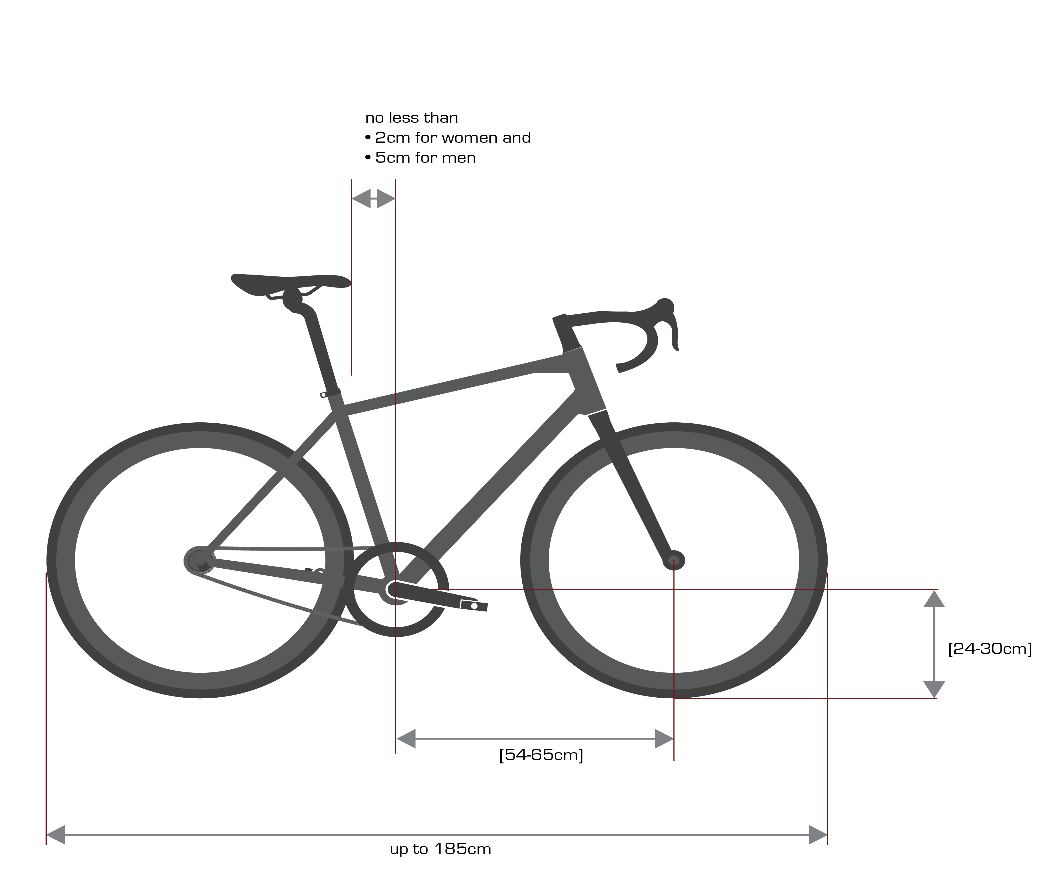
(ill) Non-traditional or unusual bikes:
-
Non-traditional or unusual bikes or equipment shall be illegal unless details have been submitted to the World Triathlon Technical Committee for approval at least 30 days before the Event;
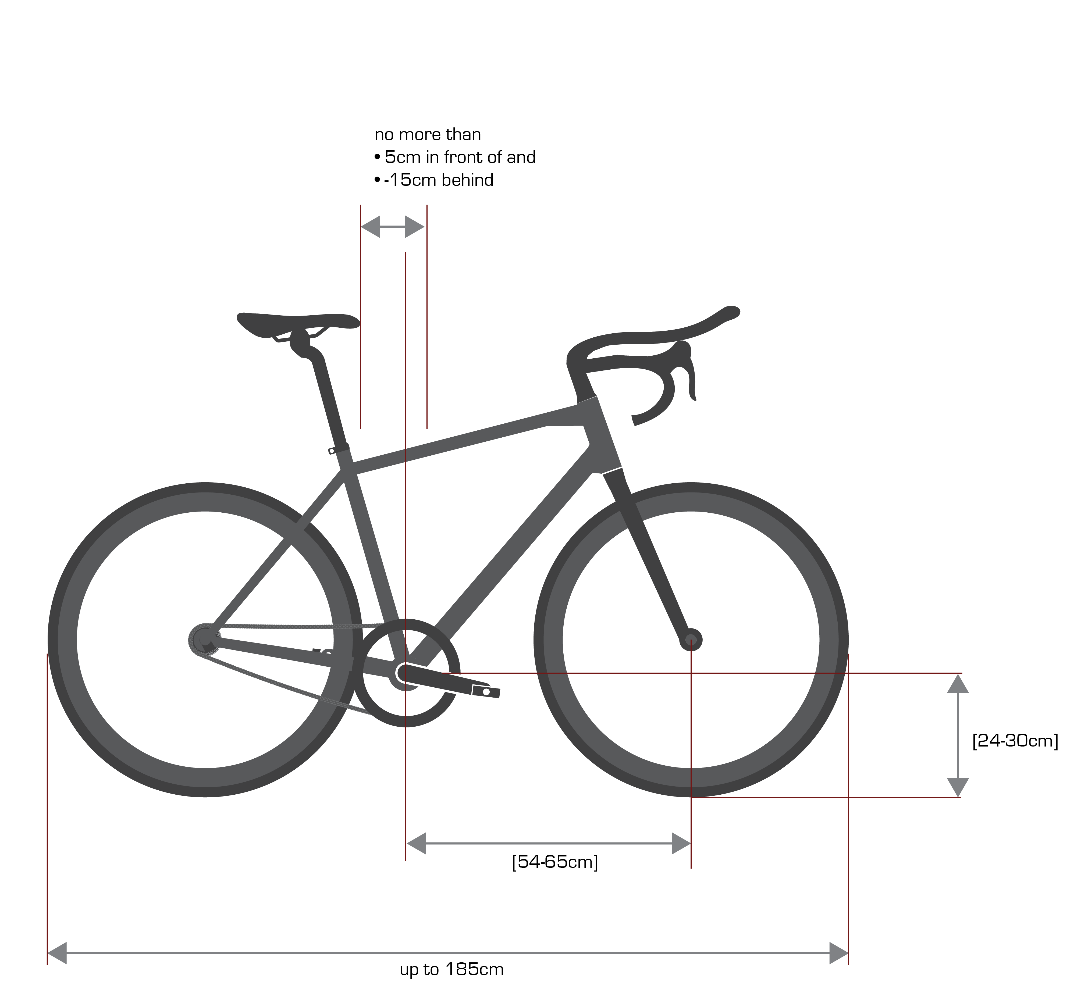
-
Provided all other criteria of the World Triathlon rules are met then full details of the equipment including images must be supplied to the World Triathlon Technical Committee. The procedure is outlined in Appendix P;
-
A catalogue of all previously submitted equipment will be available on the website with confirmation as to whether it has been accepted or rejected. A form is available on the World Triathlon website for athletes wishing to submit equipment for approval.
-
(iv) Logos and race number stickers:
-
Only logos of bicycle related products may appear on the athlete's bicycle;
-
Logos may not interfere with, or hinder the placement of, the bicycle race number on the bicycle frame;
-
The athlete's full name(s) or family name(s) or initial of the first name and family name(s), may appear once on the bike, either on the horizontal bar of the bike or on the shaft of the seat, with a maximum size of 10 cm?;
-
Bike race number stickers, provided by World Triathlon or the Local Organising Committee, must be placed on the bike as instructed, without any alteration.
-
d.) For draft-illegal events, Para Triathlon and Age-Group and draft-legal events:
-
(i) Frames:
-
The bike will be no more than 185 cm long, and 50 cm wide;
-
The bike will measure between 24 cm and 30 cm from the ground to the centre of the chain wheel axle;
-
There will be no less than 54 cm and no more than 65 cm between a vertical line passing through the centre of the chain wheel axle and a vertical line through the centre of the front wheel axle;
-
The frame of the bike shall be of a traditional pattern, i.e., built around a closed frame of straight or tapered tubular elements (which may be round, oval, flattened, teardrop shaped or otherwise in cross-section). Bikes built around a diamond shape (no saddle down tube) or with a rear triangle which does not connect at the top of the down tube/top tube section are considered acceptable;
-
Bikes provided with the UCI Time Trial homologation label (Code TT) are always allowed in World Triathlon draft-illegal events, even if they contravene any of the previous bullets in this 5.2 d.) (i) insert.
-
(ii) Saddle-position:
-
There will be a vertical line touching the front-most point of the saddle which will be no more than 5 cm in front of, and no more than 15 cm behind, a vertical line passing through the centre of the chain wheel axle, and an athlete must not have the capability of adjusting the saddle beyond these lines during competition;
-
Non-traditional or unusual bikes:
-
Non-traditional or unusual bikes or equipment shall be illegal unless details have been submitted to the World Triathlon Technical Committee for approval at least 30 days before the Event. Provided all other criteria of the World Triathlon rules are met then full details of the equipment including images
up to 185cm must be supplied to the World Triathlon Technical Committee. The procedure is outlined in Appendix P. A catalogue of all previously submitted equipment will be available on the website with confirmation as to whether it has been accepted or rejected. A form is available on the World Triathlon website for athletes wishing to submit equipment for approval.
(iii) Logos and race number stickers:
- Only logos of bicycle related products may appear on the athlete's bicycle;
- Logos may not interfere with, or hinder the placement of, the bicycle race number on the bicycle frame;
- The athlete's full name(s) or family name(s) or initial of the first name and family name(s), may appear once on the bike, either on the horizontal bar of the bike or on the shaft of the seat, with a maximum size of 10 cm?;
- Bike race number stickers, provided by World Triathlon or the Local Organising Committee, must be placed on the bike as instructed, without any alteration.
e.) Wheels:
-
(i) No wheel may contain any mechanisms, which are capable of accelerating it;
-
(ii) Tubular tyres must be well glued, the levers of the quick releases must be closed tightly onto the hubs and wheels must be fixed properly onto the frame;
-
(iii) There must be a brake on each wheel;
-
(iv) Wheels can be replaced only at official wheel stations, where provided;
-
(v) Technical Officials at the wheel station will give the proper wheel to the athlete. The athlete is responsible for replacing the wheel in the forks. Wheels designated specifically for other athletes or teams cannot be used;
-
(vi) For Elite, U23, Junior and Youth draft-legal competitions, wheels are allowed to be used if they are included in the current UCI approved non-standard wheels lists. (Both list applicable, the one contains wheels approved prior 1st January 2016 and the other after this date.) Wheels not on this list must comply to the following criteria:
-
A diameter between 70 cm maximum and 55 cm minimum, including the tyre;
-
Both wheels must be of equal diameter;
-
Wheels shall have at least 20 metal spokes;
-
The maximum rim dimension (depth) will be 65 mm on each side;
-
The rim must be alloy;
-
All components must be identifiable and commercially available.
-
(vil) For Age-Group draft-legal competitions, wheels must have the following characteristics:
-
Wheels shall have at least 12 spokes;
-
Disc wheels are not allowed.
(vili) For draft-illegal competitions, covers are allowed on the rear wheel. However, this provision may be changed by the Technical Delegate in the interest of safety, i.e. high winds.
f) Handlebars
-
(i) For Elite, U23, Junior and Youth draft-legal competitions, the following handlebar rules will apply:
-
plugged; · Only traditional drop handlebars are permitted. The handlebars must be
-
The brake controls attached to the traditional drop handlebars shall consist of two supports with levers. It must be possible to operate the brakes by pulling on the levers with the hands on the lever supports in a safe manner, in accordance with the maximum inclination of 10° of the brake levers as described in the Clarification Guide of the UCI Technical Regulations. Any extension to or reconfiguration of the supports to enable an alternative use is prohibited. A combined system of brake and gear controls is authorised;
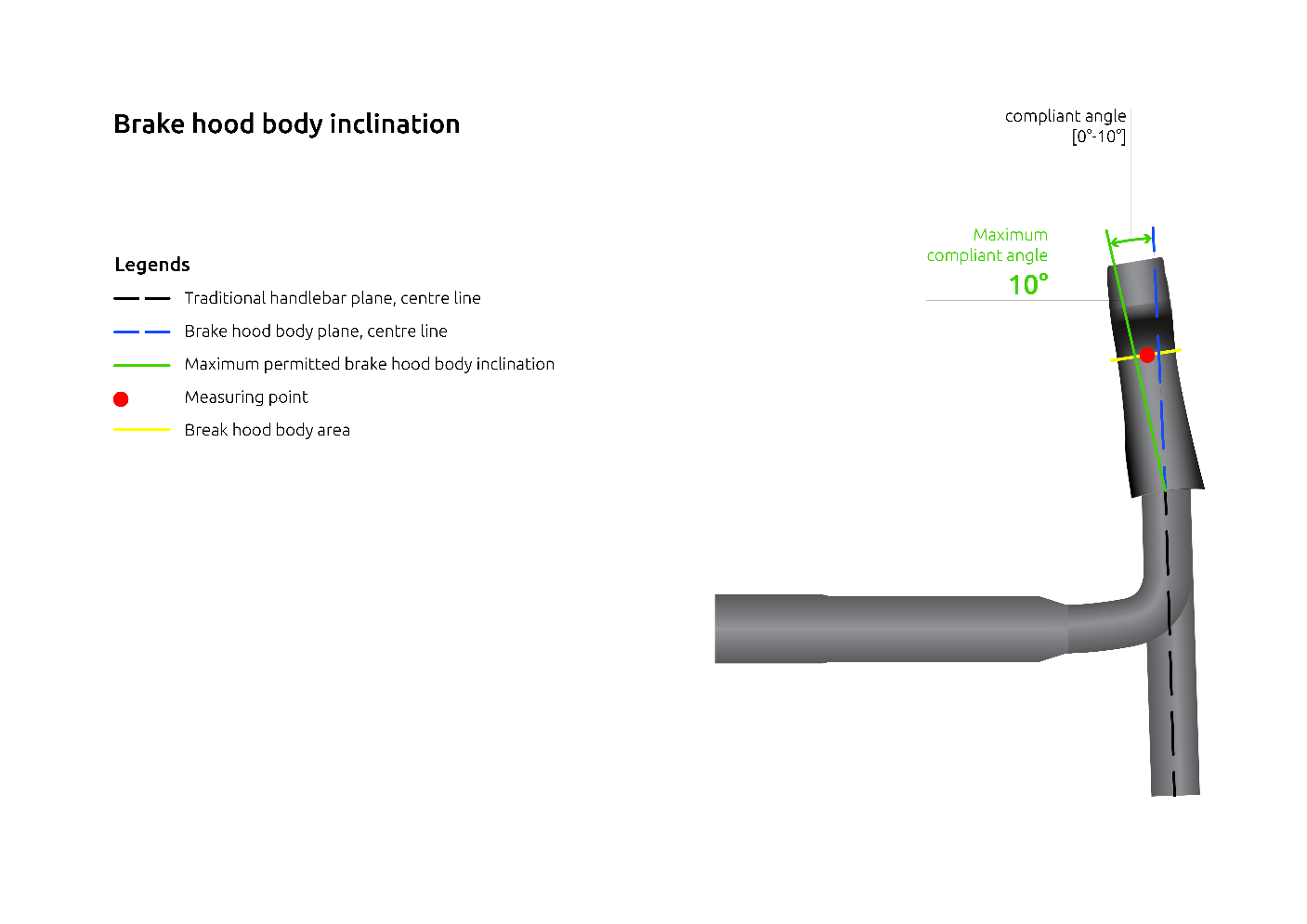
-
Water bottles and water bottle holders may not be mounted onto the handlebars;
-
Clip-ons are not allowed.
-
(ii) For Age-Group draft-legal competitions, the following handlebar rules will apply:
-
Only traditional drop handlebars are permitted. The handlebars must be plugged;
-
Clip-ons are not allowed.
-
(iii) For draft-illegal competitions, the following rules on handlebars apply:
-
Only handlebars and clip-on bars not extending beyond the leading edge of the front wheel will be permitted. Clip-on bars in two pieces do not need to be bridged. All tube ends have to be plugged;
-
Water bottles and water bottle holders may be mounted onto the handlebars or clip-on.
-
(iv) There is no limit in the handlebar width.
g.) Helmets:
-
(i) Helmets must be approved by a national accredited testing authority recognised by a National Federation affiliated with World Triathlon;
-
(ii) Helmet must be used in all official activities when the athlete rides the bike: competition, familiarisation and training sessions;
-
(iii) An alteration to any part of the helmet, including the chin strap, or the omission of any part of the helmet, including an outer cloth cover, is prohibited;
-
(iv) The helmet must be securely fastened and fit properly at all times and any garment worn underneath must not affect the fit when the athlete is in possession of the bike. If an athlete moves the bike off the course for any reason, the athlete may not unfasten or remove the helmet until after he/she has moved outside the boundary of the bike course route and has dismounted the bike; and he/she must fasten the helmet securely on the head before returning onto the bike course or before remounting the bike;
-
(v) Helmet race number stickers, provided by World Triathlon or the Local Organising Committee, must be placed on the front and both sides of the helmet, without any alteration. No other stickers are allowed;
-
(vi) There must be a clearance around the official helmet number sticker of 1.5 cm to ensure the number is clearly visible;
-
(Vil) The helmet can be any colour or design;
-
(viii) The helmet shell and any accessories must not extend to cover, obstruct or enclose the athlete's ears. (Looking from the lateral view. Applicable for draft legal races only;
-
(ix) Integrated or detachable visors are not permitted. Helmets must be used without any visor attachments or shield-like accessories. Applicable for draft legal races only.
h) Platform Pedals
- (i) Platform pedals are allowed, provided a quick-release mechanism is fitted to ensure the release of the feet in case of a fall.
i) Disc brakes
- (i) Disc brakes are allowed.
j) Illegal Equipment
-
(i) Illegal equipment includes, but is not limited to:
-
Headphone(s), headsets), technical earplug(s) or smart helmets which are inserted or covering the ears;
-
Glass containers;
-
Mirrors;
-
Bike or parts of the bike not complying with these rules;
-
Uniform not complying with the applicable Guidelines Regarding Authorised Identifications;
-
Water bottles if placed behind the saddle for draft-legal competitions.
-
k.) Any equipment or devices carried during the bike segment or added to the bike are subject to approval by the Head Referee before the competition, must be securely mounted, not endanger any athlete or give unfair advantage;
-
I.) Fairings are prohibited. Fairings are defined as any devices or materials (including duct tape) added, attached, or blended into the structure of the bicycle which have the effect of reducing the resistance to air penetration. Devices or materials (including duct tape) added, attached, or blended into the structure of the bicycle that does not fundamentally alter or enlarge the general shape of the structure, (e.g., to cover valve cut out of the rear disc wheel, to cover bolts access, etc.) are not affected by this rule;
-
m.) Hydration Volume Limitation: Hydration volume (e.g. bottles or hydration systems) mounted to components that rotate around the steering axis (e.g. cockpit extensions, base bar) must have a combined maximum capacity of 2 litres;
-
n.) Rear Mounted hydration systems, (excluding those mounted to the inside the frame triangle bike are limited in size, capacity, dimension and location as set forth below:
-
(i) cannot contain more than two water bottles;
-
(ii) must not exceed 1L capacity per bottle.
-
o.) Specifically, the following items are not allowed:
-
(i) Bottles/hydration or any other objects (excluding nutrition) attached to or inserted in an athlete's race suit;
-
(ii) Any inserts in an athlete's calf sleeves and arm sleeves.
5.3Bike Checkp. 59
- a.) A bike check may include all items listed in 5.2;
- b.) A visual bike check will take place before the athletes access the transition area prior the competition. Technical Officials will check that bikes comply with the World Triathlon Competition Rules;
- c.) Athletes may request approval from the Head Referee after the Athletes' Briefing if their bike is legal;
- d.) Each registered athlete may only check one bike into their transition;
- e.) All athletes must rack their bike before the Transition Area closes. Any athlete unable to do this must inform the Head Referee.
5.4Overlappingp. 59
- a.) In the draft legal races for Elite, U23, Junior, Youth and Mixed Relay, athletes who have been lapped during the bike segment will be withdrawn from the competition by the Technical Officials. Technical Officials may anticipate this decision, for safety reasons, if the athlete is closer than 100 meters ahead from the leader and the Technical Official is totally sure that the overlapping will happen. This provision can be modified by the Technical Delegate, following the procedure outlined in 1.5.
5.5Draftingp. 59
a.) General Guidelines:
- (i) There are two kinds of competitions, depending on the allowance of drafting:
- Draft-legal competitions;
- Draft-illegal competitions.
- (ii) The competitions will be draft-legal or illegal according to this table:
| Junior and Youth | U23 | Elite | Age-Group | Para triathlon | |
|---|---|---|---|---|---|
| TRIATHLON | |||||
| Mixed Relay | Legal | Legal | Legal | Legal | Illegal |
| Super Sprint Distance | Legal | Legal | Legal | Illegal | |
| Sprint Distance | Legal | Legal | Legal | Both options | Illegal |
| Standard Distance | Legal | Legal | Illegal | Illegal | |
| Middle and Long Distance | Illegal | Illegal | Illegal |
| DUATHLON | DUATHLON | DUATHLON | DUATHLON | DUATHLON | DUATHLON |
|---|---|---|---|---|---|
| Mixed Relay | Legal | Legal | Legal | Legal | |
| Super Sprint | Legal | Legal | Legal | Illegal | |
| Sprint Distance | Legal | Legal | Legal | Both options | lllegal |
| Standard Distance | Legal | Legal | Illegal | Illegal | |
| Middle and Long Distance | Illegal | Illegal | Illegal | ||
| AQUATHLON | |||||
| WINTER TRIATHLON (all distances) | Legal | Legal | Legal | Legal | Legal |
| CROSS TRIATHLON AND DUATHLON (all distances) | Legal | Legal | Legal | Legal | Legal |
| AQUABIKE | Illegal |
b.) Draft legal events:
- It is forbidden to draft off a different gender athlete;
- (ii) It is forbidden to draft off an athlete being in a different lap;
- (iii) It is forbidden to draft off a motorbike or vehicle.
c.) Draft-Illegal events:
- (i) It is forbidden to draft off another athlete or motor vehicle. Athletes must reject attempts by others to draft;
- (ii) An athlete is entitled to any position on the course, provided they get to that position first and without contacting others. When taking a position, an athlete must allow reasonable space for others to make normal movements without making contact. Adequate space must be available before passing;
- (iii) An athlete who approaches from any position to take advantage of the draft, bears responsibility for avoiding the draft;
- (iv) To draft is to enter the bicycle or vehicle drafting zone:
- The bicycle draft zone will be 12 meters long measured from the leading edge of the front wheel. An athlete may enter the draft zone of another athlete but must be seen to be progressing through that zone. A maximum of 25 seconds will be allowed to pass through the zone of another athlete. Several consecutive attempts to overtake with no success may lead to a drafting infringement;

- Motorbike draft zone: the draft zone behind a motorbike will be 20 meters long. This applies also for draft legal events;
- Vehicle draft zone: The draft zone behind a vehicle will be 35 meters long and applies to every vehicle on the bike segment. This applies also for draft legal events.
- (v) Entry into the bicycle drafting zone: An athlete may enter a bike draft zone in the following circumstances:
- For safety reasons;
- If the athlete enters the draft zone, and progresses through it within the allotted time in the overtaking manoeuvre;
- 100 meters before and after an aid station or transition area;
- At an acute turn;
- If the Technical Delegate excludes a section of the course because of narrow lanes, construction, detours, or for other safety reasons.
(vi) Overtaking:
- An athlete is passed when another athlete's front wheel is ahead of theirs;
- An overtaken athlete must drop out of the draft zone of the passing athlete by continuously making rearward progress out of the draft zone of the passing athlete. Re-passing by an overtaken athlete prior to dropping out of the draft zone will result in a drafting violation;
- Overtaken athletes who remain within the draft zone of the passing athlete for more than the allotted time will be given a drafting violation;
- Athletes must keep to the side of the course and not create a blocking incident. Blocking is where an athlete who is behind cannot pass due to the leading athlete being poorly placed on the course;
- The Technical Delegate will instruct the athletes during the briefing on which side they must pass another athlete when mounted on their bicycle.
- (vii) See the diagrams below for events where the right-hand side road rules apply.
5.6Penalties for draftingp. 62
- a.) It is forbidden to draft in a competition declared as draft-illegal;
- b.) Technical Officials will notify the athletes who draft they are subject to a time penalty. This notification must be clear and unambiguous;
- c.) The athlete sanctioned has to stop in the next penalty box and must stay there for a specific time depending on the competition distance. Drafting time penalties are outlined at 3.3 e.);
- d.) It is the athlete's responsibility to stop in the next penalty box. Failing to stop will result in a disqualification;
- e.) A second drafting offence will lead to a disqualification in standard distance events or shorter;
- f.) The third drafting offence will lead to disqualification for middle- and long-distance events;
- g.) Drafting violations cannot be protested.
5.7Blockingp. 62
- a.) Athletes must keep to the side of the course and not create a hazard by blocking other athletes on the course. Blocking is where an athlete who is behind an athlete cannot pass due to the leading athlete being poorly placed on the course. Athletes blocking will receive a yellow card to be served at the next bike penalty box.
Illustration for riding on the right side of the road
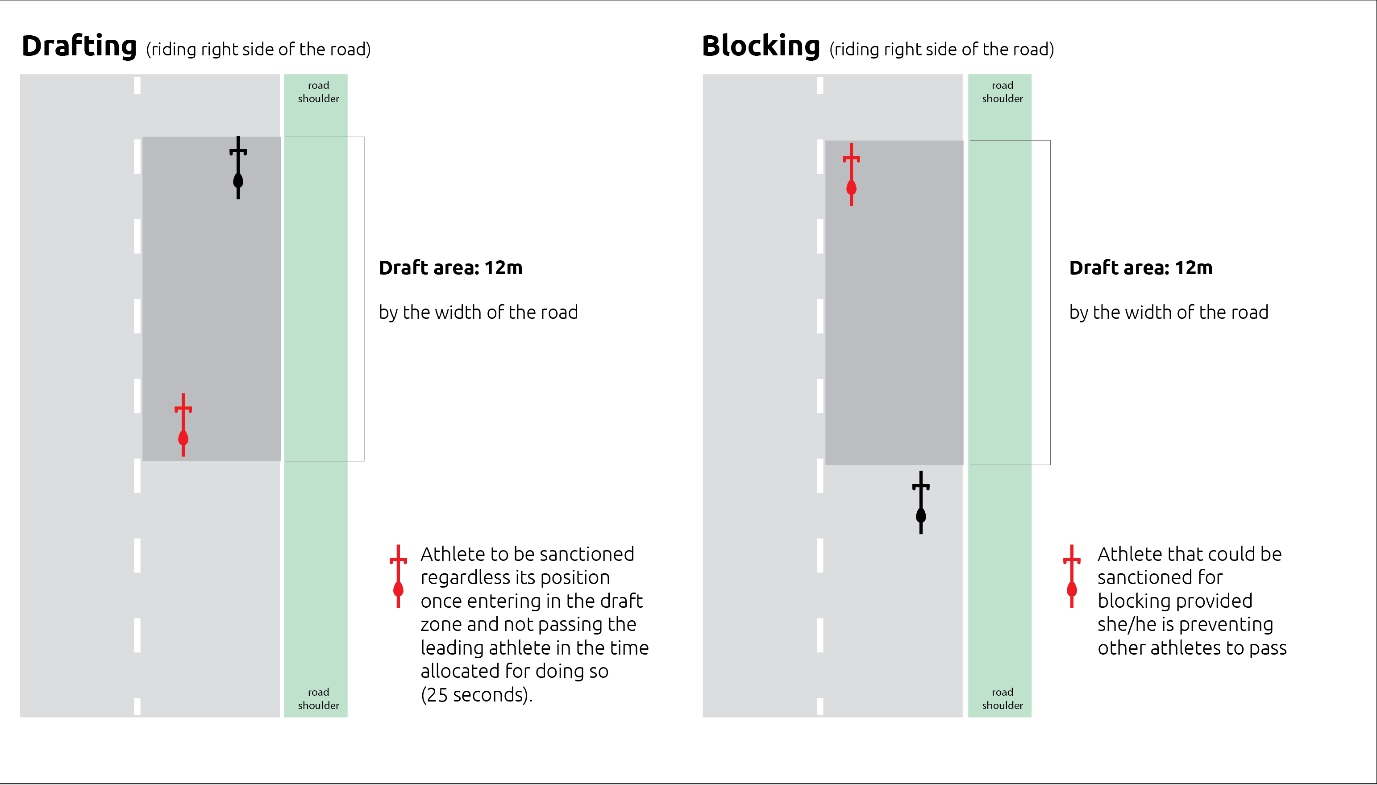
5.8Riding positionsp. 62
-
a.) The riding position requires that the only points of support are the following: the feet on the pedals, the hands on the handlebars and the seat on the saddle;
-
b.) Additionally, during the draft-illegal races, forearms can be used as a point of support on the handlebar. While arms or elbows are in contact with the handlebar or armrest, hands will grip the clip on;
-
c.) This article does not apply in Cross and Winter races.
Image 1:
Allowed positions in all races:

Image 3:
Forbidden positions in all races:

5.9Wheel Stationsp. 63
- a.) Wheel stations are designated locations within the competition course where athletes can replace wheels;
- b.) Three types of wheel stations are available in competitions:
- (i) Neutral Wheel Station: Wheels are provided by the Local Organising Committee (LOC) and are available to all athletes;
- (ii) Team Wheel Station: Wheels are supplied by athletes or their teams and are available only to the designated teams or athletes;
- (iii) Mobile Wheel Station: Wheels are provided by the Local Organising Committee (LOC) and are available to all athletes.
- c.) The following types of wheel stations will be available:
- (i) At Elite, U23, Youth events on Standard and shorter distances on the bike course: at least 1 Neutral Wheel Station and 1 Team Wheel Station;
- (ii) At Para events on the bike course: at least 1 Neutral Wheel Station and 1 Team Wheel Station;
- (iii) At Para events on the run course: at least 1 Team Wheel Station;
Image 2:
Forbidden position in all races (handlebar without clip-on):

- (iv) The Technical Delegate may approve additional wheel stations if required.
- d.) Technical Officials and/or LOC personnel at the wheel stations will distribute wheels to athletes as needed. It is the athlete's responsibility to correctly install the replacement wheel;
- e.) At Para events personal handlers are allowed to assist their athletes with bike repairs, including wheel replacements, but only within the designated wheel station. The Technical Delegate may approve other accredited team staff to assist their athletes with wheel replacements or bike repair at the specific wheel station;
f) Neutral Wheel Station
- (i) The inventory of wheels provided at Neutral Wheel Station are to be approved by the Technical Delegate. The list of provided wheels is to be published at the Athletes' Briefing;
- (ii) The location of the Neutral Wheel Station will be approved by the Technical Delegate and published at the Athletes' Briefing;
- (iii) The Neutral Wheel Station will be marked with a "Wheel Station" sign on the racecourse;
- (iv) There will be a "Wheel Station 200 meters" sign on the racecourse, 200 m before the specific wheel station;
- (v) The servicing follows the "first come first served" principle.
g) Team Wheel Station
-
(i) Teams may supply wheels in advance, ensuring they meet competition standards;
-
(i) The collection of wheels will happen according to the instructions provided at the Athletes' Briefing;
-
(iii) The location of the Team Wheel Station will be approved by the Technical Delegate and published at the Athletes' Briefing;
-
(iv) The Team Wheel Station will be marked with a "Wheel Station" sign on the racecourse;
-
(v) There will be a "Team Wheel Station 200 meters" sign on the racecourse, 200 m before the specific wheel station;
-
(vi) Only dedicated teams or athletes can use the provided wheels;
-
(vii) Teams or athletes must ensure that their wheels are clearly marked with identifiers as specified in the Athletes' Briefing;
-
(vili) The team or athletes is responsible for the readiness and condition of the wheels.
-
h. Mobile Wheel Station:
- (i) The inventory of wheels provided at Neutral Wheel Station are to be approved by the Technical Delegate. The list of provided wheels is to be published at the Athletes' Briefing;
- (ii) The way of operation the Mobile Wheel Station are to be approved by the Technical Delegate. Information regarding its operation is to be published at the Athletes' Briefing;
- (iii) The servicing follows the "first come first served" principle.
- i.) In case of a wheel replacement the original (replaced) wheel must be left at the wheel station. Not adhering this rule may lead to disqualification.
Chapter 6: Running:
6.1General Rulesp. 66
a) The athletes will
- (i) Run or walk;
- (ii) Wear the bib number (applicable always in the Age-Group events. For other events, the Technical Delegate can make it mandatory and athletes will be informed in the race briefing);
- (iii) Not crawl;
- (iv) Not run with a bare torso;
- (v) Not run with a bike helmet on;
- (vi) Not use posts, trees or other fixed elements to assist manoeuvring curves;
- (vii) Not be accompanied by any non-competing athletes, team members, team managers or other pacemakers on the course or alongside the course;
- (viii) Not run together and/or take pace from other athlete/s who is/are on another lap (Applicable only to Elite, U23, Junior, Youth athletes and Para triathletes).
- b.) Where an athlete makes accidental contact during the run with another athlete, then immediately moves away and does not cause a fall, the athlete will not incur a penalty;
- c.) Where an athlete makes contact with another athlete during the run, continues to impede the progress of the other athlete and does not move away, the athlete will incur a time penalty;
- d.) Where an athlete deliberately targets another athlete during the run and impedes their progress, gains an unfair advantage, potentially causes harm or a fall, the athlete will be disqualified and may be reported to the World Triathlon Tribunal for potential suspension or expulsion.
6.2Finish Definitionp. 66
- a.) An athlete will be judged as finished, the moment any part of the torso crosses a vertical line extending from the leading edge of the finish line.
6.3Safety Guidelinesp. 66
- a.) The responsibility of remaining on the course rests with the athlete. Any athlete, who appears to Technical Officials or Medical personnel as presenting a danger to themselves or others, may be removed from the competition;
- b.) Athletes can't be accompanied by any non-competing person in the finish chute.
6.4Illegal Equipmentp. 66
-
a.) Headphone(s), headsets) or technical earplug(s), which are inserted or covering the ears;
-
b.) Glass containers;
-
c.) Uniform not complying with the World Triathlon Guidelines Regarding Authorised Identification;
-
d.) Crutches, canes, poles or any device to help the progress by pushing or pulling with the arms. The specific regulation for para triathletes is included in chapter 17;
e) Shoes
- (i) World Triathlon follows World Athletics' Shoe Regulations applicable to road events for all the triathlon and its other related multisports as described Appendix I;
- (ii) Customised shoes, as defined in the World Athletics' Shoe Regulations, are permitted to be worn in competitions following approval from the World Triathlon Technical Committee;
- (iii) Development shoes, as defined in the World Athletics' Shoe Regulations, can be used in all World Triathlon recognised events (with the exception to the elite competitions of the World Triathlon Championship Series events, the elite events of T100 World Tour, the elite/u23 competitions of the World Triathlon Championship Finals, the elite/junior competitions of the World Triathlon Sprint & Relay Championships, the elite/u23/junior/para competitions of all the World Triathlon Multisport Championships, the World Triathlon Para Championships, the Olympic Games and the Paralympic Games) with the conditions that:
- the specific shoe is already on the list of Shoes Approved by World Athletics as a development shoe; and
- the triathlon event where the shoes to be used is held within the approved dates as on the list of Shoes Approved by World Athletics; and
- the shoe manufacturer or the athlete must submit the request to World Triathlon Technical Committee to be able to use the development shoes.
- (iv) The intention of using a development shoe has to be reported to the technical officials during the athletes' lounge check in process;
- (v) Athletes are subject to random shoe control in the following timelines:
- In the case of Elite, Youth, Junior, U23, and Para competitions: from the time the Athletes Lounge registration opens until 20 minutes after the last athlete in the competition crosses the finish line;
- In the case of Age Group competitions: from the time athlete check-in begins until 45 minutes after the last athlete in the competition crosses the finish line.
For any shoe that cannot be identified, each piece of information (and maybe the shoe itself) will be required to be sent to the World Triathlon headquarters for verification within 7 days after the competition it was worn;
- (vi) In the official results, the athletes under shoe review will have a note (Uncertified/ UNC) added to the results footer notes. If the shoe is confirmed as legal, the note will be removed. In any different case, the athlete will be disqualified.
Chapter 7: Transition Area:
7.1General Rulesp. 68
- a.) Athletes must use only their designated bike rack and must rack their bike:
- (i) For a traditional bike rack, the bike must be racked as follows:
- For the first transition: in an upright position with the front of the saddle hooked over the horizontal bar so the front wheel is pointing to the middle of the transition lane. Head Referee may apply exceptions;
- For the second transition: In any direction, with both sides of the handlebar, both brake levers or the saddle within 0.5 m of the rack number or name plate. The bike must be racked in a way that does not block or interfere with the progress of another athlete.
- (ii) In case of an individual bike rack, the bike must be racked in the first transition by the rear wheel and in the second transition by either of the wheels.
b) Position of equipment
-
(i) Athletes must place within 0.5m of the bin all equipment to be used at a later stage in the event. If a bin is not provided, the 0.5m will be measured from the point on the ground immediately below the rack number or name plate. The bin, if provided, must be within 0.5m from the rack number or name plate;
-
(ii) Only equipment to be used during the competition can be left in transition. All other belongings and equipment are to be removed before competition starts;
-
(iii) By the end of the last transition all equipment - regardless whether used or not - must be deposited in the corresponding numbered bin provided, with the following exceptions:
-
bike shoes, which may remain fixed on the pedals;
-
other bike equipment than helmet and glasses, if placed on the bike previously in Transition 1 may remain on the bike.
-
(iv) For any previous transitions, only used equipment must be deposited in the corresponding numbered bin provided. For events with repeating segments, the rule applies for any used equipment that will not be used again;
-
(v) A piece of equipment is considered deposited in the bin when one part of the equipment is inside the bin.
-
c.) If an athlete wishes to use the same shoes in a duathlon for the second run these do not have to be placed in the bin in transition one, however, only one pair of running shoes may be on the floor at any time during the bike segment of the competition. Running shoes must be located within 0.5m of the athlete's bin (rack number/name plate);
-
d.) Athletes who are observed by a Technical Official intentionally discarding any item between the swim exit and transition will receive a penalty;
-
e.) Bike shoes, glasses, helmet, and other bike equipment can be placed on the bike in Transition 1;
-
f.) Athletes must not impede the progress of other athletes in the transition area. Interference that prevents another athlete to continuing in the competition will result in disqualification. Misplaced equipment can be moved by the athlete affected;
-
g.) Cycling is not permitted inside the transition area, except during the cycling segment. Mount and dismount lines are part of the transition area;
-
h.) Athletes must mount their bicycles after the mount line by having one complete foot contact with the ground after the mount line;
-
i.) Athletes who cycle out of transition rather than mounting at the mount line will be disqualified;
-
j.) Athletes must dismount their bicycles before the dismount line by having one complete foot contact with the ground before the dismount line;
-
k.) Athletes who make no attempt to dismount at the Dismount line causing them to cycle in Transition will be disqualified;
-
l.) While in the transition area (before the mount line and after the dismount line) the bike can be pushed only by the athlete's hands;
-
m.) It during the mount or dismount manoeuvre, the athlete loses their shoe(s) or other equipment, they will be collected by the Technical Officials and no penalty will be applied;
-
n.) Nudity or indecent exposure is forbidden;
-
o.) Athletes cannot stop in the flow zones of the transition area;
-
p.) Wetsuits can only be fully removed in a designated area or at the transition spot. However, the wetsuit covering the upper part of the body and arms may be undone before arrival at the designated area or at the transition spot provided the torso remains covered at all times;
-
q.) Marking positions in the transition area is forbidden. Marks, towels and objects used for marking purposes will be removed and the athletes will not be notified;
-
r.) All athletes must have their helmet securely fastened and cannot lock or unlock the locking mechanism of the helmet from the time they remove their bike from the rack before the start of the bike segment until after they have placed their bike on the rack and let go after the finish of the bike segment;
-
s.) The helmet strap must remain unfastened in the transition area while the athlete is completing the first segment.
Chapter 8: Competition Categories
8.1World Championshipsp. 70
- a.) World Triathlon may organise World Championships in the distances, formats and categories shown in this chart:
| Elite | U23 | Junior | Age-Group | Para triathlon | |
|---|---|---|---|---|---|
| TRIATHLON | |||||
| Mixed Relay | Yes | Yes (U23/Jr combined or separated) | Yes (U23/Jr combined or separated) | Yes | Yes |
| Eliminator | Yes | ||||
| Super Sprint Distance | Yes | Yes | Yes | Yes | |
| Sprint Distance | Yes | Yes | Yes | Yes | Yes |
| Standard Distance | Yes | Yes | Yes | Yes | |
| Middle Distance | Yes | Yes | Yes | ||
| Long Distance | Yes | Yes | Yes | ||
| DUATHLON | |||||
| Mixed Relay | Yes | Yes | |||
| Sprint Distance | Yes | Yes | Yes | Yes | Yes |
| Standard Distance | Yes | Yes | Yes | Yes | |
| Middle Distance | Yes | Yes | Yes | ||
| Long Distance | Yes | Yes | Yes | ||
| AQUATHLON | |||||
| Standard Distance | Yes | Yes | Yes | Yes | Yes |
| Long Distance | Yes | Yes | Yes | ||
| Mixed Relay | Yes | ||||
| WINTER TRIATHLON AND WINTER DUATHLON | WINTER TRIATHLON AND WINTER DUATHLON | ||||
| Mixed Relay | Yes | Yes | |||
| Sprint Distance | Yes | Yes | Yes | Yes | Yes |
| Standard Distance | Yes | Yes | |||
| CROSS TRIATHLON AND CROSS DUATHLON | CROSS TRIATHLON AND CROSS DUATHLON | CROSS TRIATHLON AND CROSS DUATHLON | CROSS TRIATHLON AND CROSS DUATHLON | CROSS TRIATHLON AND CROSS DUATHLON | CROSS TRIATHLON AND CROSS DUATHLON |
| Mixed Relay | Yes | Yes | |||
| Sprint Distance | Yes | Yes | Yes | Yes | |
| Standard Distance | Yes | Yes | Yes | Yes | |
| AQUABIKE | |||||
| Standard Distance | Yes | ||||
| Long Distance | Yes |
- b.) National Federations and Continental Confederations should be encouraged to include each of these categories in their National and Continental Championships;
- c.) National Federations and Continental Confederations may organise National and Continental Championships in super sprint and shorter distances for ages of 15 years and below. The decision on which ages are grouped together is the responsibility of the National Federation and the Continental Confederation respectively.
Chapter 9: Prizes And Awards
9.1Prize Moneyp. 72
a.) General Rules:
- (i) Prize money for the World Triathlon Events shall be distributed equally between men and women in both amount and depth, according to the World Triathlon Prize Money Percentage Breakdown, as outlined in Appendix H;
- (ii) Prize money will be paid regardless of the points cut-off percentage time of the winner.
9.2Awardsp. 72
- a.) Athletes or team members who place first, second or third at any event will be awarded an official podium medal (gold, silver, bronze);
- b.) In addition, teams may receive a medal and/or trophy for first, second and third positions.
9.3Prizes, Points and Awards in combined events/categoriesp. 72
- a.) In case of events which take place together or different categories competing together in the same wave, the awards, prize money and points will be distributed as follows:
| Events taking place together: | Awards (medals) to: | Prize money to: | Points to: |
|---|---|---|---|
| Elite and U23 | - Elite awards for all athletes - U23 awards for U23 athletes | - Overall | - Overall |
| Elite, U23 and Junior | - Elite awards for all athletes - U23 awards for U23 athletes - Junior awards for Junior athletes | - Overall | - Overall |
| U23 and Junior | - U23 awards for U23 athletes - Junior awards for Junior athletes | - Overall | - Overall |
| All categories | - Elite awards for all athletes - Categories awards per categories | - Overall | - Overall |
| Triathlon Continental Championships with athletes from other continents | - Award for the athletes from the continent | - All are eligible | - Athletes from the continent |
| Multisport Continental Championships with athletes from other | - Award for the athletes from the continent | - All are eligible | - Overall |
| Continental Cups | - Overall | - Overall | - World Triathlon points: overall |
| - Continental points: Athletes from the continent |
|---|
- b.) Following the Continental Confederation approval, athletes from other continents can participate in Continental Championships provided that the competition is not full with the athletes from the host continent. In this case, points and medals are going to athletes from the host continent, but prize money is distributed to the athletes in the overall results. The exceptions to this paragraph are the Duathlon and Long-distance Triathlon Continental Championships that are part of the World Series as well: in this case points are distributed to the overall results.
Chapter 10: Events
10. A. Events: Safety and environment: [p.74]
10.1Water qualityp. 74
a) Water quality
- (i) Samples of the water collected from three different locations on the swim course will be separately analysed and the poorest results will determine if the swim can take place. The following values are set as the World Triathlon tolerance limits in the different types of water:
- Sea and transition water:
- PH between 6 and 9;
- Entero-cocci not more than 200 per 100 ml (cfu / 100 ml);
- Escherichia coli E. Coli not more than 500 per 100 ml (cfu / 100 ml);
- Absence of positive visual evidence of Red Tide Algal bloom.
- Inland water:
- PH between 6 and 9;
- Entero-cocci not more than 400 per 100 ml (cfu / 100 ml);
- Escherichia coli E. Coli not more than 1000 per 100 ml (cfu / 100 ml);
- The presence of Blue-Green Algal blooms/scum (cyanobacteria) not more than 100.000 cells/ml. This test is only required in case of positive visual evidence of Blue-Green Algal bloom. Because of the potential for rapid scum formation daily visual inspection is mandatory by the LOC Medical Director in the two weeks before the competition in the area prone to scum formation. Where no scums are visible, but the water shows strong greenish discoloration, turbidity and the transparency is less than 0.5 m the cyanobacteria test must be performed.
- All units have to be cfu/100 ml or nmp/100 ml. (cfu: Colony Forming Units; nmp: Most Probable Number).
10.2Water quality information and decision-making flowp. 74
a) Water Quality Data
-
(i) According to the World Triathlon rules, the LOC must submit water quality tests taken from three locations of the swim course:
-
2 months before the competition;
-
7 days before the competition;
-
on the first competition day of the event, for statistical purposes only.
-
(ii) However, results delivery may vary from 48 hours to 96 hours depending on the methodology that the laboratory is using. Results received more than seven days after the sample collection will not be accepted;
-
(iii) Therefore, making a decision on competition delay based purely on data that is not reflecting the current conditions 100% is not advisable;
-
(iv) Additionally, for Olympic and Paralympic Games the collection of water samples will be done:
-
One test per day for a period of ten days before the first competition till two days after the last competition, one, two and three years before the Olympic Games and the Paralympic Games;
-
From ten days before the first competition till two days after the last competition twice every day, in the morning and in the evening in the year of the Olympic Games and the Paralympic Games;
-
Results will be delivered within 24 hours from the sample collection.
b) Applicable process
- (i) Use approach in the cases but not limited to, where the event is running under rainy conditions recommended by WHO to guide decision making by combining:
- Visual inspection;
- Water quality analysis;
- Weather forecasts.
c) Visual inspection
-
(i) The World Triathlon TD and/or the assigned World Triathlon MD must check the following entities that are specific water quality indicators:
-
The absence of oils and smell of phenol;
-
The colour of the water does not change in an abnormal way;
-
Visibility of the water of more than one meter (this may only be less when natural circumstances cause this);
-
The absence of garbage;
-
The absence of discharge of cooling water from a factory;
-
The absence of sewage discharge or the occurrence of houses and boats;
-
The absence of bird colonies;
-
The absence of Blue-Green, Algal bloom or Red Tide Algal bloom.
-
d.) Water Quality Information Flow:
-
(i) The Events Water Quality Evaluation Panel is represented by:
-
World Triathlon Medical Committee representative;
-
World Triathlon Medical Delegate (if not applicable, the World Triathlon Technical Delegate);
-
LOC Medical Director (if not applicable the LOC Race Director);
-
e.) In case of discrepancy between the results we must consider that the E.Coli are the best indicator bacteria for inland water, and the Enterococci are the best indicator for sea water;
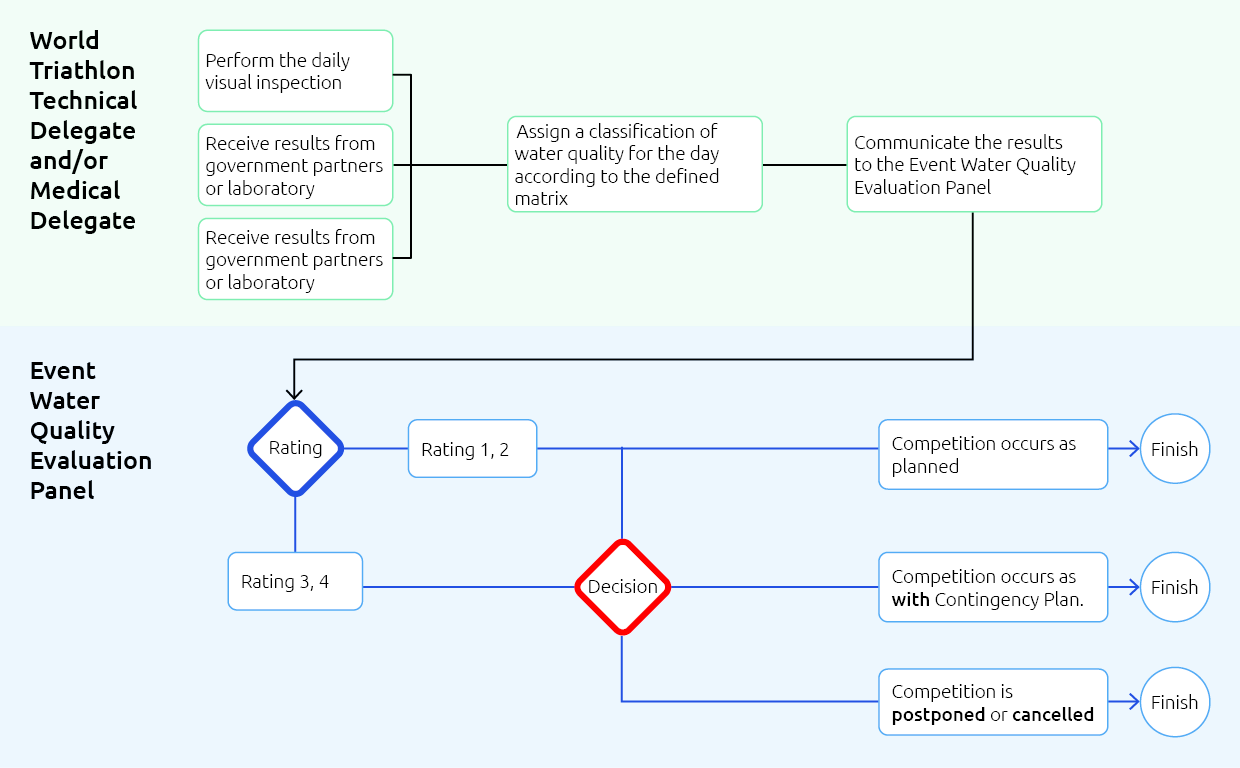
f.) Water Quality Decision Matrix (Sea and Transition water)
| Two past results E.coli < 250* Enterococci < 100* | Last result E.coli: 250 to 500* Enterococci 100 to 200* | Two past results E.coli: 250 to 500* Enterococci 100 to 200* | | Last result E.coli > 500* Enterococci > 200* | ||
|---|---|---|---|---|---|
| Visual Inspection category (susceptibility to faecal influence) | Low | 1 | 2 | 2 | 4 |
| Visual Inspection category (susceptibility to faecal influence) | Moderate | 1 | 2 | 3 | 4 |
| Visual Inspection category (susceptibility to faecal influence) | High | 2 | 3 | 3 | 4 |
Key for Levels:
- 1 = 'Excellent Water Quality': (E. coli < 250 or Enterococci < 100) with no or potential visual pollution during visual check or forecasted heavy rain;
- 2 = 'Good Water Quality': (E. coli < 250 or Enterococci < 100) with poor visual pollution during visual inspection or forecasted heavy rain;
- 2 = 'Good Water Quality': (E. coli: 250 to 500 or Enterococci 100 to 200) but with no or potential visual pollution during visual inspection or forecasted heavy rain;
- 3 = 'Fair Water Quality': (E. coli: 250 to 500 or Enterococci 100 to 200), but with potential or poor visual pollution during visual check and/or potential for forecast of heavy rain;
- 4 = 'Poor Water Quality: (E. coli > 500 or Enterococci > 200), with any visual pollution during visual check and/or potential for forecast of heavy rain.
- g.) Water Quality Decision Matrix (Inland water)
| Two past results E.coli < 500* Enterococci < 200* | Last result E.coli: 500 to 1000* Enterococci 200 to 400* | Two past results E.coli: 500 to 1000* Enterococci 200 to 400* | Last result E.coli > 1000* Enterococci > 400* | ||
|---|---|---|---|---|---|
| Visual category (susceptibility to faecal influence) | Low | 1 | 2 | 2 | 4 |
| Visual category (susceptibility to faecal influence) | Moderate | 1 | 2 | 3 | 4 |
| Visual category (susceptibility to faecal influence) | High | 2 | 3 | 3 | 4 |
Key for Levels:
- 1 = 'Very Good Water Quality': (E.coli < 500 or Enterococci < 200) with no or potential visual pollution during visual check or forecasted heavy rain;
- 2 = 'Good Water Quality': (E.coli < 500 or Enterococci < 200) with poor visual pollution during visual inspection or forecasted heavy rain;
- 2 = 'Good Water Quality': (E.coli: 500 to 1000 or Enterococci 200 to 400) but with no or potential visual pollution during visual inspection or forecasted heavy rain;
- 3 = 'Fair Water Quality: (E.coli: 500 to 1000 or Enterococci 200 to 400), but with potential or poor visual pollution during visual check and/or potential for forecast of heavy rain;
- 4 = 'Poor Water Quality': (E.coli > 1000 or Enterococci > 400), with any visual pollution during visual check and/or potential for forecast of heavy rain.
h.) Decision making
- (i) If the water quality levels show values three (3) or four (4), the swim will proceed, only if the Events' Water Quality Evaluation Panel permits with a simple majority. In this case, the local water quality regulations may be considered.
10.3Modifications due to heatp. 78
- a.) Medical Delegate or, if absent, Race Medical Director will measure the WBGT index. All the measurements with the WBGT tool should be taken at the finish area every 30 min starting 3 hours before the start of the competition. The device must be placed in direct sunlight 1.5 m above the ground;
- b.) WBGT index values are categorised:
- (i) Assessing on-site environmental heat stress at regular intervals using the Wet-BulbGlobe-Temperature (WBGT) index and providing announcements of its readings. WBGT levels for the modification of exercise or competition for healthy adults are based on recommendation from the American College of Sports Medicine (2007);
- (ii) Any decision made will take into consideration the level of medical assistance, facilities in the medical tent, evolution of the weather conditions and forecast, period of the competitive season, race distance and category, athlete fitness level and the age of the athletes. Event organisers will pay particular attention to unexpected or unseasonably hot weather in mass- participation events, considering that the unacclimatised participants or participants without a sufficient level of training are at higher risk for heat illness;
- (iii) During the races, weather information and the WBGT index will be provided at the Sport Information Centre and the Athlete Lounge. The information will be posted in the Athlete Lounge in time for athlete check in. The WBGT index will be converted to a five-level coloured flag system indicating the heat illness risk of current weather conditions. The information will be delivered in the form of written announcement.
| WBGT Risk Categories | WBGT Risk Categories | WBGT Risk Categories | WBGT Risk Categories | WBGT Risk Categories | WBGT Risk Categories |
|---|---|---|---|---|---|
| Flag Colour | Black | Orange | Blue | Green | |
| WBGT Index (°C) | > 32.2 | 30.1-32.2 | 27.9-30.0 | 25.7-27.8 | < 25.7 |
| Risk | Extreme | Very High | High | Moderate | Low |
- c.) For sprint and standard distance events, in case of very high risk (red flag) the following will be taken into consideration:
- (i) If the LOC and Medical Staff are able to provide medical assistance respecting all the rules of the World Triathlon Event Organiser Manual Medical Services and Exertional Heat Illness Prevention document, particularly in large mass participation events:
- Standard distance events: change to Sprint distance;
- Sprint distance and shorter events and below: stay as originally planned.
- (ii) If the LOC and Medical Staff are unable to provide medical assistance respecting all the rules of the World Triathlon Event Organiser Manual Medical Services and Exertional Heat Illness Prevention document, particularly in large mass participation events, the competition must be rescheduled.
- d.) For standard distance and shorter events in case of an Extreme Risk (WBGT index: >32.2°C, Black Flag) the competition must be re-scheduled or cancelled;
- e.) For middle- and long-distance events, a meeting must take place among the assigned Technical Delegate, the assigned Medical Delegate, the LOC Race Director, the LOC Race Medical Doctor and the Chair of the Event Advisory Group for agreeing the heat countermeasures to be implemented in the cases where the event is expecting to take place in very high risk and extreme high-risk conditions.
10.4Swim Currentp. 79
- a.) The Technical Delegate may modify the distance of the swim segment or even cancel the swim, depending on the speed of the current or any other environmental condition which may create safety concerns;
- b.) The race has to be rescheduled or cancelled in the case where the athletes are swimming with the current equal or more 1.5m/s or more than 1.0 m/s for Elites and 0.5 m/s for AgeGroup and Para triathletes in case of swimming against the current. These values against the current are to be measured close to the bank.
10.5Thunderstorm and lightningp. 79
- a.) Lightning can be an immediate threat to athletes. If lightning strikes are approaching the venue and are within 3.1 miles / 5 km the race should be stopped, the venue should be evacuated and the athletes should be taken to a safe area. Thirty minutes after the last lightning, activities may resume.
10. B. Events: Technical [p.74]
10.6Wave startsp. 80
- a.) To ensure the safety of the athletes, there are limits on the quantity of athletes starting at the same time. For categories of events which are not specified below, the quota of athletes is defined in the specific qualification criteria. The Technical Delegate may apply lower limits than the indicated, according to the event conditions:
- b.) Athletes from the same Age-Group can be divided in two or more wave starts provided:
- (i) Both/all waves will have the similar number of athletes assigned;
- (ii) Athletes from the same National Federation will be split in all groups randomly, assigning the similar number to each of the waves;
- (iii) National Federations with only one athlete will be entered to one or the other wave, in order to keep the numbers balanced. The same principle will apply to the excess resulting from National Federations with odd number of athletes;
| WTCS / WTPS | World Triathlon Championship | World Triathlon Cup / WTPC | Other Standard and shorter distances triathlons | a Love-Distance Triathlon - All ev | Cross Triathlon - All events | Duathlon - All events | Mixed Relay | |
|---|---|---|---|---|---|---|---|---|
| Elite | 55 | 65 | 65 | 70 | 100 | 100 | 100 | 30 |
| U23 | n/a | 70 | n/a | 70 | n/a | 100 | 100 | 30 |
| Junior | n/a | 70 | n/a | 70 | n/a | 100 | 100 | 30 |
| Youth | n/a | n/a | n/a | 70 | n/a | n/a | n/a | 30 |
| Semi-final/Final (any category) | 60 | n/a | 90 | 90 | n/a | n/a | n/a | n/a |
| Para triathlon | 80 | 122 | 80 | 52/80 (**) | 80 | 80 | 80 | n/a |
| Age-Group | n/a | 200 | n/a | 200 | 500 | 500 | 500 | 200 |
- (iv) The champion will be the athlete with quickest time, no matter in which wave he/she is starting in;
- (v) The result list of the Age-Groups affected will contain the athletes of both waves sorted by times;
- (vi) The waves containing athletes from the same Age-Group will be scheduled one immediately after the other;
- (vii) These waves will not include athletes from a different Age-Group.
10.7Transitionp. 81
- a.) The Technical Delegate will determine the position of the mount and dismount lines. Both lines will be considered as part of the transition area.
10.8Bikep. 81
- a.) A 10 % tolerance margin will be accepted for the distance of the bike segment provided that it has been approved by the Technical Delegate. In the middle- and long-distance events, this tolerance is limited to 5%;
- b.) There must be a minimum number of penalty boxes as follows:
- (1) Standard distance or shorter events: one every 10 km;
- (ii) Middle- and long-distance events: one every 30 km.
10.9Support teamp. 81
- a.) National Federations can enter in the races a crew to support the athletes and the National Federation delegation. This crew is composed by the following categories: Coaches, Medical, Bike Mechanic, Ski man and National Federation representatives. World Triathlon may add other categories if needed in a specific event. The people entered in the categories of Coaches and Medical must complete the Anti-Doping Education course;
- b.) National Federation's Quota: Every National Federation has a support team quota according to the charts below. When a National Federation has a quota allocated of 3 or higher, different genders will be represented, otherwise the quota will be reduced by 1.
- (i) Elite events:
| Athletes | 1 to 3 | 4 to 6 | 7 or more |
|---|---|---|---|
| Coaches | 2 | 3 | 4 |
| Medical | 1 | 1 | 1 |
(ii) U23 events (U23 not mixed with other categories):
| Athletes | 1 to 6 | 7 or more |
|---|---|---|
| Coaches | 2 | 3 |
- (iii) Junior events:
- (iv) Youth events:
| Athletes | 1 to 6 | 7 or more |
|---|---|---|
| Coaches | 2 | 3 |
| Athletes | 1 to 6 | 7 or more |
|---|---|---|
| Coaches | 2 | 3 |
(v) Para triathlon Events:
| Athletes | 1 to 3 | 4 to 6 | 7 to 9 | 10 to 12 | 13 to 15 | 16 to 18 |
|---|---|---|---|---|---|---|
| Coaches | 2 | 3 | 4 | 5 | 6 | 7 |
| Medical | 1 | 1 | 1 | 1 | 1 | 1 |
(vi) Mixed Relay events:
| Team | 1 or more |
|---|---|
| Coaches* | 3 |
| Medical* | 1 |
(vii) Delegation support for Age-Group events:
| Total number of athletes across all events | 1 to 50 | 51 to 100 | More than 101 |
|---|---|---|---|
| 2 | 4 | 6 | Coaches |
| 1 | 2 | 2 | Bike mechanic/Ski man |
| 1 | 1 | 1 | Medical |
| NF Representatives * | 2 | 2 | 2 |
c.) Head of Delegation:
- (i) National Federations with athletes in every category of Elite, U23, Junior in both genders, will be provided with an extra accreditation with coach access for all events during the World Triathlon Championship Finals;
- (ii) National Federations with athletes in all four events - Duathlon, Aquathlon, Cross Triathlon and Long-Distance Triathlon - in Elite category in both genders, will be provided an extra accreditation with coach access for all events during the World Triathlon Multisport Championships.
- d.) All the personnel registered as part of the support team will receive an accreditation with access according to their role;
- e.) National Federations are responsible for entering their support personnel in the World Triathlon online entry system. World Triathlon will approve the support personnel according to the quota seven days prior to the event. No additions will be admitted after this deadline.
10.10Start timesp. 83
- a.) The minimum time difference between waves will be:
- b.) The Technical Delegate can decide to reduce the above indicated differences in Continental Cup and Duathlon standard distance events provided that the men and the women will not be on the bike segment simultaneously;
- c.) The Technical Delegate can decide to reduce the above indicated differences in Continental Cups and Duathlon standard distance events to a minimum of five minutes if one of the events has fewer than 10 athletes competing, and enough officials to control any potential drafting between male and female athletes;
| Inter gender start time difference (1) | Elite/Age-Group start time difference (2) | |
|---|---|---|
| Continental Cup Sprint | 45 min | 1h |
| Continental Cup Standard | 1h 30 min | 2h |
| World Cup Sprint | 1h 45 min | 1h 30 min |
| World Cup Standard | 2h 45 min | 2h 30 min |
| WTCS Sprint | 1h 45 min | 1h 45 min |
| WTCS Standard | 2h 45 min | 2h 45 min |
| Duathlon Standard Distance | 1h 30 min | 2h 30 min |
| Triathlon / Duathlon MD-LD | 5 min | 5 min |
| Mixed Relay | 1h 45 min | n/a |
- d.) The Technical Delegate can also require different start times by asking for a specific regulation, as indicated under section 1.6;
- e.) Events not included in the previous chart will need the approval of the Technical Delegate prior to publishing the start times.
10.11Modified eventsp. 84
- a.) When a competition cannot be held in the original format due to force majeure, all the points for all the rankings related, including Olympic Qualification List points, will be reduced depending on the final conditions under which the event took place:
- (i) If the event remains as a triathlon or the multisport originally planned, but any of all of the segments are shortened according to the World Triathlon Competition Rules, 100 % of the points will be awarded;
- (ii) If the event becomes another World Triathlon multisport competition according to the World Triathlon Competition Rules in terms of distances and conditions, 100% of the points will be awarded;
- (iii) If a triathlon event becomes a duathlon and the swim is replaced by a running segment with similar duration of the cancelled swim, 100% of the points will be awarded;
- (iv) If the event becomes another World Triathlon multisport competition with deviations from the World Triathlon Competition Rules in terms of distances and conditions, 75% of the points will be awarded.
- b.) In the case of events which have multiple stages (semi-final/final format, eliminator format, supertri E, indoor events or other) and that are modified in one or more stages, the reduction of the points will be applied according to the format of the final stage or phase. If the final stage or phase is not modified there will not be reduction of the points. In case of A and B finals, A final format will determine the points reduction.
10.12Cut-off timep. 84
- a.) Technical Delegate may determine a cut-off time for the entire competition or any intermediate point;
- b.) If there is a cut-off time, it must be announced at least 30 days before registration closes.
Chapter 11: Technical Officials
11.1Generalp. 85
- a.) The duties of the Technical Officials are to conduct the competition are in accordance with the World Triathlon Competition Rules;
- b.) World Triathlon Technical Officials are:
- (i) Technical Officials;
- (ii) Para triathlon Specific Technical Officials;
- (iii) Chair of the Competition Jury.
- c.) Technical Officials must be at least 19 years old on the 31st of December in the year of the competition they are working on;
- d.) To hold a competition under these Competition Rules, it is necessary to have the presence of:
- (i) A Technical Delegate; and
- (ii) A Head Referee.
11.2World Triathlon Technical Officialsp. 85
-
a.) The Technical Officials at all World Triathlon competitions are:
-
(i) The World Triathlon Technical Delegate (TD) ensures all aspects of the World Triathlon Competition Rules and World Triathlon Event Organisers' Manual are fulfilled. Local Organising Committees will modify the competition conditions, as per the indications of the Technical Delegate at any time. Accredited coaches will be informed about the modifications;
-
(ii) The Assistant Technical Delegate (ATD) assists the Technical Delegate with his/her duties;
-
(iii) The Head Referee checks the certification of the Technical Officials, makes the results official by signing them and makes final judgments on rule violations;
-
(iv) The Chief Race Official (CRO) assigns and monitors the work of all Technical Officials;
-
(v) Technical Officials are assigned to Registration, Start, Finish, Transition Area(s), Pretransition Area, Post-Transition Area, Swim, Swim exit, Bike, Run, Wheel Stations, Aid Stations, Technology, Penalty boxes, Lap Counter, Protocol, Race Control Office, Video Review, and Vehicle Control. An adequate number of Technical Officials will be assigned to each area and will be responsible for the enforcement of World Triathlon Competition Rules within their assigned jurisdiction. A Technical Official may be assigned in more than one position. Additional positions may be created if necessary;
-
(vi) Technical Officials can be accredited as Bike Check Officials to conduct technological fraud control. Complete procedure can be found in Appendix N;
-
(vi) The Competition Jury is appointed by the Technical Delegate;
-
(vili) The World Triathlon Medical Delegate, appointed by the World Triathlon Medical and Anti-Doping Committee, is responsible for all medical and anti-doping issues on behalf of World Triathlon;
-
(ix) The Technical Delegate and the Head Referee of same event cannot be linked by a 1st degree relationship.
11.3Para triathlon Specific Technical Officialsp. 86
- a.) The Chief Classifier is a classifier responsible for the direction, administration, coordination and implementation of classification matters;
- b.) Classifiers will be responsible for determining the Sport Class and Sport Class Status of the Para triathletes from PTS2 to PTS5, PTWC1 and PTWC2 Para triathletes;
- c.) Classifiers certified by the International Blind Sports Federation and International Paralympic Committee will be responsible to determine the sport class and sport class status of the PTVI1, PTVI2 and PTVI3 Para triathletes;
- d.) World Triathlon Para triathlon Classification Rules are included in Appendix G.
11.4Technology Toolsp. 86
- a.) Technical Officials may use any kind of electric, electronic, magnetic, or other technological support to acquire data or evidence on rule infractions as supporting evidence.
11.5Volunteer Certificationp. 86
- a.) All volunteers, who are assigned to areas of responsibility on the Field of Play, must be educated to World Triathlon's minimum standard. Education kits obtained from World Triathlon will cover key areas of Field of Play responsibility.
11.6 Health:
- a.) World Triathlon encourages Technical Officials to undergo an annual health evaluation.
11.7Technical Officials' Certificationp. 86
- a.) All documents related to the procedures and regulations on Technical Officials' certification as well as the list of certified Technical Officials can be found under http://www.triathlon.org/development/technical officials/certification
11.8Eligibility International Technical Officialsp. 86
-
a.) A Technical Official (TO) can be affiliated to any National Federation (NF) according to eligibility conditions of each National Federation in terms of nationality, residence, age or any other may applied;
-
b.) Only one affiliation will be recognised by World Triathlon;
-
c.) If a TO listed as an international TO (level 1, 2 and 3a and 3b) within World Triathlon wishes to move from one NF to another NF, he/she is required to introduce an international transfer to World Triathlon;
-
d.) To get an international transfer, the application must be signed by the NF from which the TO wants to transfer and by the NF to which the TO wants to transfer;
-
e.) When a TO applies for an international transfer, the NF from which he/she is transferring from, in signing the transfer application, shall be deemed to have confirmed that there is no reason for them to prevent the TO from transferring to the new NF;
-
f.) The application for international transfer of NF shall be introduced between 1st of November and the 31st of December in any calendar year;
-
g.) When both NFs approve the transfer, the TO will change NF on the international level from the 15th of January in the following year;
-
h.) When only the receiving NF approve the transfer, the TO will change NF on the international level from the 15th of January in the second following year;
-
i.) In the meantime, the TO can continue to act as an international TO under the World Triathlon flag, without representing any NF. World Triathlon will take care of the necessary administration, so he/she can continue acting as international TO;
-
j.) Any appeal from any parties regarding the international transfer process is to be addressed to the World Triathlon Tribunal.
Chapter 12: Protests
12.1Protestsp. 88
- a.) An Athlete, a representative of a National Federation, a representative of a Continental Confederation or a representative of World Triathlon - for all cases accredited for the event - may protest against the start lists or competition results, or protest against the conduct of another Athlete (including the equipment they used), a Technical Official, a Coach or any accredited personnel, or protest against decisions made by the Head Referee;
- b.) Protests received against a disqualification for not serving a time penalty must be analysed from the basis of the rule infringement which caused the time penalty
and not the disqualification itself.
- 12.2 Matters which may be the subject of a protest, including but not limited to:
- a.) Eligibility of an Athlete;
- b.) Composition of a start list;
- c.) Conditions of a field of play, except:
- (i) When a competition cannot be held in the original format due to a force majeure event.
- d.) Conduct of an Athlete;
- e.) Equipment used by an Athlete;
- f.) Conduct of a Technical Official;
- g.) Conduct of an accredited Coach or any accredited personnel;
- h.) Decisions taken by the Head Referee or a Technical Official, except:
- (i) A drafting violation;
- (ii) A time penalty, which has already been served.
- i.) Error in competition results.
12.3Protesterp. 88
- a.) In accordance with the protest initiation procedures set out in rule 12.4, a protest may be initiated by:
- (i) An Athlete who is entered for the competition;
- (ii) A representative of a National Federation who is accredited for the competition in accordance with rule 10.9.
12.4Protest initiation and timelinesp. 89
- a.) Protests will not be accepted unless initiated and lodged in accordance with the relevant timeline. The timeline for a protest varies according to the subject matter of the protest, as follows:
- (i) Eligibility of an athlete:
- The protest must be announced to the Head Referee by the Athlete or his/her National Federation accredited representative before 20.00 of the competition time zone the day before the competition and within a further fifteen (15) minutes a protest form in accordance with rule 12.5 must be lodged with the Head Referee.
- (ii) Composition of a start list:
- See 12. 4. a. (i). 1.
- (iii) Safety measures or conditions of a field of play:
- See 12. 4. a. (i). 1.
- (iv) Conduct of an Athlete:
- Elite, Youth, Junior, U23 and Para competitions (standard and shorter distances):
- A. The protest must be announced to the Head Referee by the Athlete or his/her National Federation accredited representative within five (5) minutes of the later of:
- i. The finish time of the protester;
- ii. The finish time of the protest responder; and
- iii. within a further fifteen (15) minutes, a protest form in accordance with rule 12.5 must be lodged with the Head Referee.
- Elite, U23 and Para competitions (middle and longer distances):
- A. The protest must be announced to the Head Referee by the Athlete or his/her National Federation accredited representative within fifteen (15) minutes of the later of:
- i. The finish time of the protester;
- il. The finish time of the protest responder; and
- ill. within a further thirty (30) minutes, a protest form in accordance with rule 12.5 must be lodged with the Head Referee.
- Age-Group competitions:
-
A. The protest must be announced to the Head Referee by the Athlete or his/her National Federation accredited representative within fifteen (15) minutes of the later of:
-
i. The finish time of the protester;
-
ii. The finish time of the protest responder; and
-
IlI. within a further thirty (30) minutes, a protest form in accordance with rule 12.5 must be lodged with the Head Referee.
-
(v) Equipment used by an Athlete:
- Elite, Youth, Junior, U23 and Para competitions:
- A. See 12. 4. a. (iv). 1. A.
- Age-Group competitions:
- A. See 12. 4. a. (iv). 2. A.
- (vi) Conduct of a Technical Official:
- Elite, Youth, Junior, U23 and Para competitions (standard and shorter distances): The protest must be announced to the Head Referee by the Athlete or his/her National Federation accredited representative within five (5) minutes after the end of the competition, and within a further fifteen (15) minutes, a protest form in accordance with rule 12.5 must be lodged with the Head Referee;
- Elite, U23 and Para competitions (middle and longer distances): The protest must be announced to the Head Referee by the Athlete or his/her Nationa Federation accredited representative within fifteen (15) minutes after the end of the competition, and within a further thirty (30) minutes, a protest form in accordance with rule 12.5 must be lodged with the Head Referee;
- Age-Group competitions: The protest must be announced to the Head Referee by the Athlete or his/her National Federation accredited representative within fifteen (15) minutes after the end of the competition, and within a further thirty (30) minutes, a protest form in accordance with rule 12.5 must be lodged with the Head Referee.
- (vii) Conduct of an accredited Coach or any accredited personnel:
- See 12. 4. a. (vi). 1.
- See 12. 4. a. (vi). 2.
(vili) Decisions taken by the Head Referee:
- Elite, Youth, Junior, U23 and Para competitions (standard and shorter distances:
- A. The protest must be announced to the Head Referee by the Athlete or his/her National Federation accredited representative within five (5) minutes of the later of:
- i. The finish time of the protester;
- ii. The time of posting the decision of the Head Referee on the board at the post finish area; and
- iii. within a further fifteen (15) minutes a protest form in accordance with rule 12.5 must be lodged with the Head Referee.
- Elite, Youth, Junior, U23 and Para competitions (middle and longer distances):
- A. The protest must be announced to the Head Referee by the Athlete or his/her National Federation accredited representative within fifteen (15) minutes of the later of:
- i. The finish time of the protester;
- ii. The time of posting the decision of the Head Referee on the board at the post finish area; and
- ill. within a further thirty (30) minutes a protest form in accordance with rule 12.5 must be lodged with the Head Referee.
- Age-Group competitions:
- A. The protest must be announced to the Head Referee by the Athlete or his/her National Federation accredited representative within fifteen (15) minutes of the later of:
- i. The finish time of the protester;
- ii. The time of posting the decision of the Head Referee on the board at the post finish area; and
- ili. within a further thirty (30) minutes a protest form in accordance with rule 12.5 must be lodged with the Head Referee.
- Decisions at the briefing may be protested not later than 2 hours before the competition starts.
- (ix) Competition Results:
- Elite, Youth, Junior, U23 and Para competitions (standard and shorter distances): The protest must be announced to the Head Referee by the Athlete or his/her National Federation accredited representative within five (5) minutes after the results are posted on the board at the post finish area, and within a further fifteen (15) minutes a protest form in accordance with rule 12.5 must be lodged with the Head Referee;
- Elite, U23 and Para competitions (middle and longer distances): The protest must be announced to the Head Referee by the Athlete or his/her National Federation accredited representative within fifteen (15) minutes after the results are posted on the board at the post finish area, and within a further thirty (30) minutes a protest form in accordance with rule 12.5 must be lodged with the Head Referee;
- Age-Group competitions: The protest must be announced to the Head Referee by the Athlete or his/her National Federation accredited representative within fifteen (15) minutes after the results are posted on the board at the post finish area, and within a further thirty (30) minutes a protest form in accordance with rule 12.5 must be lodged with the Head Referee or alternatively to World Triathlon at sport@triathlon.org from fifteen (15) minutes after the end of the competition until seven (7) days after the publication of the results on www.triathlon.org.
12.5Protests initiation proceduresp. 92
- a.) The protest form may be obtained from the Head Referee. A sample of the form is included in the Appendix B of these World Triathlon Competition Rules;
- b.) The protest form must be accompanied by a fee of $50 USD or equivalent in another currency. Protests sent to World Triathlon at sport@triathlon.org must be accompanied by proof of the fee having been transferred to World Triathlon;
- c.) The protest form must contain, if applicable:
- (i) Competition name, location, date;
- (ii) Protester's name, address, phone, email;
- (iii) The alleged rule violated or decision protested;
- (iv) The location and approximate time of the alleged violation;
- (v) Persons involved in the alleged violation;
- (vi) A statement, including a diagram of the alleged violation, if possible;
- (vil) The names of witnesses who observed the alleged violation;
- (viii) Rationale/summary of the facts.
- d.) Head Referee will admit the protest if:
- (i) It is accompanied by the fee, and
- (i) It is received inside the timelines.
- e.) Once a protest is received, the Head Referee will present the case to the Chair of the Competition Jury of the competition.
12.6Composition of the Competition Juryp. 92
- a.) The World Triathlon Technical Delegate for the competition appoints the members of the Competition Jury as follows:
- (i) For Olympic Games and the Elite competitions of the World Triathlon Championship Finals the Competition Jury consists of five people being selected from:
- The Technical Delegate or the Assistant Technical Delegate, who chairs the Competition Jury;
- A member of the World Triathlon Executive Board;
- A representative of the host National Federation;
- A representative from the World Triathlon Technical Committee;
- A representative from the World Triathlon Medical and Anti-Doping Committee.
- (ii) For all the other World Triathlon Events and other Games that do not include the Olympic Games, the Competition Jury consists of three people being selected from:
~ Triathlon
- The Technical Delegate or the Assistant Technical Delegate, who chairs the Competition Jury;
- A member of the World Triathlon Executive Board or any World Triathlon Committees or Commissions, , or related staff, or if none are present, a member of the Continental Confederation's Executive Board or any Continental Confederation's Committees or Commission, or related staff, or LOC representative, or if none are available, a representative from the host National Federation;
- A representative from the host National Federation or if none are available, a member of the World Triathlon Executive Board or any World Triathlon Committees or Commissions, or related staff, or if none are present, a member of the Continental Confederation's Executive Board or any Continental Confederation's Committees or Commission, or related staff.
- (ili) Prior to the day of the athletes' briefing for the competition, all members of the Competition Jury must complete a Competition Jury online training module available on the World Triathlon Education & Knowledge Hub and obtain a completion certificate, which will remain valid until the end of the following calendar year;
- (iv) The Competition Jury may invite experts to a hearing, at which they may be requested to give expert opinion;
- (V) A member of the Competition Jury in an event must not also be:
- Being a Technical Official in the same event other than the Technical Delegate | Assistant Technical Delegate;
- Being an accredited coach in the same event;
- Being an athlete competing in the same event.
12.7Competition Jury Dutiesp. 93
- a.) The Competition Jury decides on all protests made to it which are in compliance with the relevant protest timeline;
- b.) The Competition Jury may modify the competition results, as a consequence of its decision on the protest. However, the Competition Jury may not remove the time penalty from the final time;
- c.) The Chair of the Competition Jury must file written minutes for all protests within seven days of decisions reached.
12.8Competition Jury Integrityp. 93
-
a.) The Competition Jury must observe the following principles:
-
(i) It must consider all submissions and expert opinions made to it;
-
(ii) Recognize that honest testimony can vary and be in conflict as a result of personal observation or recollection;
-
(iii) Have an open-minded approach until all evidence has been submitted;
-
(iv) Give equal weight to the evidence and testimony provided by all
-
(v) The Competition Jury's decisions to uphold or not to uphold or impose a penalty shall be based upon the standard of a comfortable satisfaction of the majority of Competition Jury members that the alleged violation has occurred.
b) Conflict of interest
- (i) The Chair of the Competition Jury decides if any member has a conflict of interest;
- (ii) In the event of a conflict of interest, or absence of another member, the Chair of the Competition Jury may appoint a replacement of that member;
- (iii) The Chair of the Competition Jury may appoint a replacement at his/her discretion, subject to the requirements of rule 12.6 for the composition of the Competition Jury;
- (iv) Following replacement of a member, the Competition Jury must have the same number of members that it originally had;
- (v) The Chair of the Competition Jury has a conflict of interest in case a person linked by a first-degree relationship with the Chair of the Competition Jury may be affected by the resolution of the protest.
12.9Competition Jury meetingp. 94
- a.) The Competition Jury will meet as determined by the Chair. At least will meet:
- (i) After the race briefing;
- (il) One hour before the start of the event;
- (iii) After the last finisher;
- (iv) After the first Age-Group finisher;
- (v) After the finish of the first half of the Age-Group field.
- b.) Competition Jury meetings method:
- (i) Competition Jury may meet in person, or online in a virtual meeting, or in combination of in person and online, as determined by the Chair.
c) Hearing procedure
-
(i) The protester and the respondent and/or one representative of their National Federation (if applicable) may be present;
-
(ii) Failure of any party to attend a hearing may result in the Competition Jury making a decision in their absence;
-
(iii) A representative may appear on behalf of the protester or the respondent if permitted by the chair of the Competition Jury;
-
(iv) The hearing will not be open to the public;
-
(v) The Chair of the Competition Jury will explain the hearing process and all parties' rights;
-
(vi) The Chair of the Competition Jury will read the protest;
-
(vil) The chair of the Competition Jury will determine if the protest is accepted, dependent upon it being:
- Received within the relevant timeline set out in rule 12.4 and;
- A matter which may be the subject of a protest as set out in rule 12.2.
- (vili) The Chair of the Competition Jury presents the submitted evidence;
- (ix) The Competition Jury will hear from each party;
- (x) The protester and the respondent will be given adequate time to give their accounts of the incident;
- (xi) If permitted by the Chair, the protester and the respondent may call witnesses, who may speak for up to three (3) minutes each;
- (xii) Once the protester, respondent and any witnesses have been heard, the Competition Jury may call other parties interested or affected to speak for up to three (3) minutes each;
- (xiii) The Competition Jury may invite any expert to speak;
- (xiv) The Competition Jury will consider the evidence and any expert opinion and render a decision by simple majority;
- (xv) The decision will be communicated immediately to the parties present and delivered in writing to the parties upon request.
- d.) Written minutes of the Competition Jury meeting, including the Competition Jury's decision, along with the protest form will be submitted to World Triathlon;
- e.) The $50 USD or equivalent fee will be returned to the protester in case the Competition Jury decides in favour of the protester. The $50 USD or equivalent deposit will be forwarded to World Triathlon in case the Competition Jury decides against the protester;
- f.) Once a protest has been lodged with the Competition Jury, no further protest may be lodged for the same matter;
- g.) The Competition Jury decisions, made in accordance with the Competition Rules, are field of play decisions;
- h.) Competition Jury decisions may be appealed to the World Triathlon Tribunal.
12.10Results revision process by the World Triathlon Technical Committeep. 95
-
a.) The World Triathlon Technical Committee may revise the competition results on the basis of new evidence;
-
b.) There is no time limit on the results revision process;
-
c.) Field of play decisions or any matter already dealt with by a Competition Jury may not be reopened under the results revision process;
-
d.) The World Triathlon Technical Committee will decide on the results revision case by maintaining or modifying the competition results;
-
e.) For results revision cases, the World Triathlon Technical Committee will follow the hearing procedure set out in rule 12.9 (C);
-
f.) Any revised competition results will be notified to the affected National Federations and athletes, and published by World Triathlon;
-
g.) World Triathlon Technical Committee results revision process decisions may be appealed to the World Triathlon Tribunal.
Chapter 13: Appeals
13.1Appeal Jurisdictionp. 97
- a.) An appeal is a request for a review of a decision made by the Competition Jury or the World Triathlon Technical Committee (Level 2 Appeal),
- solely with regard to ineligibility or the World Triathlon Tribunal (Level 3 Appeal). The content of the Level 2 Appeal Form is available in Appendix C;
- b.) Decisions from any Competition Jury and the World Triathlon Technical Committee may be appealed to the World Triathlon Tribunal, except field of play decisions.
13.2Level 2 Appeal Procedurep. 97
- a.) The following procedure will be followed in the event of a Level 2 Appeal:
- (i) Decisions from any Competition Jury and the World Triathlon Technical Committee may be appealed to the World Triathlon Tribunal;
- (ii) Appeals may be submitted up to twenty-one Jury met or within twenty-one natural days after the Competition natural days of the Competition Jury or Technical Committee decision;
- (iii) Appeals must be submitted in writing to the World Triathlon Secretary General and will be accompanied by a fee of $ 500 USD which will only be refunded if the appeal is successful;
- (iv) Level 2 appeal decisions may be appealed according to Tribunal Procedural Rules.
WORLD TRIATHLON COMPETITION RULES: SPECIFIC DISCIPLINE COMPETITION RULES
Chapter 14: Indoor Triathlon
14.1Definitionp. 98
- a.) An Indoor triathlon consists of a triathlon, which takes place in a closed space such as a sports pavilion, which has a swimming pool, a cycling track and a running track.
14.2Swimmingp. 98
- a.) Maximum two athletes are allowed per lane of 2.5 meters wide, where they have to keep to the side all the time;
- b.) Athletes will keep the assigned side of the lane.
14.3 Cycling:
- a.) The lapped athletes will be not removed from the race;
- b.) Athletes can draft from others who are on a different lap.
14.4 Running:
- a.) Spike shoes are not allowed.
Chapter 15: Middle- And Long-Distance Events
15.1Medical Guidelinesp. 99
- a.) Specific medical guidelines, including "hot weather" guidelines and medical evacuation plans will be developed by the Race Medical Director in conjunction with the World Triathlon Medical Delegate.
15.2Distancesp. 99
- a.) The course should have demanding hills and challenging technical aspects. A 5% tolerance margin will be accepted for the distance of the bike course, provided it has been approved by the Technical Delegate.
15.3 Penalties:
- a.) Details about penalties are outlined in section 3.
15.4Coaches Stationsp. 99
- a.) In elite races, coaches will have a designated space available on the bike and run segments in order to supply athletes with their own food and beverages. LOC will assign volunteers to assist those athletes without accredited coach.
15.5Personal Needs Stationp. 99
- a.) Additional stations on the bike and or run may be provided for personal needs;
- b.) Any items given out at these stations will be handed out by volunteers supplied by the Local Organising Committee.
15.6Transition Areap. 99
- a.) In the transition area, Technical Officials or Local Organising Committee staff may assist athletes by receiving and placing their bikes and handing out their equipment. This service must be equal for all athletes;
- b.) Athletes are allowed to replace their uniforms in the transition area. If the athlete needs to become nude to do it, this action needs to be done inside the tent provided by the Local Organising Committee for this purpose. All the uniforms used by the athlete have to comply with the World Triathlon Competition Rules;
- c.) Wetsuits must be removed in the designated area;
- d.) For the events where the bag drop system is in place, all equipment must be deposited inside the proper bag provided by the Local Organising Committee. The only exception is the bike shoes that may remain attached to the pedals at all times.
15.7Outside Assistancep. 99
-
a.) Medical assistance, food and liquid are permitted at aid stations, personal needs stations or at coaches' stations;
-
b.) Bike catchers may be provided;
-
c.) Bike Mechanic support may be provided at the approved locations and by the approved vehicles;
-
d.) The Local Organising Committee may provide helpers to remove wetsuits;
-
e.) All other outside assistance is prohibited.
Chapter 16: Team And Relay Events:
16.1Types of Eventsp. 101
- table: a.) World Triathlon may organise Team Events in the distances and categories shown in this
| Type of competition | Type of competition |
|---|---|
| Triathlon | |3 x Same Gender / 4 x Mixed / 2x2 Mixed Relay |
| Triathlon LD | Adding 3 best times |
| Duathlon | 3 x Same Gender / 4 x Mixed / 2x2 Mixed Relay |
| Duathlon LD | Adding 3 best times |
| Winter | 3 x Same Gender / 4 x Mixed / 2x2 Mixed Relay |
| Cross Triathlon | 3 x Same Gender / 4 x Mixed / 2x2 Mixed Relay |
| Cross Duathlon | 3 x Same Gender / 4 x Mixed / 2x2 Mixed Relay |
| Aquathlon | 3 x Same Gender / 4 x Mixed / 2x2 Mixed Relay |
| Corporate Triathlon | Corporate |
16.2Definitionsp. 101
-
a.) Mixed Relay: A team is composed of 4 athletes: 2 men and 2 women, who will compete in the following order: woman, man, woman, man. Each of them will cover a complete aquathlon, triathlon, cross triathlon, duathlon, cross duathlon, winter triathlon or winter duathlon. The total time for the team is from the start of the 1st team member to the finish of the 4'h athlete. Time is continuous and the timing does not stop between athletes. World Triathlon may allow mixed nation teams for specific competitions;
-
b.) 2x2 Mixed Relay: A team is composed of 2 athletes: 1 man and 1 woman, who will compete in the following order: woman, man, woman, man. Each of them will cover a complete twice aquathlon, triathlon, cross triathlon, duathlon, cross duathlon or winter triathlon. The total time for the team is from the start of the 1st team member to the finish of the second leg of the 2^° athlete. Time is continuous and the timing does not stop between athletes. World Triathlon may allow mixed nation teams for specific competitions;
-
c.) 3x Relay: A team is composed of 3 athletes of the same gender. Each of them will cover a complete aquathlon, triathlon, cross triathlon, duathlon, cross duathlon or winter triathlon. The total time for the team is from the start of the 1st team member to the finish of the 3rd athlete. Time is continuous and the timing does not stop between athletes. World Triathlon may allow mixed nation teams for specific competitions;
-
d.) Corporate: A team is composed of 3 athletes regardless of gender. The first athlete will cover the swim segment, the second one the bike segment and the third one the run segment. The total time for the team is from the start of the 1st team member to the finish
-
of the 3rd athlete. Time is continuous and the timing does not stop between athletes. World Triathlon may allow mixed nation teams for specific competitions;
-
e.) Team competition based on the individual results: The total team time is the addition of the 3 best times of the athletes from the same nation and gender. In case of a tie, the time of the third team member will determine the team result.
16.3Resultsp. 102
- a.) When National Federations are allowed to enter more than one team, only the team with the best finishing position will be listed in the results and eligible for awards (medals) and prize money. In the 2x2 Mixed Relay events the two best teams per NF will be listed in the results and eligible for awards (medals) and prize money.
16.4Eligibilityp. 102
- a.) The general eligibility rules apply. The minimum age is 15 years;
- b.) Athletes who are competing under World Triathlon flag are not eligible to be included in any team;
- c.) The maximum number of teams in an event is 25. TD may fix a lower limit according to the conditions of the event but never below 18. This limit does not apply to Age-Group MR events;
- d.) The Relay races, in any multisport, format and event category, may be cancelled if 20 days before the race there are entries from less than 5 teams.
16.5 Uniform:
- a.) The World Triathlon Guidelines Regarding Authorised Identification apply.
16.6Mixed Relay Briefingp. 102
- a.) In case a relay competition is held in conjunction with an individual competition of the same category, both individual and relay information will be included in the same briefing held prior to the first competition according to the timeline specified in 2.7.b;
- b.) In case a relay competition is held independently, a mandatory briefing will be conducted according to the timeline specified in 2.7.b.
16.7Team Compositionp. 102
-
a.) In case a relay competition is held in conjunction with an individual competition of the same category, the team coach will declare all competing athletes and 1 reserve athlete per gender at a given time the day before the competition. All team compositions will be published after this time;
-
b.) In case a relay competition is held independently, a coaches briefing will be held prior to the athletes briefing, where all competing athletes and 1 reserve athlete per gender must be declared. All team compositions will be published after this time;
-
c.) Teams not submitting the declaration form within the specified time will be removed from the start list;
-
d.) Two hours before the competition starts, the coach can communicate to the Head Referee a different team composition and order. These athletes must be listed on the declaration form, otherwise the team composition communicated at the mixed relay briefing will remain in force.
16.8 Competition Day Check-in:
- a.) All the team members must check in together;
- b.) Team members can use the same bike.
16.9Transition Areap. 103
- a.) General applicable rules are outlined in chapter 7. Athletes must place equipment already used in the corresponding numbered individual bin provided, exceptions are the bike shoes, which may remain fixed on the pedals;
- b.) In the 2x2 events athletes are allow to access their position in the Transition Area to reorganize the equipment to be used in the subsequent leg. Athletes may bring in tool or replacement pieces to repair the bike. Bike frame cannot be replaced.
16.10Relay Exchangep. 103
- a.) The relay exchange from one team member to another will take place inside the exchange zone, which is 15 meters long;
- b.) The exchange is completed by the in-coming athlete, using their hand to contact the body of the out-going athlete within the relay zone;
- c.) If the exchange occurs unintentionally outside the exchange zone, the team will receive a penalty of 10 seconds, which must be served in the penalty box. If the relay Exchange was done intentionally outside the relay zone, the team will be disqualified;
- d.) If the exchange is not completed, the team will be disqualified;
- e.) Prior to the relay exchange, the athletes will wait in a pre-relay exchange area until the Technical Official tells them to enter the exchange zone.
16.11Penaltiesp. 103
-
a.) Time penalties are 10 seconds long;
-
b.) Infringements due to missing the briefing and/or starting before the official start signal will be served by the first athlete in Transition 1;
-
c.) All other time penalties are to be served at the penalty box. These penalties may be served by any member of the team, who has not yet completed their portion of the event;
-
d.) Time penalties will be posted in the notice board of the run penalty box before the deadlines listed below. Notifications posted after these times will be considered invalid:
-
(i) Infringements committed during the first leg (except early start) will be notified before the athlete in the second leg finishes the second segment;
-
(ii) Infringements committed from the first change over to the end of the second leg will be notified before the athlete in the third leg finishes the second segment;
-
(iii) Infringements committed from the second change over to the end of the third leg will be notified before the athlete in the fourth leg finishes the second segment;
-
(iv) Infringements committed from the third change over to the end of the first half of the last segment, will be notified before the athlete in the fourth leg gets the half of the last segment;
-
(v) Infringements committed in the second half of the last segment of the last leg, will be notified immediately and personally to the athlete. It will be served on the spot.
16.12Finish:
- a.) Only the last team member is allowed to cross the finish line.
16.13Age-Group Mixed Relay Specific Rulesp. 104
a) Eligibility
- (i) Each team consists of two women and two athletes from the open category;
- (ii) The general eligibility rules apply. A team may include athletes of any age being 15 years old or older;
- (iii) Categories are established considering the addition of the ages (at 31st of December of the year of the competition) of the 4 members of the team and will be as the following: 60-79 (X60), 80-119 (X80), 120-159 (X120), 160-199 (X160), 200-239 (X200), 240-279 (X240), 280-319 (X280), 320+ (X320).
b) Results
- (i) All teams will be included in the results and eligible for awards (medals).
c) Uniform
- (i) The World Triathlon Guidelines Regarding Authorised Identification apply.
d) Mixed Relay Briefing
-
(i) A Team Managers briefing will be conducted two days before the competition.
-
e.) Team Composition Declaration:
-
(i) National Federations will enter the teams (without the composition of the team) by the entry deadline;
-
(ii) Two days before the race, the National Federation will declare the composition of the teams (names of the athletes and order of competition) and a list of names in each of the age categories as reserves for this age category;
-
(iii) The day before the race between 19:00 and 20:00 Age-Group team managers may replace athletes from the teams with athletes from the list of reserves. It is not allowed to move athletes from one team to another.
f) Packet Pick-up
- (i) One member of the team may pick up the team's race packet at the official competition registration area during a designated time. Packet pick-up will be open on the day before the competition;
- (ii) The race packets will contain per athlete a minimum of: five (5) official race numbers (one (1) for body, one (1) for bicycle and three (3) for helmet) and four (4) safety pins, numbered swim cap, accreditation pass, athletes' guide, tickets for all of the social functions. Local Organising Committee gifts may be distributed at the same time;
- (iii) The timing chips will be distributed at the check-in to the Transition Area on the day of the competition.
g) Competition Day Check-in
- (i) All the team members must check in together;
- (ii) Team members can use the same bike.
h) Cycling
- (i) Drafting will be permitted between athletes from the same gender.
i) Relay Exchange
- (i) Same rules will apply as of 16.10.
j) Penalties
- (i) General Age-Group penalty rules will apply.
k) Finish
- (i) Same rules will apply as of 16.12.
Chapter 17: Para Triathlon
17.1Generalp. 106
- a.) Para triathlon, as per the World Triathlon Constitution, is governed by the World Triathlon Competition Rules. This section contains the rules which affect only para triathlon.
17.2Para triathlon Sport Classesp. 106
- a.) World Triathlon Para triathlon has implemented an evidence-based classification system to group impairments into sport classes according to the extent of activity limitation they cause the athlete when performing in the sport of para triathlon;
- b.) There are nine (9) sport classes, as defined in Appendix G:
- (i) PTWC1: Most impaired wheelchair users. Athletes must use a recumbent handcycle on the bike course and a racing wheelchair on the run segment;
- (ii) PTWC2: Least impaired wheelchair users. Athletes must use a recumbent handcycle on the bike course and a racing wheelchair on the run segment;
- (iii) PTS2: Severe impairments. In both bike and run segments, amputee athletes may use approved prosthesis or other supportive devices;
- (iv) PTS3: Significant impairments. In both bike and run segments, the athlete may use approved prosthesis or other supportive devices;
- (v) PTS4: Moderate impairments. In both bike and run segments, the athlete may use approved prosthesis or other supportive devices;
- (vi) PTS5: Mild Impairments. In both bike and run segments, the athlete may use approved prosthesis or other supportive devices;
- (vii) PTVI1: Includes athletes who are totally blind, from no light perception in either eye, to some light perception. One guide is mandatory throughout the race. Must ride a tandem during the bike segment;
- (vili)PTVI2: Includes athletes who are more severe partially sighted athletes. One guide is mandatory throughout the competition. Must ride a tandem during the bike segment;
- (ix) PTVI3: Includes athletes who are less severe partially sighted athletes. One guide is mandatory throughout the competition. Must ride a tandem during the bike segment.
17.3Para triathlon Medal Eventsp. 106
-
a.) There will be six (6) medal events as follows:
-
(i) PTWC: PTWC1 and PTWC2 sport class athletes competing together;
-
(ii) PTS2;
-
(iii) PTS3;
-
(iv) PTS4;
-
(v) PTS5;
-
(vi) PTVI: PTVI1, PTVI2 and PTVI3 sport class athletes competing together.
17.4Classificationp. 107
- a.) Para triathlon Classification Rules can be found in Appendix G;
- b.) All Para triathletes competing at a World Triathlon sanctioned competition must have an international para triathlon classification to ensure they meet the minimal eligibility criteria for competition and are assigned an appropriate sport class. Para triathletes requiring classification will need to:
- (i) be available to attend an International Classification appointment with a World Triathlon designated Classification Panel prior to the competition;
- (i) provide, before the athlete is entered into his/her first ever event wait list and at time of classification, the "World Triathlon Pl Medical Diagnostics Form" or "World Triathlon VI Medical Diagnostics Form" signed by the appropriate medical personnel, a passport sized photo and any other relevant medical documentation.
- c.) Para triathletes competing at a World Triathlon event, where classification is not available, will be informed through their National Federation to submit specific medical documentation to World Triathlon, no later than eight weeks before competition, so that a provisional classification can be assigned to them.
17.5Eligible Classes and Competition Formatsp. 107
- a.) All Para triathletes are allowed to compete in triathlon, duathlon and aquathlon events. Only Para triathletes from sport classes PTS2, PTS3, PTS4 and PTS5 are allowed to compete in winter triathlon, winter duathlon, cross triathlon and cross duathlon events;
- b.) All Para triathletes may start all together or grouped in waves. Athletes from the same sport class and gender must start in the same wave;
- c.) The Para triathlon competitions at the Paralympic Games, the World Triathlon Para Championships, the Continental Triathlon Para Championships, World Triathlon Para Series and the World Triathlon Para Cups are taking place on Sprint distance will have a time limit of 2 hours;
- d.) In a Duathlon event, a para triathlon competition should be organised at least in two wave starts with a difference of at least one (1) minute. PTWC1 and PTWC2 athletes should start in the first wave and the rest of the athletes in the second wave;
- e.) At the discretion of the technical delegate the competition format may be changed;
- f.) Athletes in different classes may compete together by using the staggered start called "Interval Start System":
- (i) In all competitions (mass start or interval start), the relevant compensation time will be added to the real times of the athletes. The compensation times are indicated in the
following chart:
| PTWC1 Men | PTWC2 Men | PTWC1 Women | PTWC2 Women | |
|---|---|---|---|---|
| Sprint triathlon | 0:00 | +3:00 | 0:00 | +3:38 |
| Sprint duathlon | 0:00 | +2:44 | 0:00 | +3:18 |
| Aquathlon 750 m + 5 km | 0:00 | +1:17 | 0:00 | +1:33 |
| Aquathlon 1000 m + 5 km | 0:00 | +1:29 | 0:00 | +1:48 |
| PTVI1 Men | PTVI2/PTV13 Men | PTVI1 Women | PTVI2/PTVI3 Women | |
|---|---|---|---|---|
| Sprint triathlon | 0:00 | +2:51 | 0:00 | +3:21 |
| Sprint duathlon | 0:00 | +2:35 | 0:00 | +3:02 |
| Aquathlon 750 m + 5 km | 0:00 | +2:51 | 0:00 | +3:21 |
| Aquathlon 1000 m + 5 km | 0:00 | +3:14 | 0:00 | +3:48 |
- (ii) In races utilising the Interval Start System', the start list should be prepared according to the example shown in Appendix L;
- (iii) If an athlete is reclassified into a different class following observation, their finishing time will be adjusted according to the designated compensation times;
- (iv) In order to avoid overlapping or issues due to time constraints, the Head Referee may allow a mass start;
- (v) Any protests that are filed regarding the starting order and/or compensation times, shall take place according to the World Triathlon Article. 12., "Protest of Eligibility."
17.6Para triathletes' Briefingp. 108
-
a.) Rule 2.7 b.) includes provisions regarding the Para triathletes briefing;
-
b.) All guides and personal handlers must be registered at the briefing;
-
c.) All Para triathletes will pick up their own race packet following the briefing. The race packet will include:
-
(i) PTWC athletes: red, yellow or green swim cap, 3 race number stickers for the helmet, 1 race number sticker for the handcycle, 1 race number sticker for the racing wheelchair, 4 sets of body marking, 1 race number sticker for the daily wheelchair, 1 bib number for the athlete and 1 bib number for the personal handler;
-
(ii) PTS2, PTS3, PTS4 and PTS5; red, yellow or green swim cap, 3 race number stickers for the helmet, 1 race number sticker for the bike, 3 race number stickers for the prosthesis/aiding devices, 1 bib number for the athlete or 4 sets of body marking, 4 sets of body marking and 1 bib number for the personal handler if authorised;
-
(iii) PTVI: PTVI1 (1 orange swim cap for the athlete) and PTVI2/3 (1 green swim cap for the athlete). Common items: 1 white swim cap for the guide, 6 race number stickers for the helmets, 1 race number sticker for the bike, 4 sets of body marking for the athlete and 1 bib number for the guide with the word "GUIDE written on it.
17.7Para triathlon Personal Handlersp. 109
-
a.) Securing qualified personal handlers shall be the responsibility of the para triathlete, and they should all be identified and receive credentials from the World Triathlon Technical Officials at the Para triathlon Briefing;
-
b.) Personal handlers are to be allotted as follows:
-
(i) Up to one (1) personal handler for sport classes PTS2, PTS3, PTS4 and PTS5. The classification process will determine for each athlete the allowance of using one handler in the competitions. The information about athletes with allowed handlers, can be found in the World Triathlon Para triathlon Classification Master List https://triathlon.org/documents/paratriathlon-docs. The approval for already classified athletes will be done by an Approval Panel composed of:
-
World Triathlon Head of Classification;
-
A member of the World Triathlon Para triathlon Committee;
-
A person designated by the Sport Department.
-
(ii) Up to one (1) personal handler for sport class PTWC;
-
(iii) No personal handlers for sport class PTVI1, PTVI2 and PTVI3 (Guides may act as the personal handler for this sport class).
-
c.) Personal handlers are specifically allowed to assist Para triathletes by:
-
(i) Helping with prosthetic devices or other mobility equipment;
-
(ii) Lifting Para triathletes in and out of handcycles and wheelchairs;
-
(ili) Removing wetsuits or clothing;
-
(iv) Repairing bikes and helping Para triathletes with other equipment at the transition area or at the official wheel station. PTVI1, PTVI2 and PTVI3 guides can help to repair the bike along the whole bike course, without receiving external help;
-
(v) Racking the bikes in transition.
-
d.) All personal handlers shall be subject to the World Triathlon Competition Rules in addition to further regulations deemed appropriate or necessary by the Head Referee;
-
e.) Any action taken by a personal handler, which propels the Para triathletes forward may result in a disqualification;
-
f. One personal handler can assist maximum of one athlete;
-
g.) All personal handlers shall be located within two (2) meters of their athletes' transition spot during the competition. Permission from a Technical Official is required in order to move outside that zone.
17.8Para triathlon Registrationp. 110
a) Briefing registration
- (i) Para triathletes have to sign the attendance list in order to enter the briefing room. At this stage, they must communicate to the Registration Officials whether they will have their own personal handler;
- (ii) Para triathletes must attend the briefing with their personal handler;
- (iii) Immediately after the briefing, they will collect their race package and their personal handler will collect the personal handler's t-shirt, as provided by the Local Organising Committee.
- b.) Para triathletes' lounge check in:
- (i) Para triathletes, guides and personal handlers must check in together;
- (ii) Personal handlers need to present themselves with the bib number and the official personal handler's t-shirt;
- (iii) If a Para triathlete is present without his/her personal handler/s, he/she has to wait until the personal handler/s arrive. If the Para triathletes wishes to register on his/her own, then the personal handler/s will not have access to the Field of Play;
- (iv) Once a personal handler has been registered, they can only be replaced in exceptional circumstances and only after approval by the Technical Delegate;
- (v) Two Timing chips will be delivered to all athletes during this process;
- (vi) Equipment (prosthesis, crutches, etc.) for the pre-transition area (must have a race number on it) and will be checked at the Para triathletes' lounge.
17.9Pre-Transition Areap. 110
-
a.) If a pre-transition area exists, para triathletes in PTWC1, PTWC2, PTS2, PTS3, PTS4 and PTS5 sport classes may remove their wetsuits in this area. Only personal handlers from athletes racing in the PTWC1 and PTWC2 sport class are allowed to assist their assigned Para triathlete in this area, but cannot propel nor push the athlete forward. Personal Handlers must not assist their athlete until they are placed by the swim exit assistants on the daily chair, or assigned chair or space in pre-transition;
-
b.) All PTWC1 and PTWC2 athletes must transfer in a day chair from pre-transition to transition. The wheelchairs provided by the PTWC1 and PTWC2 Para triathletes for this area must have functional brakes;
-
c.) The closest available area to the swim exit area will always be used to line up the PTWC1 and PTWC2 wheelchairs according to their race number;
-
d.) There should be a dedicated space in the pre-transition area with numbered chairs from 1-9+0, to set up and display all prosthetic devices/crutches for Para triathletes from the PTS2, PTS3, PTS4 and PTS5 sport classes (if required). PTS2, PTS3, PTS4 and PTS5 athletes must leave their prosthesis or crutches at the chair with the same number as the last digit of their race number. A minimum of two (2) Technical Officials will coordinate the distribution of these equipment devices to the athletes as they exit the water and receive notification of the race number from the Technical Official situated at the water exit. All of the equipment will be lined up in numerical order;
-
e.) No athletes' equipment can be left in the pre-transition area, once the athlete exits the pretransition area. Handler is allowed to carry the equipment of an athlete;
-
f.) Adapted cleats and bike shoes with non-exposed cleats - that are mounted on prosthetic legs - are allowed in the pre-transition area, provided that the cleats are covered or enclosed by anti-slip material;
-
g.) Athletes approved in classification may leave running shoes in Pre-Transition Area. Athletes are responsible to tag the shoes;
-
h.) Para triathletes in PTS2 to PTS5 with an absent lower limb must use a prosthesis or crutches between Pre-Transition and Transition area 1. Hopping on one leg is not permitted from Pre-Transition to Transition area 1.
17.10Transition Areap. 111
-
a.) The Local Organising Committee shall provide a minimum of 16 swim exit assistants at the swim exit area, who will be responsible for assisting the Para triathletes from the swim exit to the pre-transition area. The final number of swim exit assistants shall be determined by the World Triathlon Technical Delegate. Only these persons will be allowed to enter this area. Their training should be supervised by the World Triathlon Technical Delegate;
-
b.) During the swim exit, the para triathletes will receive assistance from the swim exit assistants according to their swim cap colours, as follows:
-
(i) Red: Para triathlete needs to be lifted from the swim exit to the wetsuit removal area;
-
(ii) Yellow: Para triathlete needs to be supported to walk/run from the swim exit to the wetsuit removal area;
-
(iii) Green, orange or white: Para triathlete does not need any assistance at the swim exit. White caps will be used for the guides.
-
c.) Swim exit assistants will assist the athletes to the best of their ability, in good faith and considering safety as the main principle;
-
d.) Bicycles, tandems or handcycles are not allowed from the swim exit to the transition area;
-
e.) All mobility equipment shall remain within each Para triathlete's assigned space in the transition zone. All used swim caps, goggles, wetsuits, swim tethers, helmets must be left in the bin;
-
f.) Bike shoes must be left in the athlete assigned space in the transition area, before and after the bike segment;
-
g.) PTVI1, PTVI2 and PTVI3 positions in the transition area must be the closest to the mount line (women and men), followed by the rest of the sport classes PTS5, PTS4, PTS3, PTS2 and PTWC1 and PTWC2. PTWC1 and PTWC2 Para triathletes are allowed to ride the handcycle inside the transition area;
-
h.) Each PTWC1 and PTWC2 para triathlete will have an individual space of 4x2 meters. The athlete, the handlers and all the equipment will be inside this space, while completing transition activities;
-
i.) Mobility equipment areas, one before the mount line and other after the dismount line will be provided to be able to use prosthetic legs in transition. That equipment will be moved from mount to the dismount area by a Technical Official or an authorized person by the TD. Athletes may use this extra leg in T1, T2 or both. Athletes will not be penalized if they do not collect the mobility equipment in the dismount mobility equipment area. That equipment must be clearly identified with the athletes' race number.
17.11Para triathlon Swimmingp. 112
- a.) For safety reasons, categories will be presented during the Para triathletes' presentation at competition start in the following order: PTVI1, PTVI2, PTVI3, PTS5, PTS4, PTS3, PTS2, PTWC1 and PTWC2. For safety reasons, PTWC1 and PTWC2 para triathletes should always enter the water after all other Para triathletes are in place;
- b.) The swim start shall be an "in-water" start;
- c.) If the swim portion consists of multiple laps, Para triathletes will not be required to exit the water between laps;
- d.) Artificial propulsive devices including (but not limited to) fins, paddles, or floating devices of any kind are not allowed. All prosthetic and/or orthoses devices are considered propulsion devices except for the approved knee braces. Use of any such devices will result in disqualification;
- e.) Any sharp objects, screws, prosthetic liners, or prosthetic devices that can be harmful are not allowed during the swim segment;
- f.) Wetsuit use is determined by the chart below:
| Swim length | Wetsuits mandatory below | Maximum stay in water |
|---|---|---|
| 750 m | 18 °C | 45 mins |
| 1500 m | 18 °C | 1h 10 mins |
| 3000 m | 18 °C | 1h 40 mins |
| 4000 m | 18 °C | 2h 15 mins |
- g.) If any para triathlete has not completed the swim course within this time limit and is more than 100 meters short of the finish, they shall be removed immediately from the water;
- h.) Wetsuits will not be permitted when the water temperature is 24.6 °Celsius or above;
- i.) If the water temperature is between 30.1°C and 32.0°C, the maximum stay in water 20 minutes;
- j.) The swim portion may be cancelled, if the official water temperature is higher than 32°C or lower than 15 °C. (Official water temperature is calculated, as indicated in the chart below):
- (i) The temperatures above are not always the water temperature used in the final decision. If the water temperature is lower than 22°C and the air temperature is lower than 15°C, then the adjusted value is to decrease the measured water temperature according to the next chart:
| Air temperature (All values in °C) | Air temperature (All values in °C) | Air temperature (All values in °C) | Air temperature (All values in °C) | Air temperature (All values in °C) | Air temperature (All values in °C) | Air temperature (All values in °C) | Air temperature (All values in °C) | Air temperature (All values in °C) | Air temperature (All values in °C) |
|---|---|---|---|---|---|---|---|---|---|
| 15 | 14 | 13 | 12 | 11 | 10 | 9 | 8 | 7 | |
| 22 | 18.5 | 18.0 | 17.5 | 17.0 | 16.5 | 16.0 | 15.5 | 15.0 | Cancel |
| 21 | 18 | 17.5 | 17.0 | 16.5 | 16.0 | 15.5 | 15.0 | Cancel | Cancel |
| 20 | 17.5 | 17.0 | 16.5 | 16.0 | 15.5 | 15.0 | Cancel | Cancel | Cancel |
| 19 | 17 | 16.5 | 16.0 | 15.5 | 15.0 | Cancel | Cancel | Cancel | Cancel |
| 18 | 16.5 | 16.0 | 15.5 | 15.0 | Cancel | Cancel | Cancel | Cancel | Cancel |
| 17 | 16 | 15.5 | 15.0 | Cancel | Cancel | Cancel | Cancel | Cancel | Cancel |
| 16 | 15.5 | 15.0 | Cancel | Cancel | Cancel | Cancel | Cancel | Cancel | Cancel |
| 15 | 15 | Cancel | Cancel | Cancel | Cancel | Cancel | Cancel | Cancel | Cancel |
17.12Para triathlon Cyclingp. 113
-
a.) Para triathlon competitions are draft-illegal events. Winter Triathlon, Cross Duathlon and Cross Triathlon are draft legal events for Para triathletes;
-
b.) In para triathlon competitions, the term "bike" used herein shall include bicycles, tandems, or handcycles;
-
c.) All bikes shall be propelled by human force. Arms or legs can be used to propel the cycle, but not both. Any violation shall result in disqualification;
-
d.) Bike specifications for para triathlon competitions are outlined in the World Triathlon Competition Rules section 5.2 d);
-
e.) Bicycles, tandems, and handcycles must have two independent braking systems. Bicycles and tandems must have an independent brake on each wheel. Both brakes on the handcycles will act on the front wheel;
-
f.) Disc brakes are allowed;
-
g.) Para triathletes with one upper limb impairment may use a splitter in the braking system and it is not considered as a bike adaptation;
-
h.) Protective shields, fairings or other devices, which have the effect of reducing resistance, are not allowed;
-
i.) Artificial hand grips and prosthetics can be fixed to the bike or to the athlete's body, but not both simultaneously;
-
j.) Except for handcycles (PTWC1 and PTWC2), a rider's position shall be supported solely by the pedals, the saddle and the handlebars;
-
k.) Para triathletes with a lower limb above the knee amputation or limb deficiency not wearing a prosthesis may use a support/socket for the thigh which is not considered an adaptation requiring approval;
-
l.) All requests for impairment adaptations to any bike or handcycle must be submitted by the corresponding National Federation in writing for World Triathlon approval at least one (1) month before the event in which the athlete wishes to compete in, with a clear explanation and a minimum of 5 pictures using the form named "Equipment Adaptation Form" posted under: http://www.triathlon.org/about/downloads category/paratriathlon. The solicitant will be informed by the World Triathlon on the outcome of the request once the panel has reviewed the information. If accepted, the information will be incorporated to the "Approved Para triathlon Impairment Adaptations on Bicycles" file under the same location;
-
m.) The World Triathlon and the World Triathlon Technical Officials shall not be liable for any consequences deriving from the choice of equipment and/or any adaptations used by Para triathlete, nor for any defects it may have, or its non-compliance;
-
n.) No bike course shall have a maximum gradient of over 12% at the steepest section;
-
o.) If the use of the bib number is mandatory, it must be visible from the back.
17.13Para triathlon PTWC1 and PTWC2 Swimmingp. 114
-
a.) Athletes may only use up to 3 bindings made of non-floating material around the legs in any position. The bindings will be 10 cm in width, as a maximum;
-
b.) The use of knee brace is permitted, provided the equipment provides neither flotation nor propulsion. If a wetsuit is worn, the brace shall be fitted to the outside of the wetsuit. The knee brace can cover half of the leg's surface as a maximum. The length cannot surpass the upper half of the thigh or the bottom half of the calf and has to be holding the knee/s area:
-
(i) Knee brace specifications:
-
Material: PVC plastic or carbon-fibre with no floatability or propulsion capacity;
-
It cannot have any space or chamber that traps air or any other kind of gas;
-
The thickness is limited to 5mm as a maximum.
-
c.) The knee braces have to be approved by the the World Triathlon. All requests must be submitted by the corresponding National Federation in writing for World Triathlon approval at least (1) month before the event in which the athlete wishes to compete in, with a clear explanation and a minimum of 5 pictures using the form named "Knee Brace Approval Request Form" posted under the "Documents" section of the World Triathlon website. The National Federation solicitant will be informed by the World Triathlon on the outcome of the request once the panel has reviewed the information. If accepted, the information will be incorporated to the "Approved Knee Braces Catalogue file under the same location;
-
d.) The use of wetsuit bottoms is always permitted. 5 mm +/- 0.3 mm, thickness applies.
17.14Para triathlon PTWC1 and PTWC2 Cyclingp. 115
-
a.) Para triathletes must use an arm powered (AP) handcycle in a recumbent position;
-
b.) Specifications of a recumbent position handcycle are as follows:
-
(i) A handcycle shall be an arm powered, three-wheeled vehicle, which conforms to the general principles of the International Cycling Union's (UCI) construction for bicycles, except that the chassis frame is not required to be straight or tubular. For the seat or backrest construction, the maximum frame tube diameter may exceed the maximum defined by the general principles of UCI;
-
(ii) The single wheel may be of a different diameter to the double wheels. The front wheel shall be steerable and driven through a system comprising handgrips and a chain. The handcycle shall be propelled solely through a chainset and conventional cycle drive train, of crank arms, chainwheels, chain and gears, with hand grips replacing foot pedals. It shall be propelled by the hands, arms and upper body only;
-
(iii) The Para triathlete must have clear vision. As such, the horizontal of the Para triathlete's eye line must be above the centre of the crank housing/crank set, when he/she is sitting with his/her hands on the handlebars facing forward at full extent, the tip of his/her shoulder blades in contact with the backrest and his/her head in contact with the headrest, when applicable. From this position, conforming measurements are calculated as follows: (#1) The distance from the ground to the centre of the Para triathlete's eyes and (#2) the distance from the ground to the centre of the crank housing (crank set). Measurement (#1) must be equal or greater than measurement (#2);
-
(iv) All handcycles must have a mirror fixed either to the athlete's helmet or at some point on the front of the bike to ensure rear-view vision is possible;
-
(v) The athlete must have the feet positioned in front of the knees during the bike segment;
-
(vi) Adjustments to handcycle may not be made during the competition;
-
(vii) Wheels of the handcycle may vary in diameter between a (ERTRO) 406 mm minimum and a 622 mm maximum, excluding the tyre. Modified hub attachments may be used if necessary. The width of handcycle double wheels may vary between 55 cm minimum and 70 cm maximum, measured at the centre of each tyre where the tyres touch the ground;
-
(viii) Disc wheels are allowed;
-
(ix) Disc brakes are allowed;
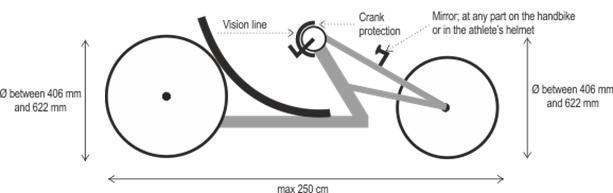
-
(x) A handcycle shall not measure more than 250 cm in length or 75 cm in width;
-
(xi) The shifting device can either be within the extremities of the handlebars, or on the side of the Para triathlete's body;
-
(xii) The largest chain ring shall have a guard securely fitted to protect the Para triathlete. This protection shall be made of solid material that is sufficiently robust and covers the chain ring fully over half of its circumference (180°) on the side facing the rider;
-
(xili) Any fillets, or ribs, inserted at joints between tubes, shall be for strengthening purposes only. Non-functional, aerodynamic devices are not permitted for competition;
-
(xiv)A quick release body harness is permitted;
-
(xV) Para triathletes must ensure that their lower limbs have enough support/bracing/foot rest to prevent them from dragging or making contact with the ground during the event;
-
c.) The bib number will be placed at the back of the handcycle and will be visible from the back;
-
d.) The helmet must be fastened before getting onto the handcycle and it must remain fastened till the finish;
-
e.) Athletes must stop completely at the mount line exiting Transition 1 and at the dismount line on entering Transition 2. Once stopped, the Technical Official will say "Go" and the athlete can continue the competition. The wheelchair is considered correctly stopped if the
front wheel stops immediately before the line. If the front wheel stops touching the line or beyond the line, a time penalty will be applied.
17.15Para triathlon PTWC1 and PTWC2 Runningp. 117
-
a.) All para triathletes perform the run portion in a "racing wheelchair";
-
b.) The specifications of a "racing wheelchair" (hereafter referred to as "the chair") are as follows:
-
(i) The chair shall have two large wheels and one small wheel;
-
(ii) There should be a brake at the front wheel;
-
(iii) No part of the body of the chair may extend forwards beyond the hub of the front wheel and be wider than the inside of the hubs of the two rear wheels. The maximum height from the ground of the main body of the chair shall be 50 cm;
-
(iv) The maximum diameter of the large wheel, including the inflated tyre, shall not exceed 70 cm. The maximum diameter of the small wheel, including the inflated tyre, shall not exceed 50 cm;
-
(v) Only one plain, round, hand rim is allowed for each large wheel. No mechanical gears or levers that propel the chair shall be allowed;
-
(vi) Only hand operated, mechanical steering devices will be allowed;
-
(vii) Para triathletes must be able to turn the front wheel manually to the left and right;
-
(vili) No part of the chair may protrude behind the vertical plane of the back edge of the rear tyres;
-
(ix) It will be the Para triathlete's responsibility to ensure the wheelchair conforms to all the above rules and no event shall be delayed while adjustments are made to the chair;
-
(x) Para triathletes must ensure that their lower limbs have enough support/bracing to prevent them from dragging or making contact with the ground during the event;
-
(xi) Para triathletes shall wear the approved bike helmet at all times while seated in the chair.
-
c.) Propulsion by any other method except the Para triathlete pushing on the wheels or pushrims will result in disqualification;
-
d.) It is forbidden to draft off a motorbike or vehicle and blue cards will be used to inform the athletes. Drafting is entering the motorbike or vehicle drafting zone (penalties outlined in 5.6):
-
(i) Motorbike draft zone: the draft zone behind a motorbike will be 20 meters long;
-
(ii) Vehicle draft zone: The draft zone behind a vehicle will be 35 meters long and applies to every vehicle.
-
e.) A Para triathlete attempting to overtake another Para triathlete carries the responsibility of ensuring full clearance of the chair being overtaken before cutting across. The Para triathlete being overtaken has the responsibility not to obstruct or impede the passing Para triathlete once the front wheel(s) of the passing chair is ahead of his/hers;
-
f.) PTWC1 and PTWC2 athletes will be judged as finished, the moment in which the centre of the axle of the leading wheel reaches the vertical plane of the nearer edge of the finish line;
-
g.) The bib number will be placed at the back of the wheelchair and visible from the back;
-
h.) No run course shall have a maximum gradient of over 5% at the steepest section.
17.16Para triathlon PTS2, PTS3, PTS4 and PTS5 Runningp. 118
- a.) Athletes with a lower limb deficiency are permitted to use a prosthesis on that limb only to ensure both legs are balanced and to allow for symmetrical movement during competition. The effective need/use of prostheses, orthoses or other special adaptive equipment must be approved during the classification evaluation and/or evaluated by the Classification Advisory Group;
- b.) The use of running blades is only allowed as long as they are mounted on a prosthesis;
- c.) Athletes will wear a bib number or four sets of body decals, which will be visible from the front.
17.17Para triathlon PTVI1, PTVI2 and PTVI3p. 118
The following additional rules apply to all visually impaired (PTVI1, PTVI2 and PTVI3) para triathletes and their guides:
a.) General:
-
(i) No guide dogs will be allowed at any time;
-
(ii) Each athlete must have a guide of the same gender and nationality. Both athlete and guide will hold a licence from the same National Federation;
-
(iii) Each athlete is allowed a maximum of one (1) guide during each competition;
-
(iv) An athlete cannot act as a guide until a period of twelve (12) months has passed since his/her last sprint or standard distance elite triathlon World Triathlon event or any elite triathlon event recognized by World Triathlon on sprint or standard distance;
-
(v) All guides must comply with minimum age requirements as per the World Triathlon Competition Rules Appendix A;
-
(vi) In the event of an injury or illness, and upon presentation of a medical certificate, a guide may be replaced up to 24 hours before the official start of the competition. No changes will be allowed after this deadline;
-
(vii) Guides are not allowed to pull or push the athletes in order to gain unfair advantage;
-
(viii) Athlete and guide shall not be more than 1.5 meters apart during the swim segment and no more than 0.5 meters apart during any other segment of the competition;
-
(ix) Guides may not use paddleboards, kayaks, etc. (on the swim portion) or bicycles, motor bicycles, etc., (on the run portion) or any other mechanical means of transport;
-
(x) All PTVI1 athletes must wear blackout goggles throughout the entire competition. Swim blackout goggles may be removed only once the athlete and guide have reached their bike position in Transition area 1. The bike/run blackout glasses must be used from Transition area 1 until the athlete and guide cross the finish line. Both the blackout goggles and glasses will be checked at registration and the athlete must ensure they do not allow light to enter through the main patched or painted area, nose piece, sides or bottom. Logos are allowed only on the frame;
-
(xi) Athletes and guides are subject to World Triathlon Anti-Doping Rules.
b.) Swimming:
- (i) Each athlete must be tethered to their own guide during the swim;
- (ii) At no time may a guide propel, pull or push the para triathlete with any part of their own body in order to gain an unfair advantage;
- (iii) The guide must swim next to the athlete within a maximum separation distance of 1.5m from the athletes' head to the guide's head. The tether must be elastic rope with bright or reflective colour and up to 80 cm long measured with no tension. It can be fixed at any point of the athletes' body.
c.) Cycling:
- (i) All para triathletes and guides must use a tandem bicycle. The specifications of the tandem bicycle are as follows:
- A tandem is a vehicle for two riders, with two wheels of equal diameter, which conforms to the general principles of UCI construction for bicycles. The front wheel shall be steerable by the front rider, known as the pilot. Both riders shall face forward in the traditional cycling position and the rear wheel shall be driven by both cyclists through a system comprising pedals and chains; the maximum sizes will be 2.70 meters long and 0.5 meters wide;
- The tandem top tube, and any additional strengthening tubes, may slope to suit the morphological sizes of the riders.
d.) Running:
-
(i) Each athlete must be tethered during the run to his/her guide while in motion. The tether shall be made from non-elastic material and not store energy and or offer a performance gain to the athlete;
-
(ii) The athlete may use an elbow lead during the run. The guide-runner is not allowed to push, pull or otherwise propel athletes in order to gain an advantage at any stage during a competition. A guide-runner may assist an athlete who has tripped or fallen to regain his/her footing and/or orientation as long as such assistance does not provide any advantage to the athlete towards his/her running direction;
-
(iii) As the athlete crosses the finish line, the guide must be beside or behind the para triathlete but not further apart than the required 0.5 meters maximum separation distance;
-
(iv) Free Leading zones: for safety reasons, leading is allowed 10 meters before and after an aid station, a sharp turn, penalty box, transition area swim exit, pre-transition area or any other section of the run course determined by the Technical Delegate and indicated at the athlete's briefing.
17.18Outside assistancep. 120
- a.) Technical Delegates may determine areas or sections of the course where para triathletes may receive assistance, what assistance may be provided and the instructions and conditions applicable;
- b.) Assistance can be provided to a Para triathlete to allow them to get back into their handcycle/racing wheelchair or onto their bike following an incident. In such cases any mechanical repair must be done by the athlete without external assistance. Assistance may only be provided by a Technical Official, Event Personnel, or another athlete in the same race.
17.19Hygienep. 120
- a.) It is mandatory for all para triathletes, who use catheters or other urinary diversion devices, to prevent spillage by using a catheter bag at all times. This includes during training, competition and classification.
17.20Approval panelsp. 120
- a.) Decisions on bike adaptations or brace approval will be made by a panel composed of:
- (i) A World Triathlon Technical Committee member;
- (i) A representative of the World Triathlon Sport Department;
- (iii) A member of the World Triathlon Para triathlon Committee;
- b.) The decisions of the Approval Panel can be appealed to the World Triathlon Tribunal. This appeal does not suspend the decision of the Approval Panel, but rather the decision will stay in place during the time the World Triathlon Tribunal takes to make a decision on the appeal.
17.21Para Triathlon Mixed Relayp. 120
- a.) The distance ranges per leg are: swim 125 m - 150 m; bike 3,5 km - 4 km and run 0,8 km - 1 km;
- b.) The general eligibility rules apply. The minimum age is 15 years old;
c) Team Composition
-
(i) A team is composed of 4 athletes (2 men and 2 women). Each team member will cover a complete triathlon race/distance (draft illegal);
-
(ii) A team can be composed of 3 athletes (at least one of a different gender). Athletes of the same gender cannot cover three segments, so the athlete of the least represented gender must do the 2nd and 4th leg of the relay;
-
(iii) Gender is not a factor in determining the order of the athletes;
-
(iv) Every team must have one and not more PTWC athlete which must only compete in the first leg;
-
(v) In the World Championships, teams will be made of athletes from the same National Federation (NF). In all other events international teams are allowed
-
(vi) An NF can enter more than one team but at least one team must consist of 4 members. At World Championships an NF can only enter 1 team until the maximum quota of 15 teams has been reached. If the start list is not full, a second team may enter ten days before the race, a random draw will be conducted if needed;
-
(vii) Only one PTVI and one PTWC athlete can be part of each team;
-
(viii) Numbers will be assigned according to the last world championships' results, starting at 1. The first team from those NFs absent will receive the next numbers randomly, and the second teams will follow.
-
d.) Combined Sport Classes
-
(i) The Para Mixed Relay Sport Class Points (PMRSCP) table will be used when forming a team. Each sport class is assigned a point value according to the PMRSCP table. Teams shall be composed of athletes from sport classes with a combined point value of a maximum of 20 points. In the case of a 3 members composition, the point value of the athletes' sport class racing twice, will be added twice to the teams' total point value;
-
(i) Para MR Sports Class Points Table:
| CLASS | MEN | WOMEN |
|---|---|---|
| PTVI2-3 | 7 | 6 |
| PTS5k | 6 | 5 |
| PTWC2 | 5 | 4 |
| PTV1 | 5 | 4 |
| PTWC1 | 4 | 3 |
| PTS4 | 4 | 3 |
| PTS3 | 2 | 1 |
| PTS2 | 2 | 1 |
- e.) Personal Handlers. Each team can have one personal handler that can assist only the PTWC and any other athlete who is eligible to receive assistance from the same team;
- f.) Pre-Transition Area. Each team will have its own space in the pre-transition marked with the race number of the team;
- g.) Transition Area. The team members will be grouped together;
h) Relay Exchange
- (i) The relay exchange from one team member to another will be conducted "virtually" at a designated point on the run course near the swim start. The Technical Officials will be responsible to inform the next team member to start the swim leg as soon as the previous team member has crossed the designated line;
- (ii) Each team member will have an in-water start. The athletes shall have their hand on the pontoon or behind the start buoys until signalled to go;
- (iii) Athletes are responsible to be in the start position before the previous team member has completed the leg.
- i.) Finish. Only the athlete covering the last leg is allowed to cross the finish line;
- j.) Number of teams. The maximum number of teams allowed in a specific event will be determined by the TD;
- k.) Two hours before the competition starts, the coach can communicate with the Head Referee a different team composition by:
- (i) Replacing a maximum of one athlete or adding a fourth athlete to the three-member team;
- (ii) Modifying the order of the athlete.
Chapter 18: Winter Triathlon And Winter Duathlon
18.1Definitionp. 123
- a.) Winter Triathlon and Winter Duathlon may take place in different formats:
- (i) Winter Triathlon:
- 3 segments: Running, mountain biking and cross-country skiing;
- 6 segments: Running, mountain biking and cross-country skiing repeated continuously twice.
- (ii) S3 Winter Triathlon: Running, skating and cross-country skiing;
- (ili) Winter Duathlon:
- 2 segments: Running and cross-country skiing;
- 4 segments: Running and cross-country skiing repeated continuously one more time.
- b.) All segments of the competition will be preferably on snow or ice. The run and bike segment can also take place on a different surface.
18.2Official Training and Course Familiarisationp. 123
- a.) Official training and familiarisation sessions will be conducted by the Technical Delegate and the Local Organising Committee. Athletes and coaches may attend these official training and familiarisation sessions;
- b.) Conduct on competition days: Athletes are not allowed to warm up or do any familiarisation on the course while a competition is in progress.
18.3Runningp. 123
- a.) Running shoes are mandatory on the running segment. This rule is not applicable to AgeGroup athletes;
- b.) Any type of shoes including spike shoes are allowed.
18.4Mountain Bikingp. 123
-
a.) The minimum tyre diameter is 26 inches and maximum is 29 inches. The minimum cross section is 1.5 inch;
-
b.) Front and rear wheels may have different diameters;
-
c.) The bike segment of winter triathlon competitions is laid out as a cross-country course over snow and may follow normal roads or paths;
-
d.) Athletes are allowed to push or carry the bike over the course;
-
e.) Drafting is allowed. For safety reasons there may be no passing zones on the course. Lapped athletes will not be removed from the competition;
-
f.) Clip-ons are not allowed;
-
g.) Traditional road handlebars are forbidden;
-
h.) Athletes must bring their own tools and parts and must carry out their own repairs;
-
i.) Spiked tyres are allowed provided that the spikes are shorter than 5 mm. measured from the tyre surface;
-
j.) Traditional MTB bar ends are authorised. Ends must be plugged.
18.5Skiingp. 124
- a.) Testing of equipment (skis) is allowed prior to the competition on specially marked tracks, or on the competition-course, if announced by the Technical Officials;
- b.) Athletes cannot be accompanied by team members, team managers or other pacemakers on the course, during the competition;
- c.) Athletes are allowed to change one ski and both poles. During Elite and Juniors competitions, one ski can be changed only if the ski or binding are broken or damaged. This can take place anywhere along the course, but the competitor must do it outside of the track without help from any other person. The equipment failure must be proven to the Head Referee after the competition. Athletes can check in as many pair of skis as ski legs the competition has;
- d.) Athletes may ski using their preferred technique;
- e.) Technical Delegate may determine that the classic style is mandatory in specific areas;
- f.) Wearing the bike helmet during the ski segment is not allowed. However, due to the effect of cold temperatures on mobility, wearing a helmet could be authorised by the Technical Delegate;
- g.) Once a request to pass is made by an athlete, the athlete being passed must move to the side as soon as possible;
- h.) The last straight (50-100 meters) will be the finish chute. This zone is normally separated into corridors to avoid the athletes impeding other athletes progress. They must be clearly marked and highly visible but the markings must not interfere with the skis. The corridors should be as long as possible. The number, width and length of corridors will be determined by the Technical Delegate;
- i.) In the finish chute, athletes are not allowed to change from one corridor to another, except to overtake;
- j.) Athletes cannot remove their skis until at least 10 meters past the finish line. The last ski check will take place after this line;
- k.) Ski shoes are mandatory in the cross-country ski segment. This rule is not applicable to Age-Group athletes.
18.6Skatingp. 124
-
a.) All types of skates, including Nordic blades, are allowed;
-
b.) Athletes are not allowed to change any of the skates;
-
c.) Once a request to pass is made by an athlete, the athlete being passed must move to the side as soon as possible;
-
d.) Athletes will wear helmets, as outlined in Competition Rules 5.2 g).
18.7Transition Areap. 125
- a.) Skiing inside the transition area is forbidden;
- b.) Athletes must put on and take off their running shoes and skates within the transition area, in the athletes' own space. If a "Nordic blades changing zone" is provided, athletes may choose to put the Nordic blades on there;
- c.) In the transition area, Technical Officials may assist athletes by receiving and placing their bikes and handing out their equipment. This service must be equal for all athletes;
- d.) All athletes must have their helmet securely fastened from the time they remove their bike from the rack at the start of the bike leg or when they put the skates on, until after they have placed their bike on the rack at the finish of the bike leg or when they takes the skates off;
- e.) A "Nordic blades changing area" may be created by the side of the edge of the ice;
- f.) A littering zone will be placed after the "ski placing line" where the athletes can discard the shoe covers.
18.8Coaches' Stationp. 125
- a.) Coaches will have a designated space available on the run, bike ski and segments in order to supply athletes with their own food and beverages.
18.9Personal Needs Stationp. 125
- a.) Additional stations on the bike and or run may be provided for personal needs;
- b.) Any items given out at these stations will be handed out by volunteers supplied by the Local Organising Committee;
- c.) If these stations are not provided no items may be provided by any other person, otherwise this will be considered outside assistance;
- d.) A Repair Zone may be provided on the bike section where athletes will have the opportunity to leave special tools and spares provided that they are correctly packed and labelled. The athlete is responsible to carry out their own repairs. It is forbidden to leave complete wheels at these stations.
18.10Finish Definitionp. 125
- a.) An athlete will be judged as "finished," the moment the tip of the front ski boot crosses a vertical line extending from the leading edge of the finish line.
18.11Weather conditionsp. 125
- a.) The competition will be cancelled when the air temperature is lower than -18 °C.
Chapter 19: Cross Triathlon And Duathlon
19.1Generalp. 126
- a.) Cross Triathlon consists of swimming, mountain biking (MTB) and cross-country running;
- b.) Cross Duathlon consists of cross-country running, mountain biking (MTB) and crosscountry running.
19.2Distancesp. 126
- a.) The distance of Cross Triathlon is outlined in Appendix A;
- b.) The distance of Cross Duathlon is outlined in Appendix A;
- c.) The course should have demanding hills and challenging technical aspects. A 5% tolerance margin will be accepted for the distance of the bike course, provided it has been approved by the Technical Delegate.
19.3Official Training and Familiarisationp. 126
- a.) Official training and familiarisation sessions will be conducted by the Technical Delegate and the Local Organising Committee. Athletes and coaches may attend these official training and familiarisation sessions;
- b.) Conduct on competition days: Athletes are not allowed to warm up or do any course familiarisation while a competition is in progress.
19.4Mountain Bikingp. 126
- a.) The minimum tyre diameter is 26 inches and maximum is 29 inches. The minimum cross section is 1.5 inch;
- b.) Front and rear wheels may have different diameter;
- c.) Studded and/or slick tyres are allowed;
- d.) Athletes are allowed to push or carry the bike over the course;
- e.) Drafting is allowed for same gender and also different gender athletes. For safety reasons there may be no passing zones on the course;
- f.) Lapped athletes will not be removed from the competition;
- g.) Clip-ons are not allowed;
- h.) Traditional road handlebars are forbidden;
- i.) Traditional MTB bar ends are authorised. Ends must be plugged;
- j.) Athletes must bring their own tools and parts and must carry out their own repairs.
19.5 Transition Area:
- a.) See all reference in Competition Rules, section 7.
19.6 Running:
- a.) Any type of shoes including spike shoes are allowed.
19.7Coaches Stationsp. 127
- a.) Coaches will have a designated space available on the bike and run segments in order to supply athletes with their own food and beverages.
19.8Personal Needs Stationsp. 127
- a.) Additional stations on the bike and or run may be provided for personal needs;
- b.) Any items given out at these stations will be the handed out by volunteers supplied by the Local Organising Committee;
- c.) If these stations are not provided no items may be provided by any other person, otherwise this will be considered outside assistance;
- d.) A Repair Zone may be provided on the bike section where athletes will have the opportunity to leave special tools and spares provided they are correctly packed and labelled. The athlete is responsible to carry out their own repairs.
Chapter 20: Competition In Qualifying Round Format
20.1Generalp. 128
- a.) An event in Qualifying Round Format consists of several rounds with a number of heats each qualifying athletes to the next round and eventually finishing with a final to determine a winner.
20.2Roundsp. 128
- a.) The rounds will be called semi-finals and final;
- b.) An event will have two rounds;
- c.) Semi-finals and finals will have 30 athletes as a maximum. The number of semi-finals will be as tollows:
| Athletes entered | Semi-finals |
|---|---|
| Less than 30 | No semi-finals, direct final |
| 31 to 60 | 2 semi-finals (15 to 30 athletes each) |
| 61 to 90 | 3 semi-finals (20 to 30 athletes each) |
| 91 to 120 | 4 semi-finals (22 to 30 athletes each) |
| 121 to 150 | 5 semi-finals (24 to 30 athletes each) |
20.3Qualification to finalp. 128
- a.) Every semi-final will qualify a fixed number of athletes for the final. Additionally, a number of athletes will qualify from semi-final heats, based on fastest times:
- b.) Athletes from different heats and with the same time (in seconds), which are tied in the last qualifying position, will all qualify, increasing the number of athletes qualified for the next round;
- c.) In case there are less finishing athletes from a semi-final than the fixed number, the remaining spots will be filled from the other semi-final heats, based on the fastest times;
- d.) Athletes who have not qualified for the final will be sorted by time. In case of athletes withdrawing from the final, replacement will be made by the first athlete who has not qualified. The replacement will happen if the number of athletes in the final drops down to
| Athletes entered | Semi-finals | By position in the semi-final | By time |
|---|---|---|---|
| 31 to 60 | 2 | 14 | 2 |
| 61 to 90 | 3 | 9 | 3 |
| 91 to 120 | 4 | 7 | 2 |
| More than 121 | 5 | 5 | 5 |
- 30 athletes. (a random selection will be made from those athletes who have the same time). The deadline for the replacements will be when registration opens;
- e.) In case where an event has a B final, the best 30 athletes from the semi-finals who have not qualified for the A final, will be sorted according to their times and will qualify to the B final. B final will only be held if a minimum 10 athletes qualify for it.
20.4Distribution of athletes in the semi-finalsp. 129
- a.) The Technical Delegate will compose the heats as follows:
- (i) If there are not any applicable ranking, the athletes will be distributed among the heats in order to have the same number of athletes per semi-final (some semi-finals can have one more athlete than others). The athletes from the same National Federation will be distributed among the heats following the same principle;
- (i) If a ranking is applicable, the ranked athletes will be distributed according to the chart below and the non-ranked athletes will ill the remaining spots by applying the principle of assigning a similar number of athletes from the same National Federation to every heat, and keeping all the heats of equal size.
Chart: Distribution of ranked athletes among the semi-finals (The number in the cells reflects the ranking order):
| Semi-final 1 | Semi-final 2 | Last Semi-final (-1) | Last Semi-final |
|---|---|---|---|
| 1 | |||
| 2 | |||
| 3 | |||
| 4 | |||
| 5 | |||
| 6 | |||
| 7 | |||
| 8 | |||
| 9 | |||
| 10 | |||
| 11 | |||
| 12 | |||
| 13 | |||
| 14 | |||
| 15 | |||
| 16 | |||
| 17 | |||
| etc... |
20.5Numberingp. 130
- a.) There are two options to number the final:
- (i) The numbers in the final will be assigned as first criteria according to the positions in the semi-finals. The second criteria will be the time in the semi-final, the third, the World Triathlon Points List position, and the fourth a random appointment;
- (ii) The numbers in the final will be same as in the semifinals. Athletes will be lined up according to position in the semifinals as first criteria and final time as second criteria. However, transition positions will be in numerical order.
20.6Resultsp. 130
- a.) The overall results for the event will be the results of the final round;
- b.) If the event is included in any ranking which is allocating points to more positions than finishers in the final, the remaining points will be awarded as follows:
- (i) To the DNF athletes in the final, according to their times in the semi-finals;
- (ii) To the DNS athletes in the final according to their times in the semi-final;
- (iii) If the event does not have a B final: The athletes who did not qualify for the final, will have points allocated according to their times in the semi-finals. If the event has B final: The results from the B final will determine their points;
- (iv) DSQ athletes will not earn any points.
20.7Prize moneyp. 130
- a.) Prize money distribution will follow the general rules (Appendix H) and the preceding paragraph if necessary.
Chapter 21: Event In Time Trial Qualifying Round Format
21.1Generalp. 131
- a.) An event in Time Trial Qualifying Round Format consists of two competitions, the first one (qualifier) conducted as a time trial with athletes starting individually one by one, and the second one (final) conducted as a mass start event, in which the participants are the best ranked in the time trial competition;
- b.) The result of the event is the result of the final.
21.2Roundsp. 131
- a.) An event will have two rounds;
- b.) The rounds will be called qualifier and final;
- c.) The qualifier will be a time trial with a draft-illegal bike segment, and the final will be mass start with a draft legal bike segment. In both qualifier and final competitions, athletes must use draft legal bikes and bike equipment;
- d.) The Technical Delegate will determine the time interval between the start of each athlete in the time trial qualifier, which can be between 15 seconds and 3 minutes;
- e.) The final will have 30 athletes. The Head Referee will decide, according to the available technological resources, if a tie will be declared for two or more of the athletes. In this case, the final may have more than 30 athletes.
21.3Qualification to finalp. 131
- a.) The athletes with the best 30 times in the qualifiers will qualify for the final;
- b.) Athletes who have not qualified for the final will be placed according to their time in the qualifiers. In case of athletes withdrawing from the final, replacement will be made by the next fastest athlete who has not qualified. The replacement will only happen if the number of athletes in the final drops down below 30 athletes. The deadline for the replacements will be when registration opens;
- c.) Where an event has a B final, the athletes with the best 30 times from the qualifier, who have not qualified for the A final, will be sorted according to their times and will quality to compete in the B final.
21.4Numbering and distribution of athletes in the qualifierp. 131
- a.) Race numbers will be allocated to the athletes as regulated in the Competition Rules 2.10;
- b.) Athletes will start one by one starting by the highest number in decreasing order;
- c.) In case of athletes not showing up to the start or if any race number is not assigned, the start sequence will follow as if there was an athlete competing in the time allotted to this unused number;
d.) The start list will be created following this model:
| Race number | First Name | Last Name | NF | Start Time |
|---|---|---|---|---|
| 102 | Grzegorz | Zgliczynski | POL | 09:00:00 |
| 101 | Andrew | Farrell | USA | 09:00:30 |
| 100 | Todd | Martin | AUS | 09:01:00 |
| 99 | Gervasio | Da Silva | BRA | 09:01:30 |
21.5 Qualifier start system:
- a.) Start system outlined in World Triathlon Competition Rules 4.9 will apply.
21.6Race number allocation in the finalp. 132
- a.) The race numbers in the final will be assigned as first criteria according to the time in the qualifier. The lowest time in the qualifier will receive number 1 in the final. Tied athletes will be numbered randomly.
21.7Resultsp. 132
- a.) The overall results for the event will be the results of the final round. Awards, and prize money will be distributed accordingly;
- b.) If the event is included in any ranking which is allocating points to more positions than finishers in the final, the remaining points will be awarded as follows:
- (i) To the DNF athletes in the final, according to their times in the qualifier;
- (ii) To the DNS athletes in the final according to their times in the qualifier;
- (iii) If the event does not have a B final: The athletes who did not qualify for the final, will have points allocated according to their times in the qualifier. If the event has B final: The results from the B final will determine their points;
- (iv) DSQ athletes will not earn any points.
Chapter 22: Aquabike
22.1Generalp. 133
- a.) Aquabike consists of Swimming, Transition area 1 and Cycling;
- b.) Aquabike events will be organised only for Age-Group categories;
- c.) Aquabike may be included in the program of an event, which includes a triathlon race. Aquabike will have the same swim and bike distances as the triathlon programmed in the same event;
- d.) Aquabike may happen as a stand-alone event on the distances indicated in Appendix A.
22.2Specific Rulesp. 133
- a.) General rules, specific rules and rule exceptions applicable to the triathlon event from which the aquabike event is attached are applicable also for the aquabike event;
- b.) Rules applicable to triathlon are applicable to aquabike in case of stand-alone events.
22.3Finishp. 133
- a.) Athletes will finish the competition at the finish line located between 100 meters and 200 meters before the dismount line. The finish occurs at the instant that the tyre of the front wheel meets the vertical plane rising from the starting edge of the finishing line. The time registered in this point is the final time. Finishing athletes will continue cycling till the dismount line.
APPENDICES
Appendix A: Competition Distances And Age Requirements
TRIATHLON:
| Swim | Bike | Run | Minimum age required | |
|---|---|---|---|---|
| 2x2 Mixed relay (Distances per leg) | 250 m to 300 m | 5 km to 8 km | 1.5 km to 2 km | 15 |
| 3x Same gender relay (Distances per leg) | 250 m to 300 m | 5 km to 8 km | 1.5 km to 2 km | 15 |
| 4x relay (Distances per leg) | 250 m to 300 m | 5 km to 8 km | 1.5 km to 2 km | 15 |
| Super Sprint Distance | 250 m to 500 m | 6.5 km to 13 km | 1.7 km to 3.5 km | 15 |
| Sprint Distance | 750 m | 20 km | 5 km | 16 |
| Standard Distance | 1500 m | 40 km | 10 km | 18 |
| Middle Distance | 1900m to 2999 m | 80 km to 90 km | 20 km to 21.9 km | 18 |
| Long Distance | 3000m to 4000 m | 91 km to 200 km | 22 km to 42.2 km | 18 |
DUATHLON:
| Run | Bike | Run | Minimum age required | |
|---|---|---|---|---|
| 2x2 Mixed relay (Distances per leg) | 1.5 km to 2 km | 5 km to 8 km | 0.75 km to 1 km | 15 |
| 3x Same gender relay | (Distances per leg) | 1.5 km to 2 km | 5 km to 8 km | 0.75 km to 1 km | 15 |
| 4x Mixed relay (Distances per leg) | 1.5 km to 2 km | 5 km to 8 km | 0.75 km to 1 km | 15 |
| Super Sprint Distance | 1.7 km to 3.5 km | 6.5 km to 13 km | 0.85 km to 1.75 km | 15 |
| Sprint Distance | 5 km | 20 km | 2.5 km | 16 |
| Standard Distance | 5 km | 30 km | 5 km | 18 |
| Standard Distance | 10 km | 40 km | 5 km | 18 |
| Middle Distance | 10 km | 60 km | 10 km | 18 |
| Long Distance | 10 km to 20 km | 90 km to 150 km | 20 km to 30 km | 18 |
|---|
AQUATHLON:
| Run | Swim | Run | Minimum age required | |
|---|---|---|---|---|
| 2x2 Mixed Relay (Distances per leg) | 1.25 km | 500 m | 1.25 km | 15 |
| 2x2 Mixed Relay. Cold waters (Distances per leg) | 500 m | 2.5 km | 15 | |
| 3x Same gender relay (Distances per leg) | 1.25 km | 500 m | 1.25 km | 15 |
| 3x Same gender relay. Cold waters (Distances per leg) | 500 m | 2.5 km | 15 | |
| 4x Mixed relay (Distances per leg) | 1.25 km | 500 m | 1.25 km | 15 |
| 4x Mixed relay. Cold waters (Distances per leg) | 500 m | 2.5 km | 15 | |
| Sprint Distance | 1.25 km | 500 m | 1.25 km | 16 |
| Sprint Distance Cold waters and Para triathlon. | 500 m | 2.5 km | 16 | |
| Standard Distance | 2.5 km | 1000 m | 2.5 km | 16 |
| Standard Distance Cold waters and Para triathlon. | 1000 m | 5 km | 16 | |
| Long Distance | 5 km | 2000 m | 5 km | 18 |
| Long Distance Cold waters and Para triathlon. | 2000 m | 10 km | 18 |
WINTER TRIATHLON & DUATHLON:
| Winter Triathlon | Cross-Country Run | Mountain Bike | Cross-Country Ski | Minimum age required |
|---|---|---|---|---|
| 2x2 Mixed relay. (Distances per leg)* | 1 km | 2 km | 2 km | 15 |
| 3x Same gender relay (Distances per leg) | 2 km to 3 km | 4 km to 5 km | 3 km to 4 km | 15 |
| 4x Mixed relay (Distances per leg) | 2 km to 3 km | 4 km to 5 km | 3 km to 4 km | 15 |
| Sprint Distance specific for Age- Groups | 3 km to 4 km | 5 km to 6 km | 5 km to 6 km | 16 |
| Sprint/Standard Distance |(Run + Bike + Ski + Run + Bike + Ski) Distances per segment* | 2 km | 4 km | 4 km | 16 |
| Standard distance specific for Age- Groups | 4 km | 8 km | 8 km | 18 |
(*) +/- 10 %
| S3 Winter Triathlon | Run | Skating | Cross-Country Ski | Minimum age required |
|---|---|---|---|---|
| Standard Distance | 4 km to 6 km | 10 km to 14 km | 7 km to 9 km | 16 |
| Winter Duathlon | Cross-Country Run | Cross-Country Ski | Minimum age required |
|---|---|---|---|
| 2x2 Mixed relay. (Distances per leg)* | 1 km | 2 km | 15 |
| Sprint Distance (Run + Ski + Run + Ski) Distances per segment* | 2 km | 4 km | 16 |
| Sprint distance specific for Age-Groups (Run + Ski) | 6 km | 12 km | 16 |
(*) +/- 10%
CROSS TRIATHLON:
| Swim | Mountain Bike | Cross-Country Run | Minimum age required | |
|---|---|---|---|---|
| Mixed Relay | 200m to 250 m | 4 km to 5 km | 1.2 km to 1.6 km | 15 |
| Sprint Distance | 500 m | 10 km to 12 km | 3 km to 4 km | 16 |
| Standard Distance | 1000 m to 1500 m | 20 km to 30 km | 6 km to 10 km | 18 |
CROSS DUATHLON:
| Cross-Country Run | Mountain Bike | Cross-Country Run | Minimum age required | |
|---|---|---|---|---|
| Mixed Relay | 1.2 km to 1.6 km | 4 km to 5 km | 0.6 km to 0.8 km | 15 |
| Sprint Distance | 3 km to 4 km | 10 km to 12 km | 1.5 km to 2 km | 16 |
| Standard Distance | 6 km to 8 km | 20 km to 25 km | 3 km to 4 km | 18 |
AQUABIKE:
| Swim | Bike | Minimum age required | |
|---|---|---|---|
| Standard Distance | 1500 m | 40 km | 18 |
| Middle Distance | 1900 m to 3000 m | 80 km to 90 km | 18 |
| Long Distance | 3000 m to 4000 m | 90 km to 200 km | 18 |
Appendix B: Competition Protest Form
PROTEST FORM
Part 1: To be completed by the protester.
Protest must be filed and signed by the protester under the conditions outlined in the World Triathlon Competition Rules and submitted to the Head Referee.
Event Name:
Event Date:
Time Protest Submitted
Event Location:
Name of Protester:
Race Number:
Country of Protester:
Email:
Address of Protester
(street address)
Telephone (home):
Name of
Protestee:
Country of Protestee:
(City and Postal Code)
Telephone (mobile):
Race Number:
A protest is a formal complaint against the conduct of another athlete, or race official, or accredited person, or against conditions of the competition, or decisions of the Head Referee, or errors in the competition results. You must have substantial evidence, including witnesses, and you must be villing to take part in an interview. Any protest must be accompanied with a cheque or cash for $5 USD or equivalent amount.
What type of Protest is involved? (Check one box only.)
-
[ ] Protest concerning eligibility of an Athlete
-
[ ] Protest concerning composition of a start list
-
[ ] Protest concerning conditions of a Field of Play
-
[ ] Protest concerning equipment used by an Athlete
-
[ ] Protest concerning conduct of an Athlete, Technical Official, accredited Coach or any accredited personnel
-
[ ] Protest concerning decisions taken by the Head Referee
-
[ ] Protest concerning errors in the competition results
Witness Details (2):
Name of Witness 1:
Name of Witness 2:
Rule(s) Violated:
Where did the violation occur? (Define location. If required, use additional paper and draw a
diagram.)
To be completed if applicable
Who was involved in the Violation?
To be completed if applicable
How did the Violation occur (brief statement explaining alleged violation)?
To be completed if applicable
Signature of Protester:
Part 2 Official use only
Protest Fee $50 USD attached
Competition Jury / Technical Committee Panel members (Names) and tick box to indicate if it was a 3 person jury or 5 person.
-
[ ] • 3 person jury
-
[ ] 5 person jury
Time of Incident:
Date:
- [ ] Yes O No O
Competition Jury / Technical Committee Panel action:
Competition Jury / Technical Committee Chair's Name:
Signature:
Time, Date Protest received:
Time, Date Protest processed:
Amount of fee withheld/refunded:
Appendix C: Appeal Content
APPEAL CONTENT
An appeal is a request for a review of a decision made by the Competition Jury or the World Triathlon Technical Committee (Level 2 Appeal).
Appeals must be submitted in writing to the World Triathlon Secretary General and will be accompanied by a fee of $ 500 USD which will only be refunded if the appeal is successful. There is no specific appeal form. The appeal should contain:
- Identification of the appellant and the respondent;
- Decision of the Level 1 protest;
- Description of facts;
- Legal background and rules affected;
- Rationale/summary of the facts.
Appendix D: Definitions
| Age | The age of the athlete on the 31st of December of the year of the competition. |
|---|---|
| Age-Group Team Managers Briefing | event. |
| Aid/Outside Assistance | Any kind of material support or personal assistance received by the athlete. Depending on its nature, it may be allowed or forbidden. |
| Ambush Marketing | Deliberately using the opportunity of live television and media photographers to expose the sponsor logos larger than the approved sizes, and/or equipment or objects not provided by Local Organising Committee or World Triathlon. |
| Appeal | A request for a review of a decision made by the Competition Jury or the World Triathlon Technical Committee (Level 2 Appeal), the World Triathlon Anti-Doping Hearing Panel solely with regard to ineligibility or the World Triathlon Tribunal. |
| Appellant | An athlete submitting an appeal. |
| Aquabike | Multisport which combines swim and cycle in two segments: the first segment is swimming and finishing with cycling. |
| Aquathlon | Multisport which combines swim and run in three segments: the first segment is run, followed by swimming and finishing with running. |
| Assistance | Any attempt by an unauthorised or unofficial source to help or to stabilise an athlete. |
| Assistant Chief Technical Official | Responsible to the Chief Technical Official for coordinating the employment of the Technical Officials assigned to his/her competition course segment or area. |
| Athletes | Individuals who register for and compete in events. |
| Athletes' Briefing | Meeting with the athletes in which they are informed by the Technical Delegate about all the specifications of the event. |
| Bag Drop System | Conducting transitions by: Taking a pre-prepared bag containing all equipment to be used in the next segment; Changing the equipment in the designated area; Put all the used equipment into the same bag and drop it at the designated spot. |
| Bicycle | The bicycle is a human powered vehicle with two wheels of equal diameter. The front wheel shall be steerable; the rear wheel shall be driven through a system comprising pedals and a chain. Bicycles are also referred to as bikes. |
|---|---|
| Bike catchers | Local Organising Committee personnel located after the dismount line, who take the bikes from the athletes and deliver them to the location from where the athletes can collect them after the competition. |
| Blocking | The deliberate impeding or obstructing the progress of one athlete by another or an athlete on the bike course, who is not keeping to the appropriate side of the road. |
| Blue card | Card, which is used to inform athletes when being penalised for drafting infringement during the cycling segment. |
| Charge | The contacting of one athlete by another from the front, rear or side, and hindering that athlete's progress. |
| Check in | Control established at the entrance of the athletes lounge and at the entrance of the transition area, before the competition. In both places a time of admission is set by the Technical Delegate. |
| Chief Race Official | Appointed by the Technical Delegate and is responsible for the control and coordination of the deployment of Technical Officials. |
| Clean Start | All the athletes start after the horn. The competition continues. |
| Coaches meeting | Meeting with the coaches in which they are informed by the Technical Delegate about all the specifications of the event. |
| Comfortable satisfaction | Situation, which is greater than a mere balance of probability, but less than proof beyond a reasonable doubt. |
| Competition | Single and continuous sport action from start to finish. Most cases it fits within the definition of Race, except the semi-final/final or the time trial qualifying format. |
| Competition Jury | The Competition Jury appointed and chaired by the Technical Delegate. It is held responsible to determine the eligibility of the protest, to hear and to rule on all protests against decisions handed down through the Head Referee. |
| Conflict of interest | A set of circumstances that creates a risk that professional judgement or actions regarding a primary interest will be unduly influenced by a secondary interest. |
| Continent | Each of the five geographical divisions established in World Triathlon. They are: Africa, The Americas, Asia, Europe and Oceania |
| Continental Technical Officials (CTOs) | The Level 2 Technical Officials certified by World Triathlon. |
|---|---|
| Course | A forward line of progress from start to finish, which must be clearly marked and measured to prescribed specifications. |
| Crawling | The action by an athlete of bringing three or more limbs in contact with the ground, either together or in any sequence, to enable forward propulsion. |
| Cycling Segment | Part of the competition course over which it has been defined in the Athletes' Briefing the bike is to be ridden, walked or carried within distinctive lane boundaries. The bike course commences from the Mount Line and concludes at the Dismount Line. |
| Development Regional Cup | Event sanctioned by World Triathlon or any of the Continental Confederations, where World Triathlon may allow the participation of athletes only from certain predefined National Federations. |
| Dismount Before The Dismount Line | An athlete's foot must contact the ground before the dismount line after the athlete dismounts the bike. If this contact doesn't occur, it is considered an infringement of the rules. |
| Dismount Line | A designated line at the entrance of the transition area from the bike course before which athletes are to dismount their bikes fully and proceed to the bike racks. The Dismount Line will normally extend for the width of the entrance to the transition area and be identified by flags/line/Technical Official, or combinations thereof. |
| Disqualification | A penalty assigned as appropriate for the rule violation, which has been reported, or for which a protest has been upheld. As a result of this penalty, the athlete will not be given finish or split times for the event, no account will be taken of the athlete when placings are assessed for any category or for the competition as a whole, and the athlete's results will appear as DSQ |
| Draft Zone. Bicycle | Zone defined by an athlete during the cycling segment which is extended to the whole width of the road and 12 meters. |
| Draft Zone. Motorbike | Zone defined by a motorbike during the cycling segment which is extended to the whole width of the road and 20 meters long. |
| Draft Zone. Vehicle | Zone defined by a vehicle during the cycling segment which is extended to the whole width of the road and 35 meters long. |
| Drafting | To enter in a drafting zone and not complete the overtake in 25 seconds. |
| Duathlon | Multisport which combines cycle and run in three segments: the first segment is running, followed by cycling and finishing with running. |
| Early start | When an athlete's foot crossed the vertical plane of the start line, before the start signal. |
|---|---|
| Elite Athlete | Athletes competing in World Triathlon Elite competitions. They are limited to compete in the same multisport and in the same distance during the same calendar year. This Elite condition is synonymous to Pro condition used by various commercial organisations. |
| Elite competitions | Competitions in which elite specific rules are applied. The age limit is determined only by the distance. |
| Event | Group of Races of the same category usually happening on the same day or on the following days (i.e.: World Championship, Continental Cup). |
| Event Organisers Manual (EOM) | A document which has been developed to ensure the implementation of consistently high global event management and marketing standards. |
| Event-weekend | The days when an event is taking place, which may include days other than Saturday and Sunday. |
| Exceptional situation | Unusual, adverse, or extreme circumstances that deviate significantly from the normal expectations of a race. These conditions can affect athlete safety, race logistics, or the fairness of the competition. |
| Expulsion | An athlete penalised by expulsion will not be permitted, during his or her lifetime, to take part in any World Triathlon sanctioned event, or any event sanctioned by one of its member associations (National Federation) affiliated with the the World Triathlon. |
| Festival | Group of different multisport events happening in a short period of time (up to ten days) at the same location. |
| Field of Play (FOP) | The course on which the competition will take place, the start and pre start areas, the finish and post finish areas, the aid stations, the wheel stops, the penalty boxes, the ceremony area and the briefing area. Usually the field of play is separated from the public by a clear boundary. |
| Field of Play Decision | The application and interpretation of the World Triathlon Competition Rules by Technical Officials and/or Competition Jury. |
| Final | Last round of an event in qualifying round format. The final decides the winner and the medallist of the event. |
| Finisher | An athlete who completes the entire competition course within the rules and crosses the finish line, or a vertical extension of the forward edge of the finish line, with any part of the torso (i.e. as distinct from the head, neck, arms, legs, hands or feet). |
| Force Majeure | Action of the elements, strike, lockout or other industrial disturbance, unlawful act against public order or authority, war blockade, public riot, lightning, fire or explosion, storm, flood, blacklisting, boycott or sanctions |
| however incurred, freight embargo, significant transportation delay or any other, event which is not reasonably within the control of the party affected. | |
|---|---|
| Head Referee | A Technical Official, who is responsible to the Technical Delegate to hear and make final decisions on all rules violations reported by Technical Officials. Technical Delegate appoints the Head Referee. |
| Incapable Athlete | An athlete deemed by race medical staff as not being able to continue the event without the likelihood of causing injury to him/herself or another athlete. |
| Indecent Exposure | The wilful uncovering of either or both buttocks, or of the pubic area or of the genital area. In addition, in the case of a female athlete, the wilful complete uncovering of one or both nipples. |
| Inland Water | Lakes, lochs, canals and rivers up to the point the tide affects them in terms of changes to their level. |
| Interference | A deliberate block, charge or abrupt motion, which impedes another athlete. |
| International Technical Officials (ITOs) | The Level 3 Technical Officials certified by World Triathlon. |
| Invalid Start | Some athletes start clearly before the horn and some others stay behind the start line. The start is not clean and is declared invalid. |
| Last Biker - First Runner Scenario | This occurs when the bike and run courses are partly common, and the first runner reaches the point where both courses merge and there are still bikers on the course before this point. |
| Leg | In the relay a leg is one athlete's triathlon race. |
| Littering Area | Section of the race where the athletes are allowed to dispose any rubbish or equipment. |
| Local Organising Committee (LOC) | The organising entity of a World Triathlon event. |
| Medal Events (Para triathlon) | A competition, which may include athletes from one or more sport classes competing for the same medals. |
| Mount After The Mount Line | An athlete's foot must contact the ground past the mount line, before the athlete mounts the bike. If this contact doesn't occur, it is considered an infringement of the rules. |
| Mount Line | A designated line at the exit from the transition area onto the bike course or after which athletes are to mount their bicycles and proceed. The Mount Line will normally extend for the width of the exit of the transition |
| area and be identified by flags/line/Technical Official, or combinations thereof. | |
|---|---|
| National Federation Quota | The maximum quota allocated to a National Federation in a specific competition. |
| NF survey list | List including all World Triathlon affiliated NEs based on their survey responses and historical data. National Federations are included in different groups representing their levels of development. Groups are 0, 1, 2, 3B, 3A, 4 and 5, being 0 the less developed and 5 the most developed. |
| National Technical Officials (NTOs) | The Level 1 Technical Officials certified by the National Federation. |
| Overtake | On the bike course, when the leading edge of the front wheel of the overtaking bike moves in front of the leading edge of the front wheel of the bike being overtaken. An athlete can pass another athlete only on the appropriate side. |
| Panel | A temporary or permanent body composed by minimum three (3) people representing pre-defined stakeholders, which takes decisions or makes proposals in specific tasks. |
| Pass | When one athlete's bike draft zone overlaps another athlete's bike draft zone, makes continual forward progress through that zone and overtakes within a maximum period of 25 seconds. |
| Penalty | The consequence on an athlete, who is assessed by a World Triathlon Technical Official to have unintentionally committed a rule infringement/violation. A penalty may take the form of a time delay, disqualification, suspension or expulsion. |
| Penalty box | An area on the bike course or the run course, set aside for the implementation of a time penalty for a rule infringement/violation. |
| Pre-Transition Area | A designated space close to the swim exit that accommodates the specific needs to get the transition area. This area is intended to ensure fairness, accessibility, and safety while allowing para triathletes to manage equipment or perform additional preparatory tasks specific to their classifications. Applies to Para Triathlon events |
| Prosthesis | An artificial device used to replace a missing body part. |
| Protest | A formal complaint for grounds listed in 12.2. |
| Race | A competition or group of competitions, which determine a winner, the medals and a result list. In the case of Para triathlon, this is named as "Medal Event" (i.e.: elite men's race, 50-54 women). |
| Red card | Card, which is used to inform athletes about disqualification. |
| Region | Group of National Federations, from the same or different continents, linked by geographical or cultural reasons. |
|---|---|
| Registration | Point of control established at the entrance of athletes briefing and coaches meeting. Attenders to these meetings will sign the attendance list. |
| Results | The timed finish positions of all athletes after violation reports have been ruled on, protests and appeals have been heard, and penalties have been awarded. |
| Round | Each of the stages of an event with qualifying format. One event in the qualifying round format has two rounds: semi-finals and final. |
| Run Course | Part of the competition course, which has been defined at the Athletes' Briefing where the athlete is to run or walk within distinctive lane boundaries. In triathlons and aquathlons, the run course commences at the exit from the transition area and concludes at the Finish Line. In duations the fraunion duathlons, the first run course commences at the start line and finishes at the entry to the transition area; the second run course commences at the exit from the transition area and concludes at the Finish Line. |
| Sanction | A permit issued by the National Federation for the conduct of an event. The issue of such a permit is a declaration by the sanctioning authority that plans for the event have been thoroughly inspected and have been found to comply fully with the requirements of National Federation operating requirements to provide the greatest potential for the conduct of a safe and fair event. |
| Sea and Transition Water | Ocean, seas and the part of the river affected by the tides, including river mouths, deltas, estuaries and rias. |
| Segment | A stage of competition. E.g.: A triathlon competition consists of 5 segments: swim, transition 1, bike, transition 2 and run. |
| Semi-final | Preliminary round of an event in qualifying round format. The semi-finals determine the athletes qualified to the final. |
| Smart Helmet | Bike helmet with a built-in sound system covering or not covering the ears. |
| Sorted Waiting List | A list of athletes not yet included in the start list, ordered according to the specific qualification criteria. |
| Sport Class | Para triathlon sport class is a category defined by World Triathlon in which athletes are categorised in reference to an activity limitation resulting from impairment. |
| Sportsmanship | The behaviour of an athlete during competition. Sportsmanship is interpreted as fair, rational and courteous behaviour, while bad sports conduct is any behaviour judged to be unfair, unethical or dishonest, a |
| violent act, intentional misconduct, abusive language, intimidating behaviour, or persistent infringement of the rules. | |
|---|---|
| Standard Bridge Piece | A rigid piece of plastic or metal, which joins both sides of the handlebar clip-on at the ends and is commercially available. |
| Start List | A list of athletes approved to compete in a competition. |
| Start Wave | A group of athletes starting together at the same time. A start wave can include different races (i.e.: different Para triathlon Sport Classes, or different Age-Groups), but also a race can be split into different Start Waves (i.e.: Age-Group 20-24A and Age-Group 20-24B). |
| Stop and Go | Penalty consists of stop, correct the fault and continue the competition. |
| Suspension | An athlete awarded this penalty will not be permitted during the stated suspension period, to take part in any event sanctioned by World Triathlon or its member associations (where determined) affiliated with World Triathlon. For any suspension because of a doping violation, the athlete will not be able to compete in any IOC affiliated sport at any local, regional, state, national or international level. The suspension period may vary in length, depending on the severity of the violation. In the case of a suspension imposed by World Triathlon, the length of the suspension will be determined by the World Triathlon Tribunal. |
| Swim Course | Part of the competition course over which it has been defined in the Athletes' Briefing that the athlete is to swim within distinctive lane boundaries. In triathlons and aquathlons, the swim course commences at the start line and concludes at the water's edge/exit prior to entry to the transition area. |
| Technical Delegate | A Technical Official, who is qualified by World Triathlon, and responsible for ensuring all aspects of the World Triathlon Competition Rules and World Triathlon Event Organisers' Manual are fulfilled in preparation for, during, and after the event. Where appeals are lodged, the Technical Delegate will be the Chair of the Competition Jury. The Technical Delegate will normally be responsible for conducting or overseeing the conduct of event sanctioning. |
| Technical Official | A member of the joint team of International Technical Officials (ITOs), Continental Technical Officials (CTOs) and National Technical Officials (NTOs) at a World Triathlon event. |
| Time Penalty | Time Penalty requires an athlete to stop for a specified period of time at a specified location. |
| Torso | The human body excluding the neck, the head and the limbs. |
| Transition Area | A location within a defined boundary, which is not a part of the swim course, the bike course or the run course and within which each athlete is |
| allocated an area for the storage of individual items of clothing and equipment. | |
|---|---|
| Triathlon | A sport of individual or team character and motivation, which combines swimming, cycling and running skills in continuum. |
| Valid Start with Early Starters | Start in which few athletes started before the signal. Early starters will receive a time penalty in Transition 1. |
| Venue | All warm-up and competition areas, the air space above such areas, official hotel, broadcasters, press and media areas, sport expo area, contiguous areas, including without limitation spectators' area, VIP areas, transition area, finish area and all other areas under control of Local Organising Committee. |
| Violation | A rule infringement which results in a penalty. |
| Waiting List | A list of athletes not yet included in the start list before the creation of the start list. |
| Warning | A caution issued by a Technical Official to an athlete during the course of a competition. The purpose of a warning is to alert the athlete of the potential for a rule violation to occur and to promote a proactive attitude. |
| Winter Triathlon | Multisport which combines different winter sports. It may have two different formats, either starting with running on snow, followed by cycling on snow and finishing with cross country skiing, or starting with snowshoeing followed by skating on ice and finishing with cross country skiing. |
| World Triathlon Competition Rules | The document that contains all the rules and regulations that govern fair and safe competitions. |
| World Triathlon Members | The National Federation(s) which have been admitted to membership of World Triathlon as described in Art 5 of the Constitution, also known as Member National Federations, in accordance with the Constitution. |
| World Triathlon Rules | The World Triathlon Constitution, Codes, Rules and Regulations, directives, and decisions. |
| Yellow card | Card, which is used to inform athletes about infringements which may result in warning, time penalty or stop and go. |
Appendix E: World Triathlon General Qualification Rules And Procedures
1. General: [p.10]
- 1.1. The general procedures and rules of qualification are outlined below;
- 1.2. The specific Qualification Criteria for all World Triathlon and Continental Events are outlined in the World Triathlon website under the following link: https://www.triathlon.org/about/downloads/category/qualification criteria;
- 1.3. The specific Ranking Criteria for World Triathlon and Continental Confederations are outlined in the World Triathlon website under the following link: https://www.triathlon.org/about/downloads/category/ranking_criteria.
2. Start Lists and Waiting Lists management procedures: [p.13]
-
2.1. This section affects all World Triathlon events, except those specifically excluded. Such exclusion is indicated in the specific Qualification Criteria. The specific Qualification Criteria also sets:
-
a.) The National Federations' quota (*);
-
b.) The Host National Federation's quota (*);
-
c.) The extended National Federations' quota (*);
-
d.) The extended Host National Federation's quota (*);
-
e.) The quota excess at the discretion of the invitation panel.
-
(*) These quotas may be reduced as the result of the application of penalties.
-
2.2. National Federations may include athletes in the waiting list at any moment;
-
2.3. Start list will be created the Tuesday immediately prior 30 days before the event, unless indicated differently in the specific Qualification Criteria;
-
a.) All athletes entered in the waiting list will be sorted as follows:
-
(i) First by World Triathlon Ranking, or the priority indicated in the Qualification Criteria, Appendix T applies;
-
(ii) Then Athletes without World Triathlon Ranking points. They are sorted as one per National Federation in alphabetical order of the IOC country code, starting with the host National Federation. Once one athlete of every National Federation is on the Waiting List, a second one is included to the Waiting List, with the same principles as above. Then a third athlete, and so on;
-
b.) The number of athletes equal to the size of the start list minus five will be moved to the start list, provided that the inclusion of the specific athlete does not result in the National Federation quota or the Host National Federation quota exceeded;
-
c.) If applicable, at the same time, waiting lists are created with the athletes not included in the start list, following the same order as above.
-
2.4. Athletes entered to the Waiting List after this moment will be allocated the last positions according to the time of entry;
-
2.5. Those athletes exceeding the quota are tagged with the indication of "Exceeds the National Federation quota";
-
2.6. No more athletes are approved in the start list till the invitation process is completed. (This point does not apply to para triathlon events);
-
2.7. Till Friday after the creation of the start list:
-
a.) National Federations may request substitutions;
-
b.) National Federations may request withdrawals without penalty;
-
c.) National Federations may request invitations.
-
2.8. Saturday after the creation of the start lists invitations are awarded as outlined below in section 7 of this Appendix;
-
2.9. The start positions not filled by the invitation panel are filled by the next eligible athlete on the sorted Waiting List;
-
2.10. Following to the procedure above, when one National Federation withdraws an athlete not tagged with "Exceeds the NF quota", the tag on the first athlete from the same National Federation will be automatically removed;
-
2.11. Vacancies in the Start List are filled by the next eligible athlete in the sorted Waiting List. A vacancy in the Start List may happen as consequence of a withdrawal or because the low number of entries;
-
2.12. When all the athletes in the Waiting List are tagged with "Exceeds the NF quota" and there is a vacancy in the Start List, the first athlete will be approved. The acceptance of athletes exceeding the National Federation or Host National Federation quota follows the order of one athlete per National Federation, according to their positions in the sorted Waiting List. Once all affected National Federations have one exceeding athlete in the Start List, a second one is moved to the start list, etc.;
-
2.13. No athletes will be admitted in the wait list from 48 hours before the Athletes' Briefing;
-
2.14. Vacancies from 24 hours before the Athletes' Briefing will be filled with athletes from the waiting list who are present at the briefing.
3. Actions taken as consequence of withdrawals: [p.33]
- 3.1. Actions taken applicable to the athletes in case of wait list exists and not all athletes in it are tagged as excess:
- a.) Athletes withdrawing from a competition after 13.00 GMT on Monday before the event, are removed from all the start and waiting lists of the events in the next 30 days counted from the day of the withdrawal;
- b.) The athlete is not approved to compete in any competition on the same weekend of the competition he/she withdraws and on the following one;
- c.) The penalty of that following weekend may be avoided by the use of a "joker" as described below.
3.2. Actions taken applicable to the National Federations: [p.33]
- a.) National Federations withdrawing athletes from the start list during the period between the scheduled day for invitations and the athletes' briefing, will receive a penalty consisting in a reduction of the National Federation quota in future World Triathlon events as outlined in the following tables:
- b.) Athletes missing the briefing, without previous notice, are added to those withdrawn from the competition by the National Federation;
- c.) Also, athletes missing the briefing and missing the competition are added to determine the total numbers of athletes withdrawing from a competition;
- d.) The quota reductions are cumulative, if generated in different events on the same weekend or in events which their penalty times overlap;
| WTCS, World Cups and Continental Championships | WTCS, World Cups and Continental Championships |
|---|---|
| Withdrawals (per gender) | Quota reduction (per gender) |
| 1 | |
| 2-3 | 1 |
| 4-5 | 2 |
| 6 or more | 3 |
| Continental Cups and Junior Continental Cups | Continental Cups and Junior Continental Cups |
|---|---|
| Withdrawals (per gender) | Quota reduction (per gender) |
| 1 | |
| 2-3 | 1 |
| 4-6 | 2 |
| 7-10 | 3 |
| 11-15 | 4 |
| 16 or more | 5 |
| Para triathlon events | Para triathlon events |
|---|---|
| Withdrawals (both genders, all classes) | Quota reduction (applicable to all classes and both genders) |
| 1-3 | |
| 4-6 | 1 |
| 7 or more | 2 |
- e.) All National Federation will have a minimum quota of one (1) on an event, even if the accumulated penalties would eliminate all athletes of the National Federation from an event;
- f.) Monday after the event, the number of withdrawals per National Federation per gender are calculated and the reduction of the quotas are announced to the National Federations affected. The events affected by this reduction will be as the following:
- (i) World Triathlon Championship Series: The next two WTCS events which Start List are to be produced;
- (ii) World Triathlon Cups / Continental Championships: The next two events which Start List are to be produced;
- (iii) Para triathlon events: The next two para triathlon events which Start List are to be produced;
- (iv) Continental Cups: The events of which Start List are to be produced in the next 30 days;
- (v) Junior Continental Cups: The next two Junior Continental Cups which Start List are to be produced.
- g.) Fair and unexpected withdrawals may happen. In order not to penalise National Federations because of them, NFs can use the "jokers".
- h.) The number of "jokers" per National Federation depends on the number of participations of each National Federation over the previous years as follows:
| Number of "Jokers" | National Federation | |
|---|---|
| 10 | AUS, CAN, ESP, JPN, MEX, USA |
| 8 | BEL, BRA, CHN, FRA, GBR, GER, ITA, NED, NZL, RUS, SUI |
| 6 | ARG, AUT, CHI, CZE, ECU, HUN, ISR, KAZ, KOR, POL, POR, RSA |
| 4 | COL, CRC, EST, HKG, IRL, LUX, MAR, NOR, PHI, SVK, SWE, TPE, UKR |
| 2 | BLR, CUB, DEN, ROU, TUR, UZB |
| 1 | All other National Federation |
4. "Jokers": [p.40]
- 4.1. The use of one joker means:
- a.) To reduce by one the reduction of the quotas; or
- b.) To give to the penalised athletes the possibility to compete in the second weekend after the withdrawal.
- 4.2. National Federations have to announce the use of the joker within 48 hours of the announcement of the reduction of the quota.
5. Numbering: [p.50]
- 5.1. Events will be numbered on the previous Monday by 13:00 GMT according to the criteria indicated in World Triathlon Competition Rules, section 2.10. Athletes admitted in the start list after the numbers are assigned, will receive the next highest number.
6. Exceptional conditions: [p.66]
- 6.1. Non-Asian athletes will not be admitted in the elite competitions of the Asian Triathlon Continental Championships. For other Asian Championships, non-Asian athletes will be admitted if the competition is not full, with the same quota limitations as the Asian National Federations. These admissions will be approved 10 days before the event;
- 6.2. Non-European athletes will not be admitted in the elite competitions of the European Sprint Triathlon Continental Championships. For other European Championships, non-European athletes will be admitted if the competition is not full, with the same quota limitations as the European National Federations. These admissions will be approved 10 days before the event;
- 6.3. African-, American-and Oceania Continental Championships will be open to athletes from any continent if the race is not full, with the same quota limitations as the National Federations of the host continent. These admissions will be approved 10 days before the event.
7. Invitations: [p.68]
-
7.1. Friday after the creation of the start list (unless outlined differently in the specific Qualification Criteria) Invitation Panel will have to opportunity to award as much invitations as vacancies are which is at least five invitations (unless outlined differently in the specific Qualification Criteria) invitations based on the requests, but not limited to it;
-
7.2. Invitation request must be emailed by the respective National Federation to entries@triathlon.org;
-
7.3. The Invitation Panel cannot extend the National Federation quotas indicated in specific Qualification Criteria;
-
7.4. The Invitation Panel is composed of following members for World Triathlon events:
-
a.) The World Triathlon Secretary General or designate;
-
b.) A representative of the World Triathlon Sport Department;
-
c.) A representative of World Triathlon Development.
-
7.5. The Invitation Panel is composed of following members for Continental events:
-
a.) The Secretary General of the Continental Confederation or designate;
-
b.) A representative of the World Triathlon Sport Department;
-
c.) A representative of World Triathlon Development.
8. Substitutions: [p.70]
- 8.1. National Federations are allowed to substitute athlete(s) in any event;
- 8.2. The names of both athletes involved in the substitution must be emailed to entries@triathlon.org;
- 8.3. Substitutions are only allowed up to Friday after the creation of the start list;
- 8.4. The replacement athlete will take the position of the replaced athlete, no matter if the replaced athlete is in the start or waiting list. The replaced athlete will be removed from the competition;
- 8.5. Replaced athletes may be entered in the waiting list again and will be considered a late entry;
- 8.6. The number of substitutions per gender per event are as the following:
- a.) One (1) substitution - World Triathlon Championship Series, U23 World Championships;
- b.) Two (2) substitutions - Triathlon World Cup, Multisport Events, Continental Championships;
- c.) Three (3) substitutions - Triathlon Continental Cups, Junior Continental Cups, Regional Championship and Development Regional Cups;
- d.) One (1) substitution per gender on all Para triathlon Events.
9. Late withdrawal: [p.72]
- 9.1. Athletes present at the Athletes' Briefing, but are forced to withdraw from the competition due to a last-minute illness or injury, as proven by a certificate from a medical doctor with the approval of the Medical Delegate, will not be penalised;
- 9.2. In the event of lack of Medical Delegate, the Technical Delegate may consult with the Event Medical Director;
- 9.3. Athletes will be excused to go to the briefing following an examination by the Medical Delegate or in the absence of the Medical Delegate, by the Event Medical Director as proven, will not be penalised;
- 9.4. They will be marked as DNS and the next eligible athlete will be added to the start list.
10. Procedures on events happening the same weekend. [p.74]
-
10.1. Hierarchy of the events:
-
a.) Events in the same weekend will be classified according with this hierarchy:
-
(i) World Triathlon Championship Finals;
-
(ii) World Triathlon Championship Series;
-
(iii) World Championships Elite;
-
(iv) World Championships U23;
-
(v) World Triathlon Cup;
-
(vi) Supertri E Triathlon;
-
(vii) Continental Championships Elite;
-
(vili) Continental Championships U23;
-
(ix) World Championships Junior;
-
(x) Continental Triathlon Cup;
-
(xi) Continental Championships Junior;
-
(xil) Regional Championships;
-
(xili) Development Regional Cup;
(xiv) Junior Continental Cup.
- b.) In case that there will be more than one event from the same hierarchy level, those will be sorted first by multisport in the following order: Triathlon, Long Distance Triathlon, Duathlon, Long Distance Duathlon, Winter Triathlon, Aquathlon, Cross Triathlon, Cross Duathlon, then by continent in the following order: Europe, America, Asia, Oceania, Africa.
10.2. Athletes entered in two or more events: [p.74]
- a.) Athletes included in the start list of a higher hierarchy level event will be removed from the start or waiting list of the lower hierarchy level events;
- b.) Athletes included in the wait list of a higher hierarchy level event and in the start list of a lower hierarchy level event will remain in the wait list of the higher hierarchy level event. In case of approval, the previous point will apply;
- c.) Athletes included in the wait list of both events will remain in both waiting lists, in case of approval, previous points will apply;
- d.) Substitutions: The replaced athlete in one event will be removed from start or waiting lists of the events in the same weekend, as per 8.5 can be re-entered again as late entry. The replacement athlete will follow the procedures in the previous points, depending on the list - start or waiting- the athlete is placed after the substitution.
Appendix F: World Triathlon Guidelines Regarding Authorised Identification
1. Overview: [p.10]
- 1.1. To compete in World Triathlon Events, athletes must comply with the World Triathlon Guides Regarding Authorised Identification and the reference to the Uniform at 2.8 of the Competition Rules. Neutral uniforms provided by World Triathlon are also acceptable to compete in World Triathlon events;
- 1.2. The images on this document are reproducing a typical triathlon uniform. For winter triathlon and, in some cases, in triathlon, duathlon and aquathlon, the long sleeves and lower leg covering are allowed. This appendix applies in the same way for all the cases.
2. Purpose: [p.13]
- 2.1. Provide a clean and professional image of our sport to local and global spectators and media;
- 2.2. Provide sponsors with reasonable space for viable exposure;
- 2.3. Provide a framework for enabling World Triathlon member National Federations and athletes to have a mutually beneficial relationship with respect to rights and responsibilities, as per Section 13 of this Appendix F.
3. General Requirements: [p.33]
- 3.1. Uniforms will be completely clean of any logos or images other than those described below;
- 3.2. Logos will be measured on a flat surface when the athlete is not wearing the uniform. The "World Triathlon Logo Measurement Template" will be used to measure the logo sizes;
- 3.3. There is no restriction on the type of logo used in the sponsor spaces other than those representing tobacco, spirits and products containing any substance on the WADA Prohibited List;
- 3.4. There must be a minimum clearance space of 1.5 cm around all marks including:
- a.) The World Triathlon logo;
- b.) The family name;
- c.) The country code;
- d.) All sponsor logos.
4. Uniform Colour and Design: [p.40]
-
4.1. Uniforms must be in the colours chosen by the National Federation as indicated in the chart Rights and responsibilities in Section 13 of this Appendix F;
-
4.2. For all other World Triathlon Events the uniform colours have no restrictions;
-
4.3. The colour and design of the uniform and podium apparel must be distinct to that country and must be approved by World Triathlon in advance;
-
4.4. Country uniforms must have a distinct look, however the design requirements should not impact on technical requirements athletes might have due to body shape or size;
-
4.5. The approval process for the uniform colour and design is outlined in this Appendix F. The goal of the approval process is to ensure countries do not have the same uniform colour and design;
-
4.6. For Elite athletes, World Triathlon reserves the right to establish a specific rule till 30th of January of the given calendar year, regarding the colour that the uniform of the leader of World Triathlon Championship Series has to wear:
Diagram 1: Location of sponsor spaces
5. Family Name and Country Code: [p.50]
- 5.1. The family name (not applicable for Age-Group athletes) and the NOC country code must be placed on the upper front of the uniform and also on the buttocks. The initial of the first name may be added before the family name: athletes with the same family name are encouraged to add the initial of the first name. The representation of both the family name and country code must meet the following criteria:
a) Font Type
- (i) The font type must be "Arial";
- (ii) Letters for the family name and country code must be in upper case, unless the name is more than 9 letters, in which case lower case letters should be used following the first capital letter. Symbols such as '-. and space are considered as characters (See Diagram 2: Family Name Layout).
b) Colour
- (i) If the uniform is a dark colour, the letters must be white. If the uniform is a light colour, the letters must be black.
c.) Position:
- (i) Front: The position on the front is below the World Triathlon logo and Sponsor Spaces B and F. The athlete's family name is above the country code and Sponsor Space A;
- (ii) Back: The position on the back is below the waistline so that it is clearly visible when the athlete is on the bike. The athlete's family name is above the country code;
- (iii) Height: The family name and the country code must be 5 cm in height, regardless of the number of letters in the name;
- (iv) Width: The length for the family name is a minimum of 12 cm and a maximum of 15 cm. A family name with few letters must still be a minimum length of 12 cm. (See Diagram 2: Family Name Layout).
Diagram 2. Family Name Layout

For family names such as "MAY" above, the height is 5 cm and the width is 12 cm. For longer names such as "Polikarpenko" below, the height is still a minimum 5 cm but the name should take up the full 15 cm.

6. World Triathlon Logo: [p.66]
-
6.1. The official World Triathlon logo will appear on the upper right shoulder;
-
6.2. It will conform the proportion of the official World Triathlon logomark and logotype;
-
6.3. The horizontal dimension will be 4 cm;
-
6.4. The white version should be applied to dark coloured uniforms, the blue version should be applied to light coloured uniforms (see this appendix 6.5, 6.6, Diagram 3);
-
6.5. Click here for the print version of the World Triathlon logo: Diagram 3. World Triathlon Logo Layout 4 cm

4 cm
- 6.6. Diagram 3 above shows the correct layout for the World Triathlon Logo:
a) World Triathlon White
- b.) World Triathlon Blue: Pantone 2728.
- 6.7. The Elite individual World Champions are allowed to add below the World Triathlon Logo the design element of the WTCS recognizing this honour. Graphic details will be published separately.
7. Sponsor Spaces: [p.68]
- 7.1. Sponsor Space A:
- a.) This space is directly below the country code (See Diagram 1. Sponsor Logos: size and space);
- b.) The maximum height is 20 cm;
- c.) The maximum length is 15 cm;
- d.) Up to 3 sponsor logos may be positioned in this space;
- e.) The athlete may have 1, 2 or 3 logos in this space. Each of the logos must represent a different sponsor.
- 7.2. Sponsor Space B: upper left front:
- a.) This space is for the manufacturer of the uniform or for another sponsor;
- b.) The maximum height is 4 cm;
- c.) The maximum length is 5 cm;
- d.) The space must be on the left hand shoulder of the uniform - not the middle.
- 7.3. Sponsor Spaces C: side panels:
→
- a.) Sponsor logos may appear on the side panel;
- b.) The maximum width is 5 cm;
- c.) The maximum length is 15 cm;
- d.) Only one sponsor logo is allowed on each side and it must be the same sponsor logo;
- e.) This space must be visible from the side of the body. If, due to the athlete body, this space is partly visible from the front, it has to be visible also from the back.
- 7.4. Sponsor Space D: lower front:
- a.) The maximum height is 4 cm and the maximum length is 5 cm, or;
- b.) The maximum height is 3 cm and the maximum length is 6,5 cm;
- c.) This space can be on the lower left or right side of the uniform but not both.
- 7.5. Sponsor Space E: upper back:
- a.) One logo of any sponsor may appear above the family name on the back;
- b.) The maximum height is 10 cm;
- c.) The maximum length is 15 cm.
- 7.6. Sponsor Space F: upper front:
- a.) One logo of any sponsor may appear above the family name on the front;
- b.) The maximum height is 5 cm;
- c.) The maximum length is 15 cm.
- Wetsuits:
- 8.1. Only the wetsuit manutacturer's logo may appear on the wetsuits;
- 8.2. Sizes and locations of the manufacturer's logo(s) have no restrictions provided that they are same than those in the market at least six months before the race.
- Arm covers:
- 9.1. Arm covers must be plain or match the national uniform without any logos.
- Temporary Tattoos:
- 10.1. Athletes are not allowed to place any temporary tattoo, other than the race numbers and logos provided by World Triathlon, on their body during World Triathlon Events.
- Podium apparel:
World Triathlon Competition Rules
162/212
13 December 2025
- 11.1. All the sponsor spaces and design colours indicated in this document apply as well to the podium apparel.
12. Specific rules for PTVI Sport Class: [p.88]
- 12.1. The uniform of the Guide must comply with the rules above and use the same sponsors' logos and spaces as on the Para triathlete's uniform;
- 12.2. The uniform of the Guide must display the word "GUIDE" in the Family Name space;
- 12.3. The font type must be "Arial", the height 5 cm and the width 12 cm.
13. Rights and responsibilities: [p.97]
| World Triathlon Championship Series (Elite) World Triathlon Championship Finals (Elite) World Triathlon Championships Continental Triathlon Championships World Triathlon Multisport Championships Continental Triathlon Multisport Championships (*) World Triathlon Para Series | All World Triathlon and Continental events not specified in the previous column | |
|---|---|---|
| Uniform Colour and Design | As per the catalogue | To be agreed in good faith between Athlete and National Federation |
| Family Name | Optional for Age-Group athletes Mandatory for all other categories | Optional for Age-Group athletes Mandatory for all other categories |
| Country Code | Mandatory as per World Triathlon Competition Rules | Mandatory as per World Triathlon Competition Rules |
| World Triathlon Logo | Mandatory as per World Triathlon Competition Rules | Mandatory as per World Triathlon Competition Rules |
| Sponsor Spaces A to F | To be agreed in good faith between Athlete and National Federation | To be agreed in good faith between Athlete and National Federation |
(*) In Continental events, for all Multisport except Triathlon, Age-Group athletes may wear any uniform, provided that NF code and World Triathlon logo are printed as indicated in rule 5 and 6 of this appendix F. Rule 7 will not apply. NEs can oblige their athletes to wear the National uniform, however this obligation will not be controlled by Technical Officials. (Multisport are listed in Appendix I)
In those events the rest of categories will remain included in the first column.
WORLD TRIATHLON COMPETITION UNIFORM APPROVAL PROCESS
1. Overview: [p.10]
- 1.1. This process is part of the World Triathlon Guides Regarding Authorised Identification and is a specific addition to the World Triathlon Competition Rules.
2. Purpose: [p.13]
- 2.1. The process was created to regulate the World Triathlon's approval of the design of each National Federation's competition uniform to be used by their athletes in all World Triathlon competitions according to the World Triathlon Guides Regarding Authorised Identification.
3. General Requirements: [p.33]
- 3.1. Every National Federation uniform has to be different from any other National Federation uniform, according to the World Triathlon Guides Regarding Authorised Identification. The difference will be significant to avoid confusion between two different National Federations;
- 3.2. Artistic or creative elements are acceptable provided that the World Triathlon Competition Rules are followed. Specifically, if the design contains recognisable commercial logos or trademarks which exceed the surface limits, it will not be approved;
- 3.3. The same design applies to all types of uniforms: men, women, triathlon style, duathlon style, summer, winter, etc.;
- 3.4. Every National Federation can request the approval of one different uniform design for every different multisport. Two uniform options can be requested for the Age-Group athletes, indicating which is the 1st option and which is the 2nd option. Athletes can wear any of the approved options.
4. Timeline for Approval: [p.40]
- 4.1. National Federations will submit a proposed design of their Competition Uniform for the following year, according to these specifications:
- a.) A pattern provided by World Triathlon will be used;
- b.) Sponsor spaces and dimensions, as outlined in the World Triathlon Guides Regarding Authorised Identification. The athlete's family name and National Federation code positions (front and back) and dimensions of both;
- c.) The position and dimensions of the World Triathlon logo. The colour(s) used in the design, including the pantone. The proposed design may be submitted in jpg pdf, png or tif format;
- d.) Once approved, the Uniform approval is extended till the National Federation must seek approval for a new design.
5. Approval: [p.50]
-
5.1. World Triathlon will inform each National Federation in writing about the approval or disapproval of their National Federations uniform if the design is:
-
a.) Compliant with all the World Triathlon Guides Regarding Authorised Identification;
-
b. Distinct from other National Federation designs.
- 5.2. If the request is not approved World Triathlon will:
- a.) Ask the National Federation for a new design if the submitted one did not comply with the World Triathlon rules; or
- b.) Ask the National Federations that submitted similar requests to agree to modifying their proposed designs in order to have different uniforms;
- c.) If the National Federations do not get an agreement World Triathlon will decide on which National Federation can use the proposed design according with these priorities:
- (i) The National Federation that used the proposed uniform in the past will be given preference;
- (ii) If both National Federations are proposing new uniforms, a draw will be conducted to choose which National Federation will use the submitted design and which National Federation(s) will have to submit a new one.
- 5.3. World Triathlon will produce an electronic catalogue of approved National Federation's competition uniforms. This catalogue will be updated monthly;
- 5.4. Requests for uniform approval received will be considered on a monthly basis. National Federations requesting approval will choose designs that are different from those already approved.
6. Approval Panel: [p.66]
- 6.1. All decisions on uniform approval will be made by a panel composed of:
- a.) A member of the World Triathlon Technical Committee;
- b.) A representative of the World Triathlon Sport Department;
- c.) A representative of the World Triathlon Marketing Department.
- 6.2. The decisions of the Approval Panel can be appealed to the World Triathlon Tribunal. This appeal does not suspend the decision of the Approval Panel, but rather the decision will stay in place during the time the World Triathlon Tribunal takes to make a decision on the appeal.
Appendix G: Para Triathlon Classification Rules
The Para triathlon Classification Rules can be found in the World Triathlon website under the following link: https://www.triathlon.org/about/downloads/category/competition rules
Appendix H: Prize Money Breakdown
1. Introduction: [p.10]
- 1.1. The Prize Money Percentages were created to provide a fair and equitable formula to distribute prize money to athletes;
- 1.2. If a World Triathlon Event Organiser wants to modify these percentages, they must request a rule exception. If the modification is approved, it must be posted on the World Triathlon event's web page and on www.triathlon.org;
- 1.3. The amount and depth of prize money must be equal for women and men.
2. Percentages: [p.13]
- 2.1. The table below shows the five basic prize money percentages and the applicable based on the total amount on a World Triathlon Event;
- 2.2. For an easy tool to calculate the prize money percentage based on the event prize money, please visit www.triathlon.org:
| TOP 20 (150 001 USD and more overall prize money) | TOP 15 50 001-150 000 USD overall prize money) | TOP 10 (10 001-50 000 USD overall prize money) | TOP 5 | TOP 3 3 001 - 10 000 USD | (3 000 USD and les verall prize money) | overall prize mone | |
|---|---|---|---|---|---|
| 23.00% | 25.00% | 25.00% | 30.00% | 50.00% | |
| 18.00% | 20.00% | 20.00% | 25.00% | 30.00% | |
| 14.00% | 15.00% | 15.00% | 20.00% | 20.00% | 3 |
| 10.00% | 10.00% | 10.00% | 15.00% | 4 | |
| 8.00% | 7.00% | 8.00% | 10.00% | ||
| 6.00% | 6.00% | 7.00% | 6 | ||
| 4.00% | 5.00% | 6.00% | |||
| 3.00% | 3.00% | 4.00% | 8 | ||
| 2.30% | 2.25% | 3.00% | |||
| 1.90% | 1.75% | 2.00% | 10 | ||
| 1.60% | 1.50% | 11 | |||
| 1.40% | 1.25% | 12 | |||
| 1.20% | 1.00% | 13 | |||
| 1.10% | 0.75% | 14 | |||
| 1.00% | 0.50% | 15 | |||
| 0.90% | 16 | ||||
| 0.80% | 17 | ||||
| 0.70% | 18 | ||||
| 0.60% | 19 | ||||
| 0.50% | 20 |
Appendix I: World Triathlon Related Multisports
| Multisport | Includes: |
|---|---|
| Triathlon | Triathlon Standard distance Triathlon Sprint distance Triathlon Super Sprint and shorter distances. Triathlon in Qualifying Round format Triathlon in Time Trial Qualifying Round format Triathlon in Eliminator Format Triathlon Team Relay Triathlon Mixed Relay |
| Aquabike | Aquabike in any distance |
| Aquathlon | Aquathlon in any distance |
| Supertri E | Indoor Supertri E Outdoor Supertri E |
| Cross Duathlon | Cross Duathlon in any distance |
| Cross Triathlon | Cross Triathlon in any distance |
| Duathlon | Duathlon Standard distance Duathlon Sprint distance Duathlon Super Sprint and shorter distances. Duathlon Team Relay Duathlon Mixed Relay |
| Indoor Triathlon | Indoor Triathlon in any distance |
| Long Distance Duathlon | Long Distance Duathlon Middle Distance Duathlon |
| Long Distance Triathlon | Long Distance Triathlon Middle Distance Triathlon |
| Winter Triathlon | Winter Triathlon in any distance Winter Duathlon in any distance Winter Triathlon Team Relay Winter Triathlon Mixed Relay S3 Winter Triathlon in any distance |
Appendix J: World Triathlon Events And World Triathlon Event Categories
| WORLD TRIATHLON EVENTS | WORLD TRIATHLON EVENT CATEGORIES |
|---|---|
| World Championships World Triathlon Championship Series World Triathlon Championship Finals World Series World Cup Continental Championships Continental Cup Continental Cup Premium Continental Cup Final Development Regional Cup Regional Championships | Elite U23 Junior Youth Para triathlon Age-Group Mixed Relay |
| World Triathlon Events | Categories |
|---|---|
| World Championships. Triathlon Standard Distance | U23, Age-Group |
| World Championships. Triathlon Sprint Distance | Junior, Age-Group, Para triathlon |
| World Championships. Triathlon Super Sprint Distance | Age-Group |
| World Championships. Triathlon Mixed Relay | Elite, U23 & Junior (combined), Age- Group, Para Triathlon |
| World Championships. Triathlon Long Distance | Elite, Age-Group, Para triathlon |
| World Championships. Duathlon Standard Distance | Elite, U23, Age-Group |
| World Championships. Duathlon Sprint Distance | Junior, Age-Group, Para triathlon |
| World Championships. Duathlon Mixed Relay | Elite, Junior. |
| World Championships. Duathlon Long Distance | Elite, Age-Group, Para triathlon |
| World Championships. Duathlon Middle Distance | Elite, Age-Group, Para triathlon |
| World Championships. Winter Triathlon. | Junior, U23, Elite, Age-Group, Mixed Relay, Para triathlon PTS2, PTS3, PTS4 and PTS5 |
| World Championships. Aquathlon. | Junior, U23, Elite, Age-Group, Para triathlon |
| World Championships. Cross Triathlon. | Junior, U23, Elite, Age-Group, Mixed Relay, Para triathlon, PTS2, PTS3, PTS4, PTS5 |
| World Championships. Aquabike | Age-Group |
| World Championship Series. Triathlon. (Standard or Sprint or Super Sprint) | Elite, Para triathlon |
|---|---|
| World Championship Final. Triathlon. | Elite |
| World Cup. Triathlon. (Standard or Sprint or Super Sprint) | Elite, Para triathlon |
| World Cup. Winter Triathlon | Elite |
| World Series. Duathlon (Both Standard or Long) | Elite |
| World Series. Long Distance Triathlon | Elite |
| Continental Championships. Triathlon Standard distance | Elite, U23, Age-Group |
| Continental Championships. Triathlon Sprint Distance | Elite, U23, Junior, Age-Group, Para triathlon |
| Continental Championships. Triathlon Long Distance. | Elite, Age-Group, Para triathlon. |
| Continental Championships. Triathlon Mixed Relay | Elite, Junior, Youth, Clubs. |
| Continental Championships. Duathlon Standard Distance. | Elite, U23, Age-Group |
| Continental Championships. Duathlon Sprint Distance | Elite, U23, Junior, Age-Group, Para triathlon |
| Continental Championships. Duathlon Mixed Relay | Elite, Junior |
| Continental Championships. Duathlon Long Distance. | Elite, Age-Group, Para triathlon. |
| Continental Championships. Winter Triathlon | Junior, U23, Elite, Age-Group, Mixed Relay, Para triathlon PTS2, PTS3, PTS4 and PTS5 |
| Continental Championships. Aquathlon. | Junior, U23, Elite, Age-Group, Para triathlon |
| Continental Championships. Cross Triathlon. | Junior, U23, Elite, Age-Group, Mixed Relay, Para triathlon PTS2, PTS3, PTS4 and PTS5 |
| Continental Cup (All distances and all Multisports) | Elite |
| Continental Tour events | Elite |
| Junior Continental Cup. Triathlon | Junior |
Appendix K: Penalties And Violations
This list is a resume of the most common penalties and infringements. In case of different interpretations of the text in this appendix and the main body of the Competition Rules, the main body of the Competition Rules will be applied.
All the references to Elite in the charts below, include Elite, U23, Junior and Youth athletes.
The procedures and the amount of penalties for all categories and distances are outlined in section 3 of the Competition Rules.
APPENDIX K: GENERAL
| 1. | An athlete who competes in a category different from his/her age, in a distance in which it is not allowed, or before the 24-hour period: | - DSQ from all the events included in this period | 2.5 m.) to 2.5 o) |
|---|---|---|---|
| Failing to follow the prescribed course; | - Warning and re-enter the competition by the same point - If not: DSQ | 2.1 (xiii) 4.1 b.) 5.1 d.) | |
| Departing the course for reasons of safety, but failing to re-enter at the point of departure when advantage is | - If advantage is gained: Time penalty | 5.1 c.) | |
| Using abusive language or behaviour toward any event personnel or spectator; | - DSQ and report to the World Triathlon Tribunal for possible suspension | 2.1 a.) (v) 2.1 a.) (vi) | |
| 5. | For an unusual and violent act of unsportsmanlike behaviour; | - DSQ, removed from competition and inform World Triathlon Tribunal for a possible suspension | 2.1 a.) (i) 3.7 3.8 |
| Blocking, charging, obstructing, or interfering the forward progress of another athlete; | - Unintentionally: warning and amend - Intentionally: DSQ | 4.1 e.) 5.1 c.) 6.1 d.) 7.1 f.)p | |
| Accepting assistance from anyone other than a Technical Official, race official or other athlete; | - Warning and amend if it is possible and return to the original situation - If not: DSQ | 2.1 a.) (vil) 2.2 | |
| Not following the instructions of Technical Officials or race officials; | - DSQ | 2.1 (a) iv |
| 9. | Failure to wear the unaltered race numbers if provided by the Local Organising Committee, in the proper way ordered by the Technical Delegate and announced at the Athletes' Briefing; | Age-Group - Warning and amend if possible, or - DSQ Elite - Time penalty | 2.9 (a) |
|---|---|---|---|
| 10 | Wearing bib number during the swim segment when wetsuits are forbidden; | - Warning and amend if possible, or - DSQ | 2.9 c.) (i) |
| 11 | To dispose of rubbish or equipment around the course outside the clearly identified places, such as aid stations or rubbish disposal points; | - Warning and amend if possible, or - Time penalty | 2.1 a.) (xi) |
| 12. Using illegal, dangerous or unauthorised equipment to provide an advantage or which will be dangerous to others. | - Warning and amend if possible, or - DSQ and removed from competition | 2.1 a.) (i) 4.11 f.) 5.2 6.4 | |
| 13 | Athletes with nails not according with the conditions in 4.1 g) | - First infringement: Warning Subsequent infringements in the same year: Not allowing the athlete to compete unless the athlete cuts the nails according to the conditions in 4.1 g) | 4.1 g) |
| 14. Violating competition-specific traffic regulations; | Unintentionally: - Warning and amend if possible, or - DSQ Intentionally: - DSQ | 2.1 a.) (iv) | |
| 15. Deliberately try to finish in a contrived tie situation by elite, U23, junior and youth athletes, or Para triathletes ir World Triathlon sanctioned events; | - DSQ of all athletes involved | 2.11 h.) (i) | |
| 16 | Wearing a different uniform than the one presented in the check-in, either in competition or in the award ceremony; | - Warning and amend if possible, or - DSQ | 2.7 d.) (i) 2.8 c.) (xii) |
| 17. Wearing during the competition or the award ceremony a uniform which doesn't meet the Competition Rules; | - DSQ | 2.8 c.) (xi) | |
| 18 | Wearing clothing covering any part of the arms below the elbow and/or clothing covering any part of the legs below knee, when not allowed; | - Warning and amend if possible, or - DSQ | 4.11 b.) |
| 19. | Not covering the arms during the competition following a request from the Technical Delegate based on the weather conditions; | - Before the competition: Warning and amend - If not corrected: DSQ and removed from competition | (2.8 c.) (iv) |
|---|---|---|---|
| 20 | Not wearing the uniform over both shoulders while on field of play; | - Warning and amend if possible, or - DSQ | 2.8 c) (ix) |
| 21 | In events where uniform with front zip is allowed, wearing a uniform with front zipper totally undone during the competition; | - Warning and amend if possible, or - DSQ | 2.8 c. (viii) |
| 22 | In events where uniform with front zip is allowed, wearing a uniform with front zipper undone during the last 100 m of the run; | - Warning and amend | 2.8 c. (viii) |
| 23 | Displaying any kind of demonstration of political, religious or racial propaganda; | - Warning and amend if possible, or - DSQ and removed from competition | 2.1 a.)(x) |
| 24 | Fraud by entering under an assumed name or age, falsifying an affidavit, or giving false information; | - DSQ, removed from competition and inform Worlo Triathlon Tribunal for a possible suspension | 2.5 n.) |
| 25. Participating when not eligible; | - DSQ, removed from competition and inform World Triathlon Tribunal for a possible suspension | 2.5 | |
| 26. Drug abuse; | - Penalties will apply according to the WADA rules | 12.3 | |
| 27. Compete with a bare torso; | - Warning and amend if possible, or - DSQ | 2.1 c.) (i) 6.1 a.) (iv) | |
| 28 | Indecent exposure or nudity; | - Warning and amend if possible, or - DSQ | 7.1 n.) |
| 29 | Outside assistance: To give another athlete a complete bike, frame, wheel(s), helmet or any other item equipment which results in the donor athlete being unable to continue with their own competition; | - DSQ of both athletes | 2.2 b.) |
| 30 | Gain unfair advantage from any vehicle (excluding drafting); | - DSQ | 2.1 a.) (xi) |
| 31 | Not stopping in the next penalty box being obliged to do so; | - DSQ | 3.5 d.) (i) |
| 32. Warming up on the course while another competition is in progress; | - Warning and amend if possible, or - DSQ | 18.2 b.) 19.3 b.) | |
|---|---|---|---|
| 33 | Competing under suspension; | - DSQ, removed from competition and reported to he World Triathlon Tribuna for extending suspension or expulsion. | 2.5 b.) |
| 34. Carrying out ambush marketing in the award ceremony; | - Forfeit the prize money earned in the event. | 2.1 a.) (ix) | |
| 35 | Intentionally missing a technological fraud test after being selected; | - DSQ, removed from competition, and report to World Triathlon Tribunal for potential suspension | App N- 3.1 |
| 36 | Using any device, which makes the bike not only human powered and resulting technological fraud; | - DSQ, removed from competition, and reported to the World Triathlon Tribunal for potential suspension. | 5.2 b.) |
| 37 | Using any device distracting the athlete from paying full attention to their surroundings | - Warning and amend if possible, or - DSQ | 2.1 a.) (xiv) |
| 38 | An athlete physically assists the forward progress of another athlete; | - DSQ | 2.2 c.) |
| 39 | An athlete do not refuse to receive physically assistance the forward progress of another athlete; | - DSQ | 2.2 c.) |
APPENDIX K: BRIEFING
| RULES | RULES | | PENALTIES | REFERENCE |
|---|---|---|---|
| 40. Not attending the Athletes Briefing, - Athletes not attending the without notifying the Technical Delegate; | briefing, without informing the Technical Delegate about their absence, will be removed from the start list of the event and from all start and wait list in the events on the next 30 days | 2.7 b.) (iv), (v) | |
| 41 | Athletes entering the briefing hall after the briefing has started and athletes not attending the briefing but informed the Technical Delegate about their absence; | - Time penalty served in Transition 1 applicable for the specific distance | 2.7 b.) (iv) (v) |
| 42 | Athletes missing 3 or more briefing in Triathlon/Para triathlon World Cup or World Triathlon/Para | - Removed from the start list from every subsequent competition at which they miss the briefing | |2.7 b.) (iv) |
| triathlon Series in the same calendar year, no matter if the athlete informed the Technical Delegate or not; |
|---|
APPENDIX K: START
| 43. Starting before the starter's signal; | - Time penalty | 4.7 f.) 4.8 m.) | |
|---|---|---|---|
| 44. Starting in a wave earlier than the one the athlete is assigned to; | - DSQ | 4.7 h.) 4.8 n.) 4.10 g) | |
| 45. | Not moving directly forward before touching the water; | - Time penalty | 4.7 d.) |
| 46. | To change the start position once selected; | - Warning and amend if possible, - DSQ | 4.5 b.) |
| 47. To block more than one start positions; | - Warning and amend if possible, - DSQ | 4.5 b.) |
APPENDIX K: SWIM
| 48. Wearing clothing covering any part of the arms below the elbow and/or clothing covering any part of the swis below knee, in a non-wetsuit | - Warning and amend if possible, - DSQ | 2.8 c.) (iii) 4.11 b.) (iii) | |
|---|---|---|---|
| 49. | Not wearing the official swim cap from the time of the line-up; | - Intentionally: Warning and amend - If not corrected: DSQ | 4.11 a.) (i) |
| 50. | Make contact and continue to impede the progress of the other athlete without making an effort to move apart; | - Time penalty | 4.1 e.) (ii) |
| 51. | Deliberately target another athlete to impede their progress, gain unfair advantage and potentially cause harm; | - DSQ and may report to World Triathlon Tribunal for potential suspension or expulsion; | 4.1 e.) (iii) |
| 52. | Wearing wetsuit not covering the torso, when the wetsuit is mandatory; | - Warning and amend if possible, Or - DSQ and removed from competition | 4.11 d.) (iv) |
|---|---|---|---|
| 53 | Athletes wearing branded second swim cap visible any time from the athletes' line-up till Transition 1; | - Before the competition: Warning and amend - During the competition: - Age-Group: Warning and amend - Elite Draft-illegal and Para triathlon: Time penalty - Elite Draft Legal: Time penalty | 4.11 a.) (iv) |
APPENDIX K: TRANSITION
| Rack the bike improperly, outside the athletes' own space or blocking the progress of other athletes; | - Before the competition: Warning and amend - During the competition: - Age-Group: Warning and amend - Elite Draft-illegal and Para triathlon: Time penalty - Elite Draft Legal: Time penalty | 7.1 a.) 7.1 f.) | |
|---|---|---|---|
| 55. | To have the helmet strap fastened in T1 while completing the first segment; | - Age-Group: Technical Official will undo the strap. - Elite and Para triathlon: Technical Official will undo the strap and time penalty. | 7.1 s.) |
| 56. | Wearing the helmet unfastened or insecurely fastened, inside transition area while in possession of the bike: | - Age-Group: Warning and amend - Elite and Para triathlon: Time penalty | 7.1 r.) |
| 57. | Meunt the bike before the mount | - Time penalty | 7.1 h.) |
| 58. | Dismount the bike after the dismount line; | - Time penalty | 7.1 j.) |
| 59. | Discharge or store the athlete equipment outside the designated area; | Ale and arion damend penalty | 7.1 b.) 7.1 d.) |
| 60. Marking of position in transition area; | - Warning and amend, or - Marking and objects used for marking purposes will be removed and athlete will not be | 7.1 q.) | |
|---|---|---|---|
| Failing to deposit all equipment inside the proper bag provided by the Local Organising Committee on the events where bag drop system is in place; (with the exception of bikes shoes that may remain on the pedals at all times); | - Age-Group: Warning and amend - Elite and Para triathlon: Time penalty | 15.6 d.) | |
| 62 | Stopping in the flow zone of the transition area; | - Warning and amend if possible, or - DSQ | 7.1 p) |
| 63 | Interfering with another athlete's equipment in the Transition Area; | - Age-Group: Warning and amend - Elite and Para triathlon: Time penalty - DSQ in case the fact impedes other athlete to continue in the race | 7.1 f.) |
| 64 | Remove trisuit and/or swimskin in a different place than athletes position in TA or dedicated area; | - Warning and amend if possible, or - DSQ | 7.1 p.) |
| 65 | Lock or unlock the locking mechanism on the helmet while in possession of the bike in transition; | - Age-Group: Warning and amend - Elite and Para triathlon: Time penalty | 7.1 r.) |
| 66 | Intentionally discarding swim cap between the swim exit and transition, observed by a Technical Official; | - Age-Group: Warning and amend - Elite and Para triathlon: Time penalty | 7.1 d.) |
| 67 | Cycling out of transition rather than mounting at the mount line; | - DSQ | 7.1 i.) |
| 68 | Not attempting to dismount at the dismount line and cycling in Transition; | - DSQ | 7.1 .) |
APPENDIX K: BIKE RULES
| 69. Not wearing helmet during bike familiarisation and/or official bike training sessions; | - To be excluded from the specific session | (5.2 g.) (ii) | |
|---|---|---|---|
| 70 | Make forward progress without the bike, during the bike segment; | - Warning and amend if possible, or - DSQ | 5.1 b.) |
| 71. Drafting in a dratt-illegal competition on sprint and standard distance events; | - 1st offence: Drafting time penalty - 2nd offence: DSQ | 5.5 c.) 5.6 e.) | |
| 72 | Overtaken athlete not dropping out of the draft zone of the passing athlete by continuously making rearward progress to clear the drafting zone completed in 25 seconds on sprint and standard distance events; | - 1st offence: Drafting time penalty - 2nd offence: DSQ | 5.5 c.) 5.6 e.) |
| 73 | Re-passing by an overtaken athlete prior to dropping out of the draft zone on sprint and standard distance events; | - 1st offence: Drafting time penalty - 2nd offence: DSQ | 5.5 c.) 5.6 e.) |
| 74 | Drafting in a draft-illegal competition on middle-or long- distance events; | - Ist and 2nd offences: Drafting time penalty - 3rd offence: DSQ | 5.5 c.) 5.6 f.) |
| 75 | Overtaken athlete not dropping out of the draft zone of the passing athlete by continuously making rearward progress to clear the drafting zone completed in 25 seconds on middle- and long- distance events; | - 1st and 2nd offences: Drafting time penalty - 3rd offence: DSQ | 5.5 c.) 5.6 f.) |
| 76 | Re-passing by an overtaken athlete prior to dropping out of the draft zone on middle- and long-distance events; | - Ist and 2nd offences: Drafting time penalty - 3rd offence: DSQ | 5.5 c.) 5.6 f.) |
| 77 | Drafting off a different gender athlete in draft legal events; | - Ist offence: Warning and amend - 2nd offence DSQ | 5.5 b.) |
| 78 | Drafting off an athlete being in a different lap; | - Warning and amend if possible, - DSQ | 5.5 b.) |
| 79 | Drafting off a vehicle or motorbike in a draft-illegal competition; | - Warning and amend or - Drafting time penalty | 5.5 c.) |
| 80. Drafting off a vehicle or motorbike in a draft-legal competition; | - Warning and amend if possible, - DSQ | 5.5 b.) | |
|---|---|---|---|
| 81. Blocking in a draft-illegal competition; | - Time penalty | 5.7 | |
| 82 | Blocking in a draft-legal Age-Group competition; | - Time penalty | 5.7 |
| 83 | Passing another athlete in a no passing zone; | - Time penalty | 18.4 e.) 19.4 e.) |
| 84 | Wearing the helmet unfastened or insecurely fastened, during the bike segment; | - Age-Group: Warning and amend if possible, or - DSQ and removed from competition - Elite and Para triathlon: Time penalty | 5.2 g.) (iv) |
| 85 | Take off the helmet on the bike course, even if stopped; | - Warning and amend if possible, or - DSQ | 5.2 g.) (iv) |
| 86 | Not wearing a helmet during the bike segment; | - DSQ and removed from competition | 5.2 g.) (iv) |
| 87 | Competing with a different bicycle than the one presented at the check in, or modified after getting he approval at the check-in | - DSQ | 5.1 c.) |
| 88 | While in the bike penalty box, athletes consume food and/or water other that is on the athlete's bike or person; | - Warning and amend if possible, - DSQ | 3.5 d.) (iii) |
| 89 | Athletes using the restroom while serving a penalty in the bike penalty box; | - Penalty paused | 3.5 d.) (iv) |
| 90 | Making adjustments to equipment or performing any type of bike maintenance while serving a penalty; | - Warning and amend if possible, - DSQ | 3.5 d.) (v) |
| 91 | Make cuts across or make contact with another athlete in a dangerous manner and continue to impede the progress of another athlete without making an effort to move apart. | - Time penalty | 5.1 c.) (iv) |
| 92 | Deliberately target another athlete to impede their progress, gain unfair advantage and potentially cause harm; | - DSQ and may report to World Triathlon Tribunal for potential suspension or expulsion; | 5.1 c.) (v) |
| 93. Riding in a forbidden position. | - Time penalty - If repeated: DSQ and removed from competition | 5.8 |
|---|
APPENDIX K: RUN AND SKI
| 94. Crawl during the running segment; | - DSQ and removed from competition | 6.1 a.) (iii) 6.3 a.) | |
|---|---|---|---|
| 95. Running together and/or taking pace from other athlete/s that is/are on a different lap. (Applicable to Elite, U23, Junior, Youth athletes and Para triathletes); | - Warning and amend if possible, or - DSQ | 6.1 a.) (viii) | |
| 96. | Being accompanied by any non- competing athletes, team members, team managers or other pacemakers on the course or along the course; | - Warning and amend if possible, - DSQ | 6.1 a.) (vii) 18.5 b.) |
| 97. Run or ski wearing a helmet; | - Warning and amend if possible, - DSQ | 6.1 a.) (v) 18.5 f.) | |
| 98. | To use posts, trees or other fixed elements to assist manoeuvring curves; | - Time penalty | 6.1 a.) (vi) |
| 99. | Being accompanied by any non- competing person in the finish chute. | - DSQ | 6.3 b.) 18.5. b.) |
| 100. Not use classic style where mandatory | - First offence Time penalty - Second offence DSC | 18.5. e.) | |
| 101. Changing corridors in the finish chute, impeding the progress of other athletes. | - DSQ | 18.5. i.) | |
| 102. Make contact with another athlete in a dangerous manner and continue to impede the progress of another athlete without making an effort to move apart. | - Time penalty | 6.1 c.) | |
| 103. Deliberately target another athlete to impede their progress, gain unfair advantage and potentially cause harm; | - DSQ and may report to World Triathlon Tribunal for potential suspension or expulsion; | 6.1 d.) |
| RULES | PENALTIES | REFERENCE |
|---|---|---|
| 104. One or more declared team members in a standalone relay event, entering the briefing hall after the briefing has started or not attending the briefing; | - 10 seconds time penalty for the team served in Transition 1 by the first team member | 2.7 b.) (v) |
| 105. Not submitting the team declaration form within the specified time; | - Teams will be removed from the start list of the event and from all start and wait list in the events on the next 30 days | (16.7 c.) |
| 106. Relay exchange completed outside of the exchange zone; | - Time penalty | 16.10 c.) |
| 107. Relay exchange not completed, or intentionally completed outside the changing zone; | I - DSQ | 16.10 c.) 16.10 d.) |
APPENDIX K: PARA TRIATHLON SPECIFIC
| 108. Para triathletes who use catheters or other urinary diversion devices, have spillage during training, competition or classification; | - Warning and amend if possible, or - DSQ | 17.19 a.) |
|---|---|---|
| 109. Using adapted cleats and bike shoes with exposed cleats that are mounted on prosthetic legs (which are allowed in the pre-transition area and the cleats are not covered or not surrounded by anti- slip material; | - Warning and amend if possible, 1- DSQ | 17.9 f.) |
| 110. Para triathlete without a temporary, review or confirmed class status according to the regulated timelines; | - DSQ | 17.4 |
| 111. Para triathlete competes wearing or using any prostheses or special adaptive equipment which are not officially approved; | Pre-race: - Warning and amend - If not corrected: DSQ During the race: DSQ | 17.16 a.) 17.12 .) 17.8 b.) (vi) |
| 112. Para triathletes using unprotected sharp objects, screws, prosthetic liners, or prosthetic devices that can be harmful; | - Warning and amend if possible, or - DSQ and removed from competition | 17.11 e.) |
|---|---|---|
| 113. Para triathlete's classification is considered Not Completed (CNC); | - Removed from the start list | See Classification Rules - part 3 section 10 |
| 114. Para triathlete who have been classified as non-eligible for a para triathlon competition; | - Removed from the start list | See Classification rules - part 5 |
| 115. Para triathlete fails to attend scheduled classification session; | - Reasonable explanation: Give second chance - If not: Removed from the start | See Classification rules - part 6 |
| 116. Para triathlete who is intentionally misrepresenting his/her skills and/or abilities; | - First offence: DSQ - Second offence: DSQ and report to World Triathlon Tribunal for potential suspension or expulsion | See Classification rules - part 8 |
| 117. Guides and personal handlers, who have not registered at the athletes' briefing; | - Access to the FOP removed | 17.6 b.) |
| 118. Personal handler not carrying the special credentials which were given by the LOC/World Triathlon; | - Warning and amend if possible, or - DSQ the Para triathlete that he/she is handling | 17.7 a.) |
| 119. Para triathlete receiving help from more personal handlers that he/she has registered; | - DSQ | 17.7 b.) |
| 120. Any action taken by the personal handler which propels the para triathlete forward; | - DSQ the Para triathlete that he/she is handling | 17.7 e.) |
| 121. Personal handler repairing a Para triathlete's bike in an area other than the athletes' transition spot or the wheel station during the competition; | - DSQ | 17.7 c.) (iv) 17.7 g.) |
| 122. Para triathletes' equipment in the pre-transition area which haven't been registered; | - Warning and amend if possible, or 1- DSQ | 17.8 b.) (vi) |
| 123. Personal handlers' present in the pre-transition area from PTS2, PTS3, PTS4 and PTS5; | - Warning and amend if possible, or - DSQ the athlete that they are handling. | 17.9 a.) |
| 124. Personal Handlers assisting para triathletes before they are placed by the swim exit assistants on the daily chair, or assigned chair or space in pre-transition; | - Time penalty | 17.9 a.) |
|---|---|---|
| 125. Para triathletes with an absent lower limb not using a prosthesis or crutches to reach from Pre- Transition area to Transition 1 and hopping on one leg; | - Warning and amend if possible, or - DSQ | 17.9 h.) |
| 126. PTWC1 and PTWC2 para triathletes doing the transition outside the individual space; | - Time penalty | 17.10 h.) |
| 127. PTWC1 and PTWC2 athletes not stopping completely at the mount and at the dismount lines or continue before the Technical Official say "Go"; | - Time penalty | 17.14 e.) |
| 128. PTWC1 and PTWC2 athletes drafting off a vehicle or motorbike during the run; | - Warning and amend - If not corrected: Drafting time penalty | 17.15 d.) |
| 129. Para triathletes leaving equipment in pre-transition after exiting it; | - Warning and amend - If not corrected: Time penalty | 17.9 e.) |
| 130. PTVI1, PTVI2 and PTVI3 athletes competing with a guide who is not complying with the requirements; | - DSQ | 17.17 a.) (iv) (v) |
| 131. PTVI1, PTVI2 and PTVI3 athletes not be tethered during the swim or the run; | - Warning and amend if possible, or - DSQ | 17.17 b.) (i) 17.17 d.) (i) |
| 132. PTVI1, PTVI2 and PTVI3 athletes paced, led or being more than 1.5m away from their guide, during the swim; | - First offence: Time penalty - Second offence: DSQ | 17.17 a.) (viii) |
| 133. PTVI1, PTVI2 and PTVI3 athletes paced, led or being more than 0.5m away from their guide, during the | - First offence: Time penalty - Second offence: DSQ | 17.17 a.) (viii) |
| 134. PTVI1, PTVI2 and PTVI3 athletes pulled or pushed by the guide; | - DSQ | 17.17 a.) (vii) 17.17 b.) (i) |
| 135. PTVI1, PTVI2 and PTVI3 para triathlete crosses the finish line and the guide is beside or behind the para triathlete but further apart than the required 0.5 meters maximum separation distance; | - DSQ | 17.17 d.) ii) |
| 136. Para triathlete enters the Field of Play with a guide dog; | - Warning and amend if possible, or 1- DSQ | 17.17 a.) (i) |
|---|---|---|
| 137. PTVI1 athletes not wearing blackout goggles or glasses during the applicable segments. | - DSQ | 17.17 a.) (x) |
Appendix L: Results And Start List Samples
The Results and Start List samples can be found on the World Triathlon website.
Appendix M: Athlete'S Agreement
The Athletes Agreement is outlined in the World Triathlon website under the following link: https://www.triathlon.org/about/downloads/category/athletes_agreement
Appendix N: Technological Fraud
1. Location and time: [p.10]
- 1.1. For any event, the technological fraud check will take place at the time that the athletes' bicycles are checked (athletes' lounge or transition zone);
- 1.2. Ideally two tents should be provided by the LOC (one of them can be without walls);
- 1.3. Prior to the competition, there will be random selections among the athletes. Postcompetition tests can take place on targeted athletes according to their performance.
2. Personnel involved: [p.13]
- 2.1. One or two World Triathlon accredited bike check officials should be part of the process;
- 2.2. A qualified bike mechanic should be provided by the LOC. The bike mechanic should be very familiar with the types of bicycles that are being used at the particular competition and be able to disassemble the bike and reassemble the bike within a short period of time.
3. Process: [p.33]
- 3.1. The selected athlete will be asked to move his/her bicycle to the 1st tent. The World Triathlon accredited bike check official will explain the process to the athlete, perform a visual check and scan the bicycle including the frame and the wheels;
- 3.2. In case of low readings, the athlete and bicycle will be released;
- 3.3. In case high readings, if available, the second accredited bike check official will be asked to verify the results. If still high reading, the athlete will be asked to move his/her bike to the closed tent. In case of high reading and there is no second accredited bike check official available, the athlete will be asked to move his/her bike to the closed tent;
- 3.4. World Triathlon may use any available technology to check the athletes' bicycles;
- 3.5. In the closed tent, along with the World Triathlon accredited bike check official, the World Triathlon Head Referee has to be present (or any other official assigned by the Head Referee to represent her/him) and the bike mechanic. This tent has to be closed from any public/media view;
- 3.6. The athlete will be given the tools to remove the seat post and the chain wheel axle. Alternatively, the athletes' representative can remove the above equipment for them. If the athlete or his/her representative is not willing to remove the above equipment, he/she has to sign a waiver for any damages to the bicycle during removal by a World Triathlon approved bike mechanic;
- 3.7. The bike mechanic or the athlete will remove the chain wheel axle. If a motor exists, the athlete will be referred to the Head Referee for a decision. The Head Referee will disqualify the athlete and refer the case to the World Triathlon Tribunal for possible further penalties;
- 3.8. If the athlete refuses to sign a waiver, the case will be considered as a missed test and as such the Head Referee will disqualify the athlete and refer the case to the World Triathlon Tribunal for possible further penalties;
- 3.9. The athlete is not allowed to compete on another bicycle at any World Triathlon event until the case is closed and during the time of a possible suspension.
Appendix P: Non-Traditional Or Unusual Bike Approval Process
- The manufacturer should provide a product description (with illustrative pictures) about the bike frame to be approved;
- The manufacturer should declare that the frame (in all available/sold frame sizes) fulfils all the criteria of the actual bike safety standards, at the moment the ISO 4210:2015. This declaration should be part of the document package submitted for approval;
- The manufacturer should demonstrate the compliance with ISO 4210:2015 standard of the frame with a test report issued by an independent third-party laboratory conducting consumer product safety and compliance testing in the field of mechanical testing and accredited to the requirements of EN/ISO/IEC 17025. Test reports should be provided about all available/sold frame sizes (like 48/50/52 etc.) These test reports should be part of the document package submitted for approval;
- The certification about the compliance with EN/ISO/IEC 17025 of the accredited test laboratory should be part of the document package submitted for approval;
- The approval panel will study these documents and will take a decision on the acceptance of the request.
Appendix Q: Ppe - Pre Participation Evaluation
1. The PPE should consist of: [p.10]
- 1.1. Answer the Medical Questionnaire: this questionnaire is strictly confidential and must be given to the responsible team doctor before the medical examination. The medical questionnaire will be available to be downloaded from the World Triathlon website;
- 1.2. Physical Examination: by the doctor following the IOC recommendations published in the "Lausanne Recommendations" about the Sudden Cardiovascular Death in Sport Consensus:
a) Cardiac auscultation
- (i) Rate/rhythm;
- (i) Murmur: systolic/diastolic;
- (ii) Systolic click.
- b.) Blood pressure;
- c.) Radial and femoral pulses;
- d.) Marfan stigmata.
- 1.3. A 12-lead rest electrocardiogram (ECG). Doctor to look for anomalies in rhythm, conduction or repolarisation;
- 1.4. Each National Federation must send one letter/certificate at the beginning of each season, signed by the National Federation representative, confirming that all athletes as outlined in 2.4.c have undertaken the PPE, who will enter in a World Triathlon event in the specific calendar year. This letter will have to be submitted manually, otherwise athletes from the specific National Federation will not be admitted to any World Triathlon event.
Appendix R: Competition Rules For Eliminator Format
1. Definition: [p.10]
- 1.1. The Eliminator format is a race that consists of two or three triathlons - or other multisport races - happening one after the other, with a short recovery time between them. There will be a maximum of 30 athletes at the start of the first race and a defined number of last athletes will be eliminated at the end of every race;
- 1.2. If there are more than 30 athletes entered, a preliminary qualification phase will be held. As an alternative, the selection of the 30 athletes may be made from the result of a previous competition or based on a ranking. The Eliminator format will be used as the Final phase;
- 1.3. The distances of each of the races, including every round of the Eliminator, will be a Super Sprint,
- 1.4. Triathlon or other multisport competitions may be organised by using the Eliminator format.
2. Preliminary phase: [p.13]
- 2.1. In case that there will be admitted more than 30 athletes in the event a preliminary phase can be organised as one of the following options:
- a.) Super Sprint Time Trial Qualifying event (may be scheduled for the same or previous day of the Final phase):
- (i) Athletes with the 30 best times will qualify for the Final phase. In case of a tie involving the 30th position, all tied athletes will progress to the Final phase.
- b.) Super Sprint Qualifying event (may be scheduled the same or previous day of the Final phase). Schema with Repechage waves (extended schedule):
- (i) 31- 40 athletes:
- Two Qualifying waves (up to 20 athletes each). The top 10 athletes of each qualify for the Final;
- One Repechage wave involving up to 20 remaining non-qualified athletes. The top 10 athletes from the Repechage qualify for the Final. The athletes in the Repechage wave keep their race numbers and their position in the Transition Area from the Qualifying waves. Athletes' introduction order will be according to their current World Triathlon Ranking or any other applicable.
- (ii) 41 - 50 athletes:
- Two Qualifying waves (up to 25 athletes each). The top 10 athletes from each qualify for the Final;
- One Repechage wave involves up to 30 remaining non-qualified athletes. The top 10 athletes from the Repechage qualify for the Final. The athletes in the Repechage wave keep their race numbers and their position in the Transition Area from the Qualifying waves. Athletes' introduction order will be according to their current World Triathlon Ranking or any other applicable.
(IIl) 51 - 60 athletes:
- Two Qualifying waves (up to 30 athletes each). The top 10 athletes from each qualify for the Final;
- Two Repechage waves involving up to 20 remaining non-qualified athletes from each qualifying wave. The athletes will race against the same athletes as in the previous qualifying waves and keep their position in the Transition Area. Athletes' introduction order will be according to their race number. The top 5 athletes from each Repechage wave qualify for the Final.
(iv) 61 - 70 athletes:
- Three Qualifying waves (up to 23 or 24 athletes each). The top 8 athletes of each qualify for the Final;
- Two Repechage waves of up to 46 remaining non qualified athletes each. The top3 athletes from each Repechage wave qualify for the Final. The athletes will be ranked according to their finishing time from the Qualifying waves and will be distributed equally according to the Qualifying event rules. Athletes' introduction order will be according to their current World Triathlon Ranking or any other applicable.
- c.) Schema without Repechage waves (compact schedule):
- (i) In case of two Qualifying waves, the top 15 athletes from each wave qualify for the Final;
- (ii) In the case of three Qualifying waves, the top 10 athletes from each wave qualify for the Final;
- (iii) In the case of four Qualifying waves, the top 7 athletes from each wave, plus the fastest 2 times from all the waves, qualify for the Final.
- d.) The TD may determine other models, which may or may not include the Repechage waves and may adjust the models above depending on the number of athletes entered;
- e.) In any case of a tie in the preliminary phase, the tied athletes will progress to the Final and the number of athletes will be adjusted as needed;
- f.) Any event in any other format may be determined as a Qualifying event;
- g.) World Triathlon Ranking (or any other ranking) may be used as an alternative, or in case of cancellation or impossibility of holding or completing the Qualifying event.
- h.) The Preliminary phase will determine:
- (i) The 30 athletes qualified for the Final phase.
- (ii) The order (by time) of the non-qualified athletes in order to fill any vacancies among the qualified athletes and award ranking points if applicable.
Final phase :
- 3.1. The Final phase of the Eliminator format includes two or three rounds of Super Sprint triathlons - preferably with the distance of 300 m swim + 6 km bike + 1.5 km run. (+/- 10%) occurring one after the other with a short recovery time between them;
- 3.2. The start of the first round of the Final phase must be scheduled no earlier than 90 minutes after the end of the last waves of the Preliminary phase of the same gender;
- 3.3. Athletes will be numbered according to the results of the Preliminary phase. Refer to section 20.5 of the World Triathlon Competition Rules;
- 3.4. The next round will start within 30 minutes of the start of the previous round. The Technical Delegate may modify this time according to the local conditions;
- 3.5. Athletes will be eliminated at the Finish line only.
- 3.6. In case of a tie during the final phase, the tied athletes will progress to the next round and the number of athletes will be adjusted as needed;
- 3.7. Athletes that are DSQ, DNF and DNS are not eligible to progress;
| Eliminator with 2 rounds | Progress by round |
|---|---|
| 1st round finish line | 15 progress |
| Eliminator with 3 rounds | Progress by rounds |
|---|---|
| 1st round finish line | 20 progress |
| 2nd round finish line | 10 progress |
3.8. Equipment: [p.38]
- a.) Athletes may check-in to the Transition Area one bike and any equipment needed for the first round;
- b.) In case additional equipment is required for the following rounds, athletes may manage those during the time between rounds;
- c.) Spare wheels will not be allowed in the Transition Area;
- d.) Spare wheels may be checked-in to the Wheel Station adjacent to the Transition Area;
- e.) Warm-up or any other non-competition equipment must be deposited in the Athletes Lounge prior to each start (the Technical Delegate may modify this according to the local conditions).
- 3.9. Specific rules for the Final phase:
a) Transition Area
-
(i) Upon the start of any round, everything must be in the dedicated bin, except:
-
Cycling shoes, if already mounted on the pedals;
-
Bike helmet, if placed on the bike;
-
Glasses, if placed on the bike or on the helmet.
-
Running shoes, if placed within the athlete's space in the Transition Area.
-
b.) Penalties: must be served during the same round that the infringement happened.
-
c.) After finish/before next start:
-
(i) Athletes progressing to the next race are allowed to return to the Transition Area. They may reorganise their own space, including but not limited to repairing the bike or replacing wheels;
-
(ii) Eliminated athletes are not allowed to return to the Transition Area between rounds. Their equipment is both checked out and moved to the Athletes Lounge by Technical Officials.
-
d.) The Transition Area, the pre-start area and the path connecting the two areas are only accessible to the athletes competing in the next round and the Technical Officials;
-
e.) Coaches may assist their athletes in the Athletes Lounge;
-
f.) Athletes must be ready for line-up three minutes before the next start. Those missing will be placed in the last positions of the line-up. No further athletes will be admitted to the start line less than 30 seconds before the start;
-
g.) Field of Play decisions of the Technical Officials and Head Referee are considered final in the Final phase, with the exception of the last round. Disqualified athletes will not progress to the next round. This may result in the next athlete(s) crossing the finish line progressing to the next round. For disqualifications or penalties happening in the last round, the usual appeal/protest process applies;
-
h.) If any athlete who has qualified for the next round communicates to the Head Referee his/her withdrawal up to five minutes before the start, the first non-qualified athlete in the previous round will be allowed to compete.
-
i.) These athletes' progression charts may be modified by the Technical Delegate in case less than 30 athletes compete;
-
j.) Athletes eliminated will be informed by the Head Referee or the Finish Technical Official at the finish line;
k) Race interrupted
- (i) In case the race is interrupted with no possibility to restart, the results of the race will be as follows:
- If the race is interrupted during the first stage, the result of the race will be done by sorting the athletes:
- (i) First: those qualified directly from the qualifiers, according to the times in the qualifiers;
- (ii) Second: those qualified from the repechage according to the times in the repechage.
- If the race is interrupted during the second or third stage, the positions from the last timing point will determine the positions for the athletes competing in that moment. For those eliminated, or DNF the positions by the finish of the last stage completed will determine their positions.
4. Overall results: [p.40]
4.1. Results will be created as follows: [p.40]
- a.) Athletes crossing the finish line will be ranked according to their times at the finish line of the specific round. If more than one athlete is marked DNF or LAP, those who completed the most laps should be listed first. If several athletes are marked DNF or LAP on the same lap, athletes should be listed according to their times at the previous timing point with the fastest first;
- b.) The athletes from previous rounds will be ranked according to the same principles;
- c.) The athletes from the Preliminary phase will be ranked after those in the Final phase according to the times obtained;
- d.) Disqualified athletes will not have any rank.
Appendix S: Competition Rules For Supertri E Triathlon Format
1. Introduction: [p.10]
- 1.1. This section has been created to outline the specific rules and regulations applied to the Supertri E events. If not specified, the generic competition rules of World Triathlon are applied.
2. Qualification: [p.13]
- 2.1. The specific Qualification Criteria for the Supertri E Triathlon events are outlined in the World Triathlon website under the following link:
https://www.triathlon.org/about/downloads/category/qualification criteria
3. Eligibility: [p.33]
- 3.1. The minimum age is as per section 2.5 of the Competition Rules.
Ranking:
- 4.1. The specific Ranking Criteria for the Supertri E Triathlon events are outlined in the World Triathlon website under the following link:
https://www.triathlon.org/about/downloads/category/ranking criteria
Event Format:
5.1. Heats: [p.50]
- a.) 2 Stages continuous (Swim - Bike - Run -/ Swim - Bike - Run);
| 8-lane Swimming Pool | 8-lane Swimming Pool | 10-lane Swimming Pool | 10-lane Swimming Pool |
|---|---|---|---|
| Up to 16 athletes in total | Up to 24 athletes in total | Up to 20 athletes in total | Up to 30 athletes in total |
| 8 athletes per Heat x 2 Heats | 8 athletes per Heat x 3 Heats | 10 athletes per Heat x 2 Heats | 10 athletes per Heat x 3 Heats |
| Athletes ranked 1-3 per Heat qualify for the Final | Athletes ranked 1-2 per Heat qualify for the Final | Athletes ranked 1-4 per Heat qualify for the Final | Athletes ranked 1-2 per Heat qualify for the Final |
| The next fastest 2 athletes across all Heats also go into the Final. | The next fastest 2 athletes across all Heats also go into the Final. | The next fastest 2 athletes across all Heats also go into the Final. | The next fastest 4 athletes across all Heats also go into the Final. |
If there is a tie in the last position, a draw must take place among the athletes affected.
5.2. Final: [p.50]
- a.) 8 or 10 athletes;
- b.) 3 Stages continuous (Swim - Bike - Run - Swim - Run - Bike - Run - Swim - Bike Run);
6. Timing & Results: [p.66]
- 6.1. Times and rankings recorded by the Esports Platform shall determine the winner, all placing, and the time applicable to each athlete for those competitions that finish with a discipline on the Esports platform;
- 6.2. Automatic equipment shall be used to determine the winner, all placing, and the time applicable to each lane for the competitions finishing with a real-life swim;
- 6.3. The results of a competition shall be considered provisional until all performance verification processes have been completed, and the time limit for any appeal/ protest to be raised has elapsed.
7. Technical Officials: [p.68]
- 7.1. World Triathlon will appoint one Head Referee to each Supertri E event;
- 7.2. Technical Delegates will not be appointed to this type of competition;
- 7.3. The number of Technical Officials to be determined by the Head Referee cannot be less than five (5);
- 7.4. The composition of the Competition Jury will consist of one representative from World Triathlon being the chair, one representative from Super League Triathlon, and one representative from the host National Federation;
- 7.5. Appeal/protest can happen at any moment, but they will be discussed at the end of the phase (Heat / Repechage / Final). The procedures and the timelines to be followed are similar to any other event.
8. Equipment: [p.70]
-
8.1. Cycling and running segments of the Supertri E events are being held on cycling and running esports platforms. A cycling/running esports platform is a software that, when coupled with certain hardware, allows individuals to participate in cycling/running competitions in a virtual environment. The cycling/running esports platform must, at minimum, provide a form of continuous feedback to the participants as to their progress within the competition as related to other participants;
-
8.2. The esports platform provider is responsible for taking all reasonable steps to ensure that the software used is free from any defects that may interrupt the running of the event or otherwise produce an unfair result;
-
8.3. Before the start, or after the conclusion of any competition, any equipment used by an athlete may be subject to inspection by the Head Referee to verify the athlete's performance and the accurate measurement of the equipment;
-
8.4. Athletes will compete on identical equipment (trainers/smart bikes, treadmills) provided by the LOC of the competition. Only trainers and smart bikes with a manufacturer-claimed power reading accuracy of +/- 2% or better shall be permitted;
-
8.5. All equipment the LOC provides for the cycling and running segments must be identical. No athlete must gain any advantage from the physical or virtual equipment assigned to him/her through the LOC or esports platform;
-
8.6. The LOC must follow any required manufacturer's specifications on maintaining the accuracy of the equipment, including but not limited to conducting a spin down, zeroing, or other calibration or offset procedure for power meters or smart trainers immediately before a competition;
-
8.7. Unless explicitly specified in the event-specific regulations for a competition, athletes must compete using the equipment provided by the LOC that is necessary to record and transmit the athlete's performance data. This includes but is not limited to smart trainers or smart bikes, treadmills, cadence sensors, heart rate monitors, and other equipment as deemed necessary. To avoid interference with any of the official equipment, athletes must not use any of their own wireless transmitting devices, such as wireless head units, power meters, or others.
-
8.8. An athlete's weight, height and any other such data used to calibrate equipment or the Event Platform shall be measured during the race package distribution. Such measurements shall be measured when clothed in a Trisuit without shoes. Any athlete who misses the measurement process will be removed from the start list. The athletes' measured data must be verified by each athlete during check-in immediately prior to competition.
8.9. Trisuits:
- a.) The Trisuit that the athletes are using, need to match the virtual avatar;
- b.) Trisuit will be provided by the LOC;
- c.) The Trisuit will have a pre-selected color (identical for each athlete) with World Triathlon and Supertri E Triathlon logo.
8.10. Support team:
- a.) National Federation's Quota: Every National Federation has a support team quota of one coach and one team medical.
8.11. Athletes' briefing
- a.) For the Supertri E events, there is one single Athletes' Briefing for female and male elite athletes. This briefing will be held at 16:00 local time one (1) day prior to the first elite competition day.
9. Competition: [p.72]
9.1. General: [p.72]
-
a.) The athlete should not have any contact with the screens used;
-
b.) Time penalties of five (5) seconds will be served at the earliest convenience;
-
c.) Early starts will result in athletes being stopped after the first swim for five (5) seconds;
-
d.) No helmets are required on the bike;
-
e.) Athletes must swim in their designated swim lane, cycle on their designated bike trainer, and run on their designated treadmill. Failure to do so will result in disqualification;
-
f.) Spitting will result in a five (5) seconds penalty.
9.2. Swim: [p.72]
- a.) The swim distance is 200 m;
- b.) Start off the starting block platform for the first swim and from the edge of the pool for the successive swim segments;
- c.) There will be timing touchpads (or any other dedicated timing device) at the end of each length. Any swimmer part must touch the wall upon completion of each pool length. Upon the finish of the swim segment, the swimmer must touch the touch panel (or any other dedicated device) of the automatic officiating equipment. If not, a 5-second penalty will apply;
- d.) The athletes must exit the pool from their lane. If an athlete exits from anywhere other than their lane, they will be disqualified;
9.3. Transition: [p.72]
- a.) There is a transition bin for each athlete by the start/end of each segment;
- b.) Athletes must place all equipment used for the discipline into the transition bin of that segment. Failure to do so will result in a 5 second penalty;
- c.) Swim Caps and Swim Goggles must be placed in the Transition bin at Swim Start/exit in order to be used in the next swim segment;
- d.) Running Shoes must be placed in the Transition bin at the Treadmill;
- e.) Athletes must not run with their running shoes from the treadmill to the swim start;
- f.) Athletes must cycle with their cycling shoes. Platform pedals are not allowed;
- g.) Athletes must not carry swim caps with them - instead they must take them out of the transition bin at swim start;
- h.) Athletes are allowed multiple pairs of shoes, multiple pairs of swim caps in the transition bin.
9.4. Transition from one segment to another:
- a.) The athletes must use only the designated path to their position.
9.5. Bike:
- athletes; a.) Athlete's bike will be mounted to a Smart Trainer. Identical equipment will be used for all
- b.) Screens in front of each bike will show the progress in the segment;
- c.) Bike course will be a virtual designated course of around 3 km to 4 km. Athletes can dismount their bike by having one complete foot contact with the ground only when the
bike segment has been completed and the relevant message is shown on the screen in front of them. They cannot jump off the bicycle and leave their avatar rolling to the end of the bike segment. This action will result in immediate disqualification;
- d.) Athletes are allowed to use the towels provided by the LOC. The towel should be placed in the bin after the end of the segment;
- e.) The bike segment is finished when the virtual avatar crosses the virtual finish line. Athletes can dismount their bike by having one complete foot contact with the ground only when the bike segment has been completed and the relevant message is shown on the screen in front of them. They cannot jump off the bicycle and leave their avatar rolling to the end of the bike segment. This action will result in immediate disqualification;
- f.) Drafting may be allowed. The athletes will be informed about this during the athletes' briefing. If drafting is allowed, normal draft function will be enabled in the software. Drafting Zone rules do not apply in either scenario as drafting features will be solely applied via the software solution.
9.6. Run:
- a.) Athletes will be running on a self-powered curved treadmill. This means they will adjust speed by simply running faster / running slower;
- b.) They will be running around 1 km on a virtual designated course;
- c.) Screens mounted to the treadmill will show their progress in the competition;
- d.) Barefoot running on the treadmills is not allowed;
- e.) The run section is finished when the athletes' virtual avatar has reached the virtual finish line;
- f.) Athletes are allowed to use the handrailing of their treadmill for mounting/ dismounting. Additionally, can be used in case of emergency for avoiding falling. Contact with the handrail cannot be longer than three (3) seconds.
9.7. Exceptional conditions:
- a.) If a technical failure occurs that is outside of the control of the Athletes (e.g., Software or Hardware related but not Bike related) the Athlete(s) involved will start the next segment at the same time as the last athlete in competition;
- b.) If 4 or more athletes are impacted due to a technical failure, the race will be stopped and a new start will be given.
10. Athletes' assignments in the Heats and lane allocation. [p.74]
10.1. If 8 lanes pool, 16 athletes competing in 2 Heats and 1 Final [p.74]
| Heat 1 | Heats 2 | Lanes |
|---|---|---|
| Best ranked | 2nd ranked | Lane 4 |
| 4th ranked | 3rd ranked | Lane 5 |
| 5th ranked | 6th ranked | Lane 3 |
| 8th ranked | 7th ranked | Lane 6 |
| 9th ranked | 10th ranked | Lane 2 |
| 12th ranked | 11th ranked | Lane 7 |
| 13th ranked | 14th ranked | Lane 1 |
| 16th ranked | 15th ranked | Lane 8 |
| Final | Lanes |
|---|---|
| Winner Heat 1 | Lane 4 |
| Winner Heat 2 | Lane 5 |
| 2nd Heat 1 | Lane 3 |
| 2nd Heat 2 | Lane 6 |
| 3rd Heat 1 | Lane 2 |
| 3rd Heat 2 | Lane 7 |
| Next fastest time | Lane 1 |
| 2nd next fastest time | Lane 8 |
10.2. If 10 lanes pool, 20 athletes competing in 2 Heats and 1 Final [p.74]
| Heat 1 | Heat 2 | Lanes |
|---|---|---|
| Best ranked | 2nd ranked | | Lane 4 |
| 4th ranked | 3rd ranked | | Lane 5 |
| 5th ranked | 6th ranked | Lane 3 |
| 8th ranked | 7th ranked | | Lane 6 |
| 9th ranked | 10th ranked | Lane 2 |
| 12th ranked | 11th ranked | Lane 7 |
| 13th ranked | 14th ranked | Lane 1 |
| 16th ranked | 15th ranked | Lane 8 |
| 17th ranked | 18th ranked | | Lane O |
| 20th ranked | 19th ranked | | Lane 9 |
| Final | Lanes |
|---|---|
| Winner Heat 1 | Lane 4 |
| Winner Heat 2 | Lane 5 |
| 2nd Heat 1 | Lane 3 |
| 2nd Heat 2 | Lane 6 |
| 3rd Heat 1 | Lane 2 |
| 3rd Heat 2 | Lane 7 |
| 4th Heat 1 | Lane 1 |
| 4th Heat 2 | Lane 8 |
| Next fastest time | Lane 0 |
| 2nd next fastest time | Lane 9 |
10.3. 8 lanes pool, 24 athletes competing in 3 Heats and 1 Final [p.78]
| Heat 1 | Heat 2 | Heat 3 | Lanes |
|---|---|---|---|
| Best ranked | 2nd ranked | 3rd ranked | Lane 4 |
| 6th ranked | 5th ranked | 4th ranked | Lane 5 |
| 7th ranked | 8th ranked | 9th ranked | Lane 3 |
| 12th ranked | 11th ranked | 10th ranked | Lane 6 |
| 13th ranked | 14th ranked | 15th ranked | Lane 2 |
| 18th ranked | 17th ranked | 16th ranked | Lane 7 |
| 19th ranked | 20th ranked | 21st ranked | Lane 1 |
| 24th ranked | 23rd ranked | 22nd ranked | Lane 8 |
| Final | | Lanes |
|---|---|
| Winner Heat 1 | Lane 4 |
| Winner Heat 2 | Lane 5 |
| Winner Heat 3 | Lane 3 |
| 2nd Heat 1 | Lane 6 |
| 2nd Heat 2 | Lane 2 |
| 2nd Heat 3 | Lane 7 |
| Next fastest time | Lane 1 |
| 2nd next fastest time | Lane 8 |
10.4. 10 lanes pool, 30 athletes competing in 3 Heats and 1 Final [p.79]
| Heat 1 | Heat 2 | Heat 3 | Lanes |
|---|---|---|---|
| Best ranked | 2nd ranked | 3rd ranked | Lane 5 |
| 6th ranked | 5th ranked | 4th ranked | Lane 6 |
| 7th ranked | 8th ranked | 9th ranked | Lane 4 |
| 12th ranked | 11th ranked | 10th ranked | Lane 7 |
| 13th ranked | 14th ranked | 15th ranked | Lane 3 |
| 18th ranked | 17th ranked | 16th ranked | Lane 8 |
|---|---|---|---|
| 19th ranked | 20th ranked | 21st ranked | Lane 2 |
| 24th ranked | 23rd ranked | 22nd ranked | Lane 9 |
| 25th ranked | 26th ranked | 27th ranked | Lane 1 |
| 30th ranked | | 29th ranked | 28th ranked | Lane 10 |
| Final | Lanes |
|---|---|
| Winner Heat 1 | Lane 5 |
| Winner Heat 2 | Lane 6 |
| Winner Heat 3 | Lane 4 |
| 2nd Heat 1 | Lane 7 |
| 2nd Heat 2 | Lane 3 |
| 2nd Heat 3 | Lane 8 |
| Next fastest time | Lane 2 |
| 2nd next fastest time | Lane 9 |
| 3rd next fastest time | Lane 1 |
| 4th next fastest time | Lane 10 |
11. Overall results [p.85]
11.1. If 8 lanes pool, 16 athletes competing in 2 Heats and 1 Final [p.85]
- a.) 1st to 8th, according to the results of the Final.
- (i) DNFs will be ranked in the last positions according to the times in Heats;
- (ii) DSQs will not be ranked.
- b.) 9th to 16th according to the times in Heats.
- (i) If DSQ in the Final, this group will be 8th to 15th etc.;
- (ii) DNFs in the Heats will not be ranked;
- (iii) DSQs will not be ranked.
11.2. If 10 lanes pool, 20 athletes competing in 2 Heats and 1 Final [p.85]
- a.) 1st to 10th, according to the results of the Final.
- (i) DNFs will be ranked in the last positions according to the times in Heats;
- (ii) DSQs will not be ranked.
- b.) 11th to 20th according to the times in Heats
- (i) If DSQ in the Final, this group will be 10th to 19th etc.;
- (ii) DNFs in the Heats will not be ranked;
- (ill) DSQs will not be ranked.
11.3. If 8 lanes pool, 24 athletes competing in 3 Heats and 1 Final: [p.86]
- a.) 1st to 8th, according to the results of the Final:
- (i) DNFs will be ranked in the last positions according to the times in Heats;
- (ii) DSQs will not be ranked.
- b.) 9th to 24th according to the times in the Heats:
- (i) If DSQ in the Final, this group will be 9th to 23rd etc.;
- (ii) DNFs will not be ranked;
- (iii) DSQs will not be ranked.
11.4. 10 lanes pool, 30 athletes competing in 3 Heats and 1 Final [p.86]
- a.) 1st to 10th, according to the results of the Final:
- (iii) DNFs will be ranked in the last positions according to the times in Heats;
- (iv) DSQs will not be ranked.
- b.) 11th to 30th according to the times in the Heats:
- (iv) If DSQ in the Final, this group will be 11th to 29th etc.;
- (v) DNFs will not be ranked;
- (vi) DSQs will not be ranked.
12. Terminology [p.88]
- 12.1. Title: Supertri E World Championship powered by MyWoosh;
- 12.2. Descriptive: The Esports Triathlon World Championships;
- 12.3. Overall Winner: Supertri E Triathlon World Champion;
- 12.4. Tiers:
- a.) Series Event (if applicable);
- b.) Final.
- 12.5. Competition: the whole race at a single location;
- 12.6. Competition is divided in phases: Heats, Final;
- 12.7. Heats and Finals are divided in segments: Swim or Bike or Run.
13. Prize Money [p.97]
- 13.1. The prize money for the Supertri E Triathlon events are outlined in the World Triathlon website under the following link:
https://triathlon.org/about/downloads/category/prize_money information
42. APPENDIX T: FROZEN RANKINGS FOR PREGNANT ATHLETES. [p.206]
- Purpose: Frozen entry ranking is established to protect the position of the athletes who have to stop the sport competition due to pregnancy;
- Pregnant athletes will have a "frozen entry ranking" applicable during this period:
- 5.1. From the moment of the request till 2 years after becoming a mother; or
- 5.2. From the moment of the request till 2 years after the loss of the child provided that this happens for pregnancies greater than 20 weeks.
- To activate the "frozen entry ranking" the athlete must request it by submitting documentation of pregnancy and birth or documented loss and apply for a pregnancy clause to the World Triathlon Medical Committee;
- During the time the "frozen entry ranking" is applicable, the ranking position to be considered to create the start lists is the position occupied by the athlete at the moment of the request, unless the actual position is better;
- All other conditions related to the qualification criteria (replacements timelines and quotas, NF quotas, invitation requests timelines, withdrawal penalties, etc) are not modified.
43. APPENDIX U: PARA TRIATHLON MIXED RELAY. [p.207]
Appendix U has been fully relocated to section 17.21
World Triathlon Competition Rules
13 December 2025
207/212
Appendix V: T100 Triathlon World Series
1. Introduction [p.10]
- 1.1. This section has been created to outline the specific rules and regulations applied to the T100 Triathlon World Tour. If not specified, the competition rules of World Triathlon are applied.
2. Qualification [p.13]
- 2.1. The specific Qualification Criteria for the T100 Triathlon World Tour are outlined on the World Triathlon website under the following link: https://www.triathlon.org/about/downloads/category/qualification_criteria
3. Ranking [p.33]
- 3.1. The specific Ranking Criteria for the T100 Triathlon World Tour are outlined on the World Triathlon website under the following link: https://www.triathlon.org/about/downloads/category/ranking_criteria
4. Event Format [p.40]
- 4.1. The event format of these races is a Triathlon with 2k swim, 80k bike, and 18k run with the tolerance as per World Triathlon Competition Rules.
5. Technical Officials [p.50]
- 5.1. World Triathlon will appoint one Technical Delegate (TD) and one Head Referee (HR) to each T100 Triathlon World Tour;
- 5.2. The number of Technical Officials to be determined by the Technical Delegate cannot be less than sixteen (16);
- 5.3. The composition of the Competition Jury will consist of:
- a.) World Triathlon Technical Delegate;
- b.) PTO representative;
- c.) representative from the National Federation.
- 5.4. The World Triathlon Technical Delegate is the chair of the Competition Jury;
- 5.5. The competition jury members must have completed the World Triathlon Competition Jury module, and the T100 Triathlon World Tour rules module before the race, to be eligible to sit on the jury.
6. Athlete Race Number Allocation [p.66]
- 6.1. Athletes' race numbers allocations are according to the T100 Race to Qatar Standing. If an athlete does not have a series ranking, the athletes' PTO Contender Rankings will be used.
7. Race Briefing [p.68]
-
7.1. The Technical Delegate and the PTO representatives hold the T100 Triathlon World Tour briefing. The Head Referee will be presented at the briefing;
-
7.2. All Athletes are required to attend the Athletes Briefing;
-
7.3. The Athletes Briefing shall be held 2 days before the race;
-
7.4. Where male and female athletes are racing on separate days, separate briefings will be held;
-
7.5. Failure to attend an Athlete Briefing will result in the athlete receiving a PTO contract sanction (fine) as per the athlete's contract. No other penalties are to be applied;
-
7.6. If an athlete misses more than two T100 Triathlon World Tour Athletes Briefings in the same calendar year. In that case, he or she will be removed from the start list from the third missing briefing, and each missing briefing after, even if they inform the technical delegate in advance;
-
7.7. No one can accompany the athletes to the race briefing. It is open to competing athletes only. The race briefing will be closed to the media.
- Athlete Kit, Logos, & Sponsorship
- 8.1. Family name specifications:
- a.) Athlete's family name must be located on both the front and the back of the uniform and in a readable location and orientation;
- b.) The font height must be 5cm;
- c.) If the uniform is a dark colour, the letters must be white. If the uniform is a light colour, the letters must be black.
- 8.2. NOC code or country flag:
- a.) The country flag must in a readable location and orientation or NOC code below the Family name;
- b.) The font height must be 4cm.
- 8.3. World Triathlon or PTO logo as indicated in Appendix F 6.5;
- 8.4. Uniforms complying with Appendix F points 3 to 8 are allowed in T100 Triathlon World Series;
- 8.5. There is no limit on the number or size of any sponsor logos. There is no restriction on the type of logo used in the sponsor spaces other than those representing (but not limited to) tobacco, spirits, or products containing any substance on the WADA Prohibited List, as long as it is by advertising regulations in each territory.
- Start Position Selection
- 9.1. Before racing, all Athletes will select their start position, this will take place immediately after swim familiarisation. Selection will take place according to the race numbers;
- 9.2. Athletes failing to attend the swim course familiarizations will have their start position allocated by PTO after all athletes have made their selection, according to the ranking order.
World Triathlon Competition Rules
13 December 2025
209/212
10. Bike [p.74]
- 10.1. Athletes' bikes must comply with World Triathlon Competition Rules. Bike specifications and photos must be submitted before their first competition for approval by World Triathlon, if any changes occur during the season, the bike must be re-submitted for approval. Random checks will be carried out before racing.
11. Drafting [p.85]
- 11.1. Draft Zone - 20 meters - measured from the leading edge of the front wheel;
- 11.2. When passing, an athlete must move to the side before beginning forward progress. A pass must be completed within 45 seconds;
- 11.3. Any drafting penalties during the bike section will be served at the next bike penalty box;
- 11.4. The drafting penalty is 1 minute. The third drafting penalty is a disqualification.
12. Run [p.88]
- 12.1. Wear the bib number when it is mandatory. Losing it or failing to wear it will result in the athlete stopping at the next penalty box to rectify.
13. Prizes and Awards [p.97]
- 13.1. The prize money for the T100 World Championship Tour is outlined below and on the World Triathlon website under the following link: https://triathlon.org/about/downloads/category/prizemoney information
14. Exceptional Conditions [p.98]
- 14.1. When a competition cannot be held in the original format due to force majeure, T100 Triathlon World Tour Ranking Points will not be reduced depending on the final conditions under which the event took place;
- 14.2. In the situations outlined in 14.1) prize money will be distributed to athletes as follows:
- a.) Points a.) - d.), prize money will be paid based on finishing order;
- b.) Point e.), prize money will be distributed evenly amongst attending athletes.
15. Penalties [p.99]
- 15.1. The penalties for the T100 Triathlon World Tour follow the World Triathlon Competition Rules except as outlined in the table below;
- 15.2. All time penalties, other than drafting penalties and early start, are to be served in the Penalty Box on any lap of the Run.
| Area | Infringement | Penalty | Location Served |
|---|---|---|---|
| Briefings | Failure to attend or lateness | - Athlete Contract Sanction | - |
| Start | Early Start | - 30 seconds | T1 |
| All | Departing the course for reasons of safety, but failing to re-enter at the point of departure when advantage is gained | - If advantage is gained: Time penalty | PB - Run |
| All | Failing to follow the prescribed course; | - Warning and re-enter the competition by the same point - If not: DSQ | - |
| All | Failure to have the top of the uniform covering the shoulders at all times; | - Warning and amend, - If not: 30 seconds | PB - Run |
| Swim | Failure to wear official swim cap at the start of the race | - Warning and amend, - if not 30 seconds | PB - Run |
| All | Accepting assistance from anyone other than a Technical Official, race official or other athlete; | - Warning and amend if it is possible and return to the original situation - If not: DSQ | - |
| Transition Area | Transition Area infringement | - 30 seconds | PB - Run |
| Bike | Blocking | - 30 seconds | PB - Bike |
| Bike | 1st & 2nd Drafting Offense | - 1 minute | PB - Bike |
| Bike | 3rd Drafting Offense | - DSQ | |
| Bike | To dispose of rubbish or equipment around the bike course outside the clearly identified places, such as littering zones; | - 30 seconds | PB - Bike |
| Run | Not wearing the bib number on the run - if mandatory in the event | - Athlete to rectify at Penalty Box, - if not DSQ | |
| All | To dispose of rubbish or equipment around the course - except the bike course - outside the clearly identified places, such as aid stations or rubbish disposal points; | - Warning and amend, or 30 seconds | PB - Run |
World Triathlon - Sport Department Maison du Sport International Av. de Rhodanie 54 CH - 1007 Lausanne